
Vice President Haruko Arimura Visits Sarawak: Courtesy Calls on the State Government and Partner Agencies
The original of this article was written in Japanese and can be found here.
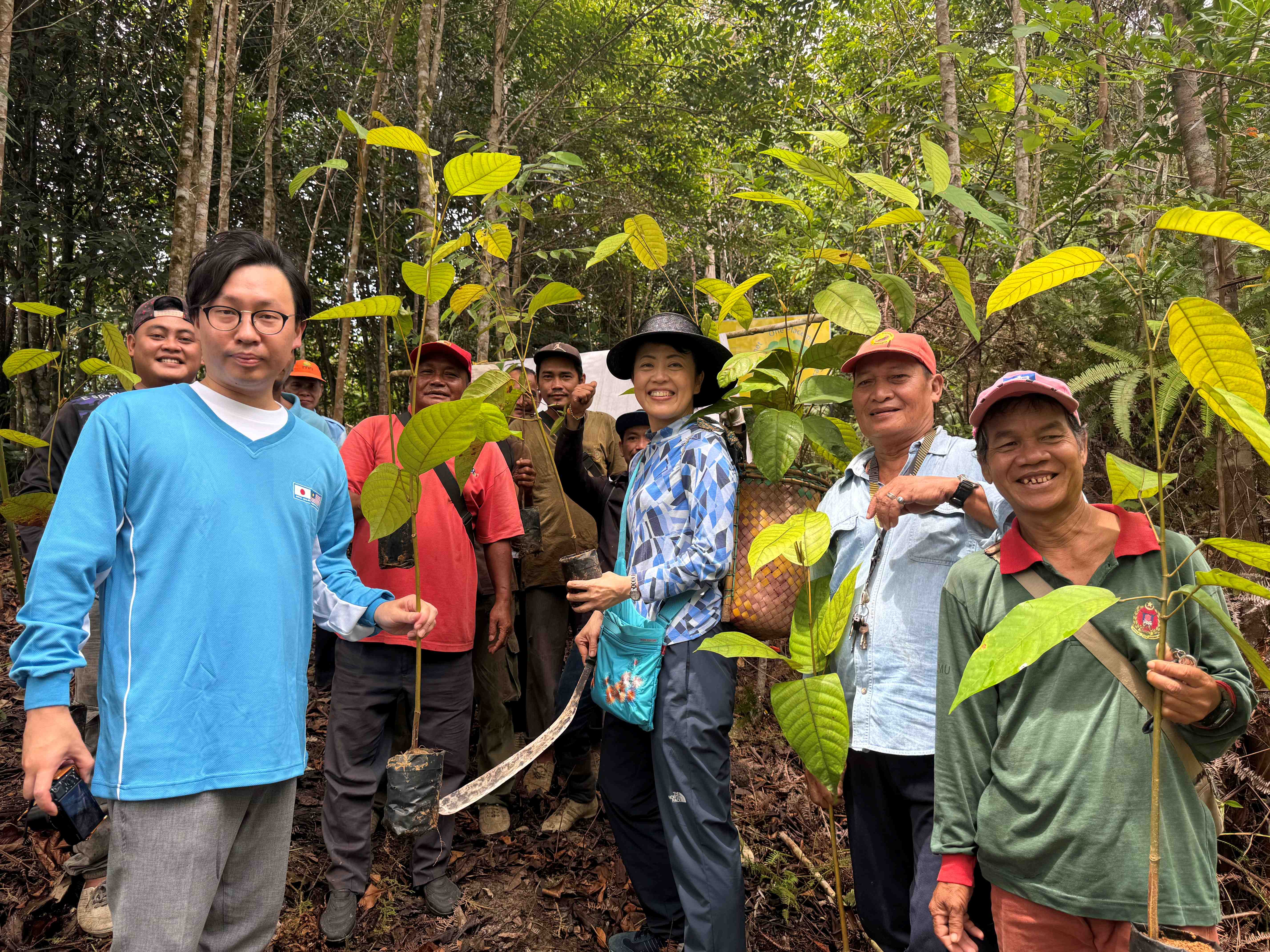
A tree-planting site in Sabal National Park, Sarawak
*This article originally appeared in our association’s bulletin “Malaysia,” Vol. 56 (published January 10, 2025).
Since 1995, the Japan Malaysia Association has carried out tree-planting activities in Sarawak, on the island of Borneo, with the aim of restoring tropical rainforest. In 2019, the Association signed a cooperation agreement on tree-planting with the Sarawak State Government, and we are now working hand-in-hand with the state government and partner agencies such as the Forest Department Sarawak and the Sarawak Forestry Corporation.
From 2021, we have also been using Japan’s Grant Assistance for Japanese NGO Projects (hereafter “N-Ren”) — a Ministry of Foreign Affairs scheme that provides ODA funding to socio-economic development projects aligned with Japan’s ODA policy — to implement our “Project for Improving Living Conditions through Water Environment Development in Indigenous Communities of Sarawak.” From August 19 to 22, 2024, JMA Vice President Haruko Arimura, Kazuhiro Watanabe (secretary at the office of President Keiji Furuya), Chairman Takakazu Ogawa, Auditor Shigenobu Nishida, Director Takashi Moribayashi, Director Fumiaki Koizumi, and Deputy Director Yuma Kosuga paid courtesy calls on the Sarawak State Government and partner organizations and inspected our rainforest restoration and N-Ren project sites on the ground. This is a report on those courtesy calls and site visits.
Introduction
This is Yuma Kosuga of the Japan Malaysia Association. On this occasion, our Vice President, Haruko Arimura, traveled to Sarawak to pay courtesy calls and inspect our project sites. President Keiji Furuya had also been scheduled to take part, but as his schedule did not allow it in the end, Kazuhiro Watanabe — a secretary at the Furuya office — accompanied the delegation in his place.
The centerpiece of the visit was a courtesy call on Sarawak Premier Abang Johari. We also met with Director of Forests Hamden of the Forest Department Sarawak and Deputy CEO Melvin of the Sarawak Forestry Corporation; with Deputy Minister Datu Len Talif Salleh of the Sarawak Ministry of Natural Resources and Environment, with whom the Association has enjoyed a relationship spanning more than twenty years; and with Deputy Vice-Chancellor Linda of Universiti Malaysia Sarawak (UNIMAS). It was an invaluable opportunity for our Vice-President to meet face-to-face with the key figures at the principal organizations that support our tree-planting work, to report on our activities and exchange views. The courtesy call on Premier Abang Johari received extensive coverage on local television and in the newspapers.
On the field-inspection side, the Vice-President and Secretary Watanabe were able to see our tree-planting sites and N-Ren project sites in Sarawak with their own eyes. Reading a report illustrated with photographs and actually visiting the site — feeling the place with one’s own senses — are two very different things, even when both concern the same “rainforest restoration through tree-planting.” Coordinated, sustained activity only becomes possible when those involved have a concrete understanding of what is actually being done. In that sense, it was deeply meaningful that the Vice-President and Secretary Watanabe were able to see for themselves Sabal National Park (one of our main planting areas), the Sabal Nursery Center developed under the N-Ren project, the village produce outlet known as the “Michi-no-Eki” roadside station, and the magnificent planted trees in the Balai Ringin Protected Forest — the area where the Association first launched its rainforest restoration work in 1995.
In addition to these courtesy calls and site visits, we also visited the Japanese Cemetery in the city of Kuching and held an exchange gathering with members of the Kuching Japanese Association.
What follows is our report on the courtesy calls and inspections in Sarawak.
Courtesy Call on the Premier of Sarawak
We paid a courtesy call on Tan Sri Abang Johari, Premier of Sarawak, at the Sarawak Premier’s Office in Kuching, the state capital. Premier Abang Johari is the son of the first Yang di-Pertua Negeri (Head of State) of Sarawak. He was first elected to the Sarawak State Legislative Assembly in 1981, served in a series of senior state positions, and became Premier of Sarawak in 2017.
Vice President Arimura thanked the Premier for granting the audience, introduced the Association, and briefed him on our tree-planting record in Sarawak. When she explained that the Association has now planted roughly 900,000 trees in Sarawak and is on track to reach the one-million-tree milestone the year after next, Premier Abang Johari responded with words of thanks. Tree-planting is built into Malaysia’s priority policies, and Sarawak accounts for a large share of the nation’s “One Person, One Tree” planting campaign; the state is also running its own forest restoration campaigns. Against this backdrop, Sarawak and the Japan Malaysia Association have concluded a memorandum of understanding on rainforest restoration in protected forests and national parks, and the planting activities the Association carries out on the basis of that MOU — and on the strength of our excellent relationship with the state government — play a substantial role.
After the meeting, the Sarawak side framed the group photograph taken on the spot and presented it to us — one of many warm gestures from the state government — and the courtesy call ended in a relaxed and cordial atmosphere.
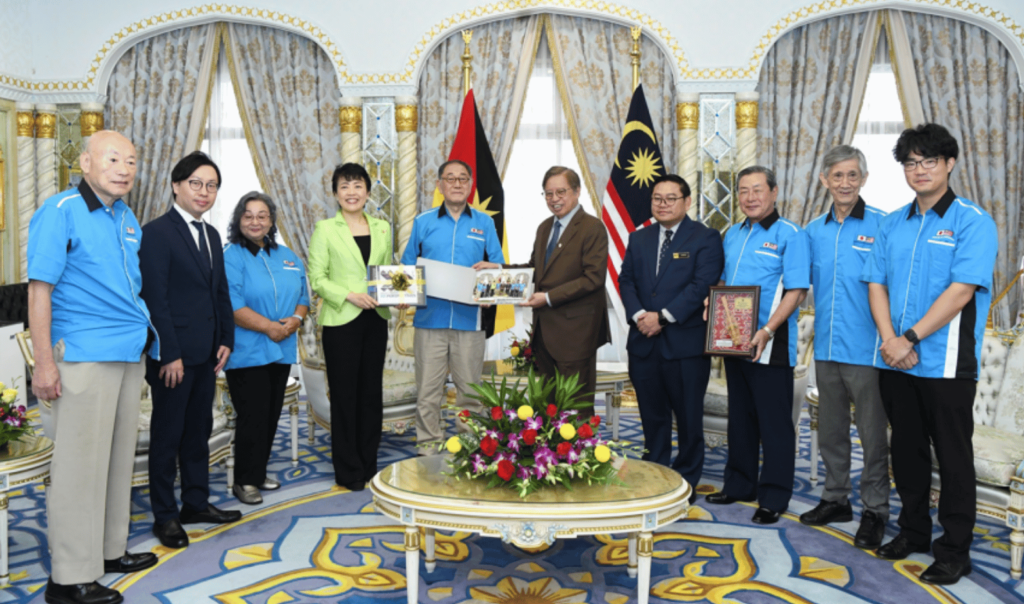
Courtesy call on Premier Abang Johari at the Sarawak Premier’s Office
Visit to the Sarawak Deputy Minister of Natural Resources and Environment
We called on Datu Len Talif Salleh, Deputy Minister at the Sarawak Ministry of Natural Resources and Environment, with whom the Association has had ties for more than twenty years. Deputy Minister Len previously served as Director of Forests of the Forest Department Sarawak, and our relationship goes back to those days. Even after moving on to the State Legislative Assembly, he has continued to take a keen interest in our tree-planting work and to give us tremendous support. Vice President Arimura expressed her thanks for his many years of cooperation, reported on the Association’s recent activities, and exchanged frank views with him. Deputy Minister Len urged us to “please continue your tree-planting work.”
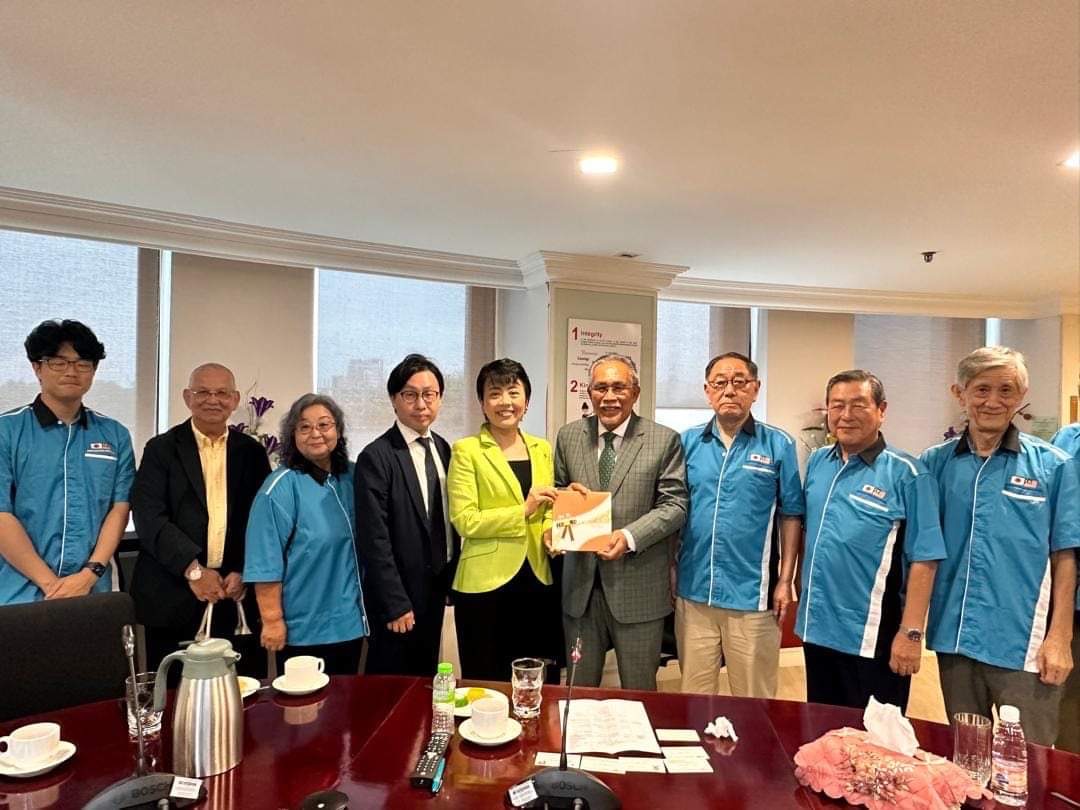
Meeting with Deputy Minister Len
Visit to the Forest Department Sarawak
At the Forest Department Sarawak we met with Director of Forests Hamden. The Forest Department Sarawak is the government agency responsible for forest areas within the state. Under the Malaysian Constitution, land and forest matters fall under the jurisdiction of the individual states, which have ownership rights and enact and administer their own state laws; within that framework, the Forest Department Sarawak — in East Malaysia — implements and enforces its own forestry-related legislation and wields considerable influence.
Vice President Arimura briefed Director Hamden on the Association’s activities and track record, and he in turn explained the work and current priorities of his department. He outlined how Sarawak intends to take its tree-planting forward and asked that the Japan Malaysia Association continue its activities. Director Hamden also showed us a promotional video for the Forest Department Sarawak that featured our work — confirming that the Department regards the Association’s activities as part of its own achievements.
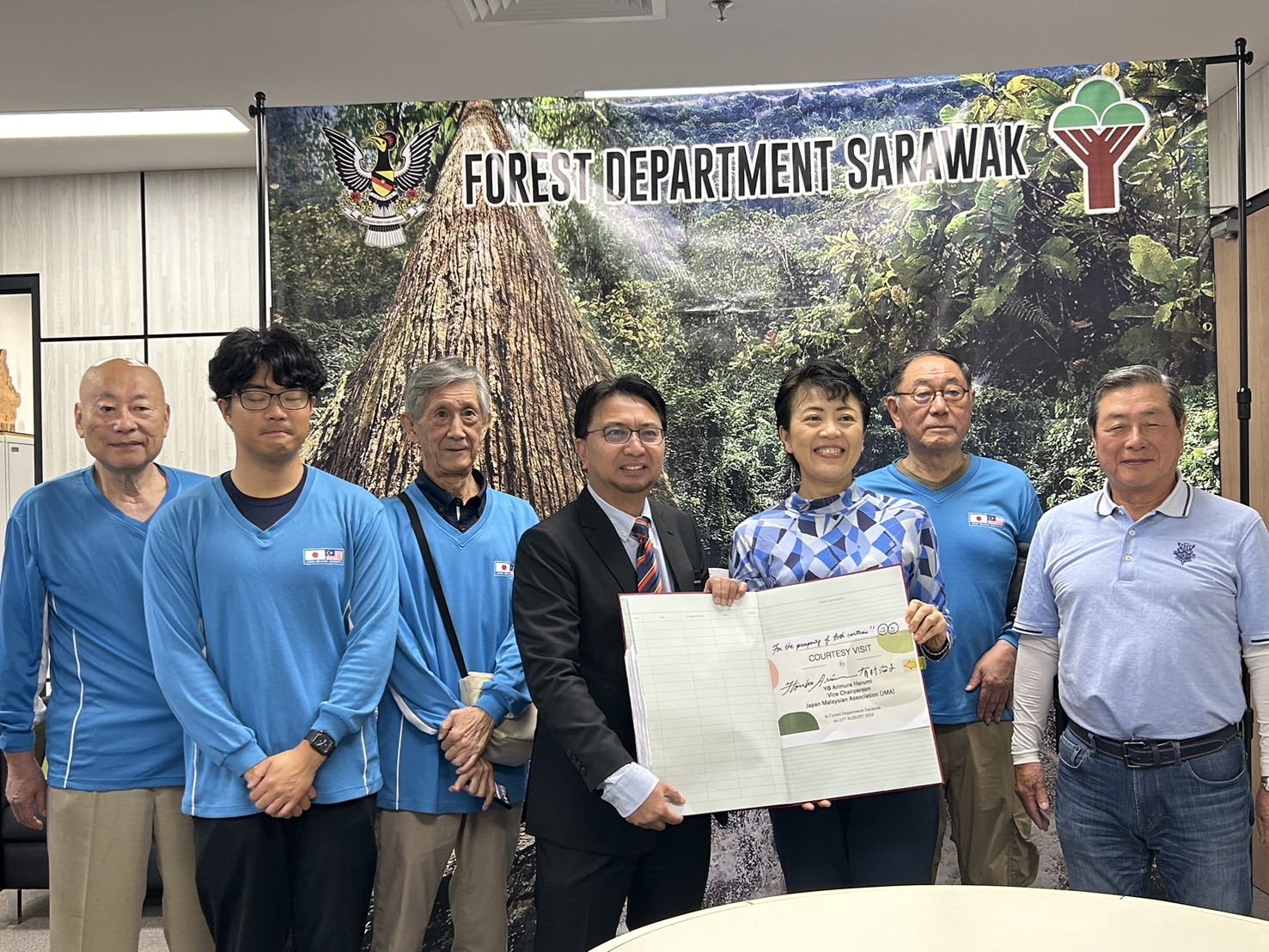
With Director of Forests Hamden, Forest Department Sarawak
Visit to the Sarawak Forestry Corporation
At the Sarawak Forestry Corporation we met with Deputy CEO Melvin. The Sarawak Forestry Corporation is the agency responsible — within the broader system of forest management in the state — for managing Totally Protected Areas such as national parks and nature reserves, and for protecting wildlife. The Forest Department Sarawak had previously also been responsible for forest management within Totally Protected Areas, but that authority was transferred to the Sarawak Forestry Corporation in January 2020. Many of our planting sites are inside national parks, all of which fall under the corporation’s jurisdiction. Thanks to the Association’s tree-planting, two of these areas have been upgraded from protected forest to national park status: Apeng National Park in 2016 and Sabal National Park in 2018. Protected forests can be used for industrial purposes under state policy, but national parks are guaranteed to remain unlogged in perpetuity — so planting trees inside a national park carries significant weight.
Deputy CEO Melvin, who holds a doctorate from the University of Cambridge, gave us a detailed account of the Sarawak Forestry Corporation’s forest conservation work and of its new initiatives in marine conservation as an extension of its broader conservation framework. Vice President Arimura reported on the Association’s activities and results, and the meeting saw a lively exchange of views on the corporation’s ambitious agenda.
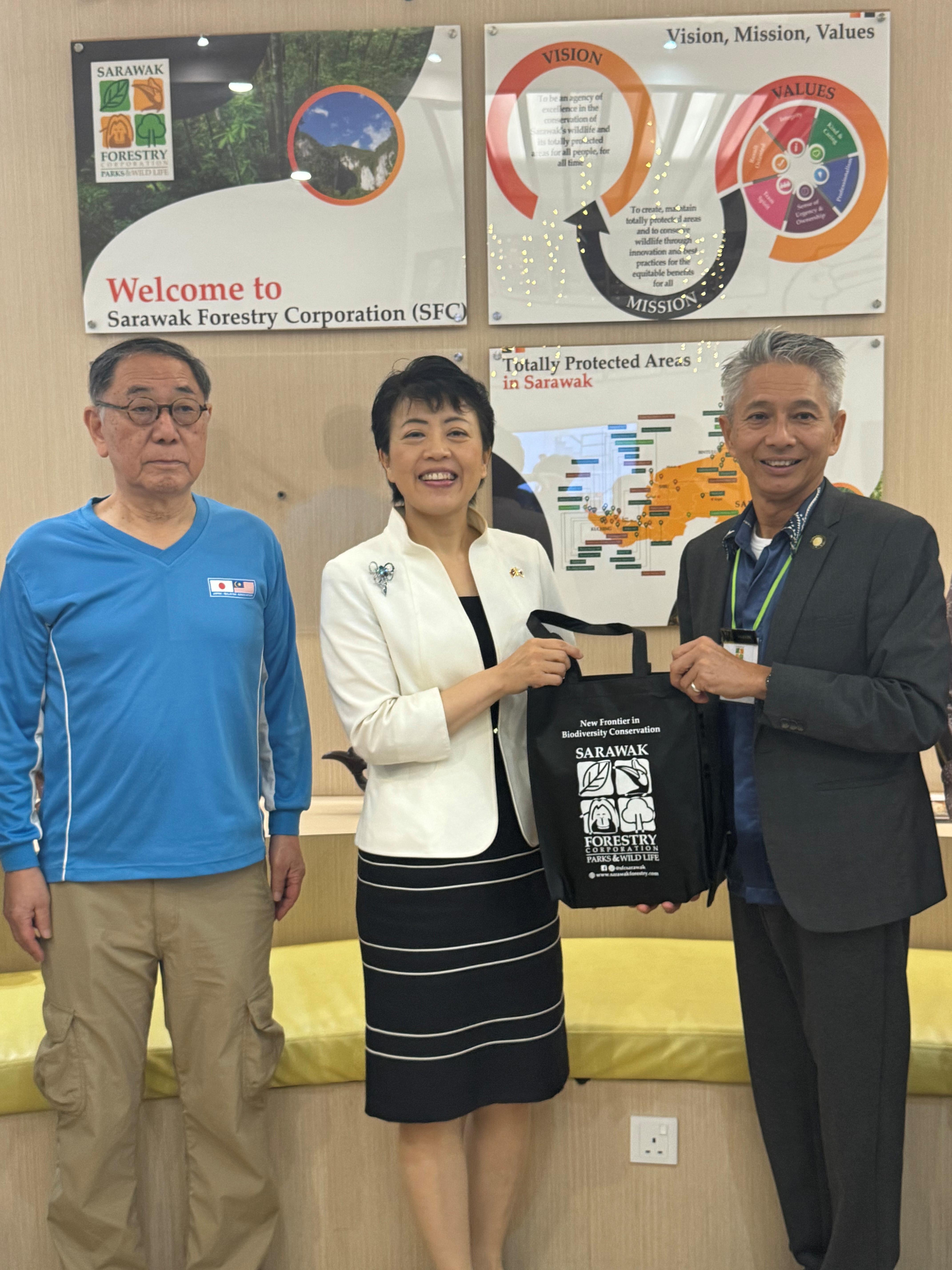
With Deputy CEO Melvin, Sarawak Forestry Corporation
Visit to Universiti Malaysia Sarawak
At Universiti Malaysia Sarawak (UNIMAS) in Kuching, we called on Deputy Vice-Chancellor Linda. UNIMAS, founded in 1992, is the first public university established in Sarawak. Since 2018, with the cooperation of Takasago Thermal Engineering Co., Ltd., we have been running the “Takasago Forest” rainforest restoration program on the UNIMAS campus. The position we visited is that of Deputy Vice-Chancellor — in Malaysia, the role of “Chancellor” is largely ceremonial, while day-to-day university management is effectively led by the Vice-Chancellor and Deputy Vice-Chancellors.
Vice President Arimura thanked UNIMAS for its sustained cooperation over some six years on the “Takasago Forest” program and gave a report on the Association’s wider activities.
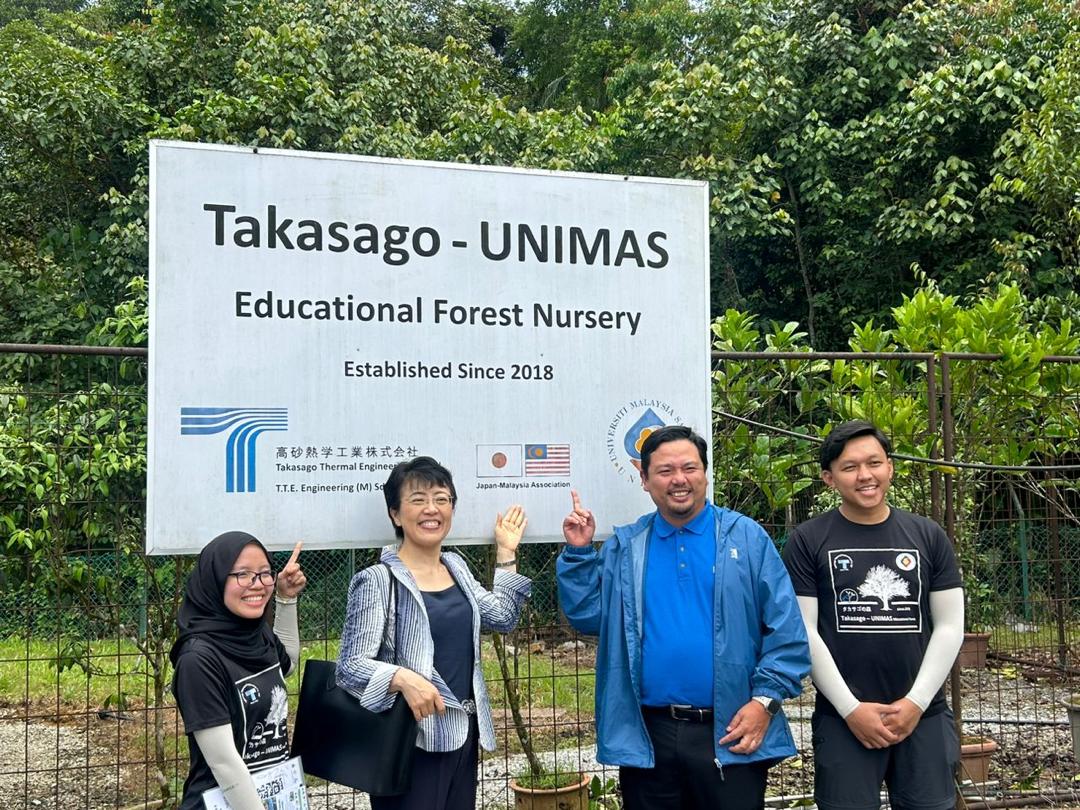
In front of the “Takasago Forest” signboard with Dr. Effendi and his seminar students
Deputy Vice-Chancellor Linda welcomed us warmly, and we exchanged views on our past collaborations and future plans. She also expressed her gratitude for JICA’s “Sarawak University Construction Project,” which funded the construction of the UNIMAS campus buildings.
From 2015, over six rounds, the Association ran the “Sakura Science Program” — an industry-academia-government youth exchange program in science and technology administered by the Japan Science and Technology Agency — in cooperation with UNIMAS. Deputy Vice-Chancellor Linda expressed her appreciation for that program and her hopes for the future of Japan-UNIMAS relations.
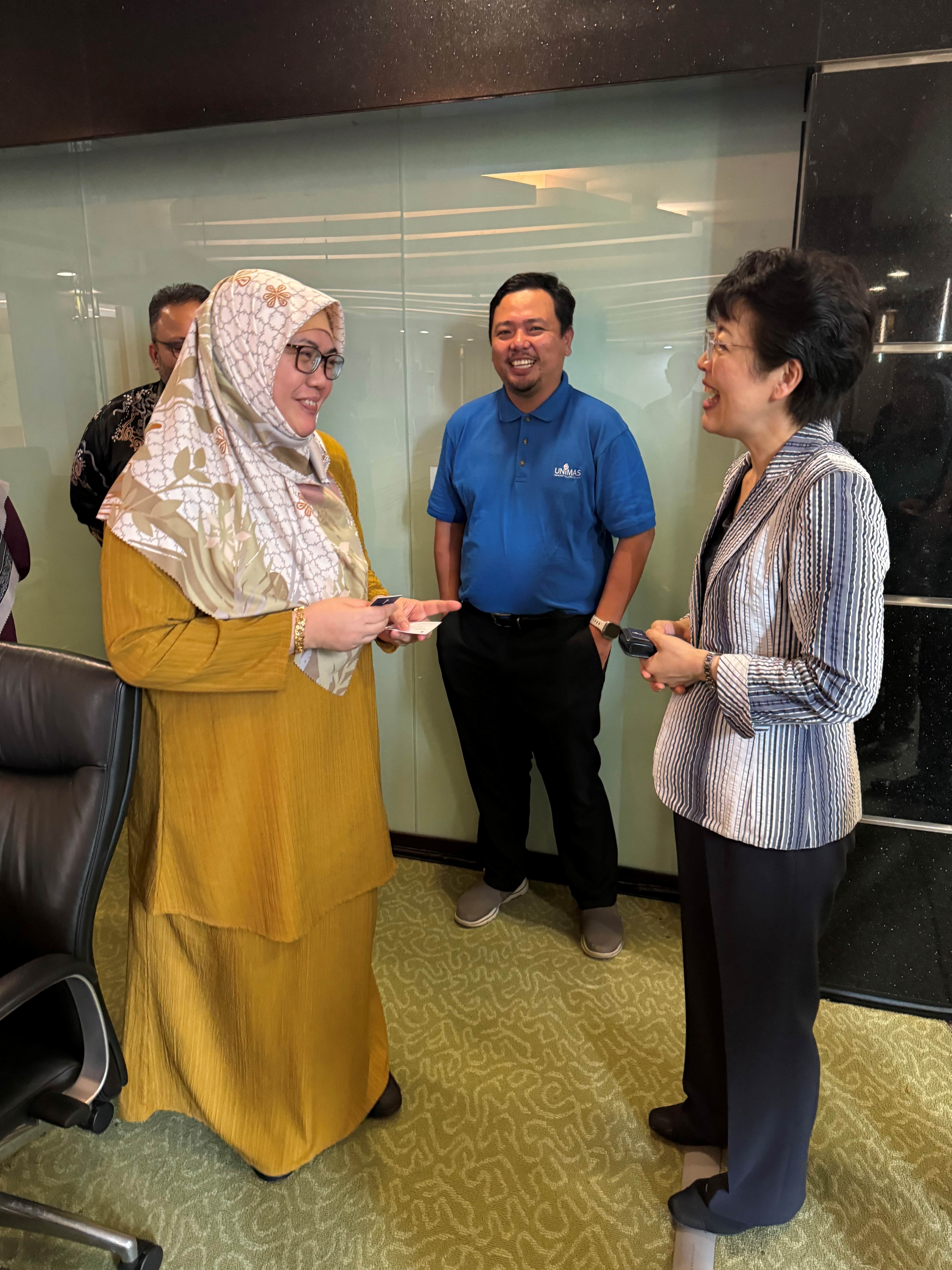
Greeting Deputy Vice-Chancellor Linda
Inspection of the Project Sites
The delegation inspected three of the Association’s project sites: the Sabal Nursery Center, the “Michi-no-Eki” roadside station, and Sabal National Park. The Sabal Nursery Center is the nursery we developed using N-Ren project funds, where roughly 30,000 of the Association’s seedlings are raised and cared for.
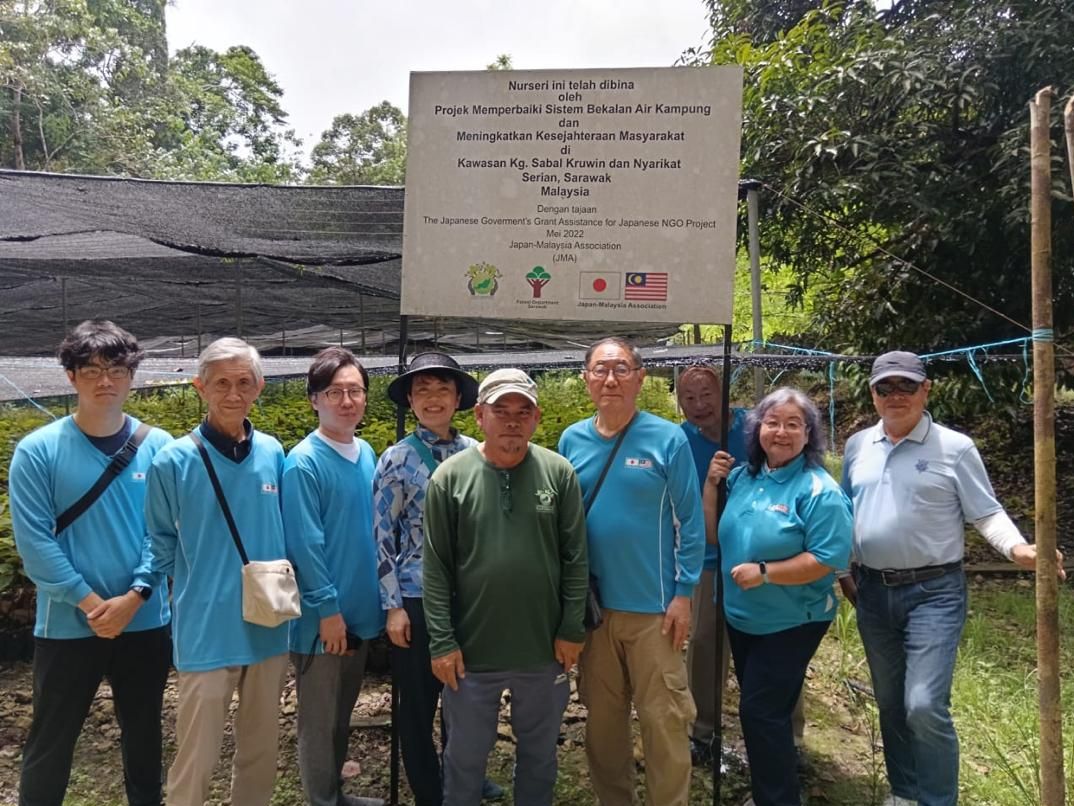
At the Sabal Nursery Center with Jonathan, the manager
The “Michi-no-Eki” roadside station was set up alongside a national highway near the villages as part of a livelihood-improvement program tied to better water infrastructure. The N-Ren-funded “Project for Improving Living Conditions through Water Environment Development in Indigenous Communities of Sarawak” has freed villagers’ time and energy enough to allow them to cultivate fruit trees and vegetables and produce traditional sweets; the station gives them a place to sell those village products.
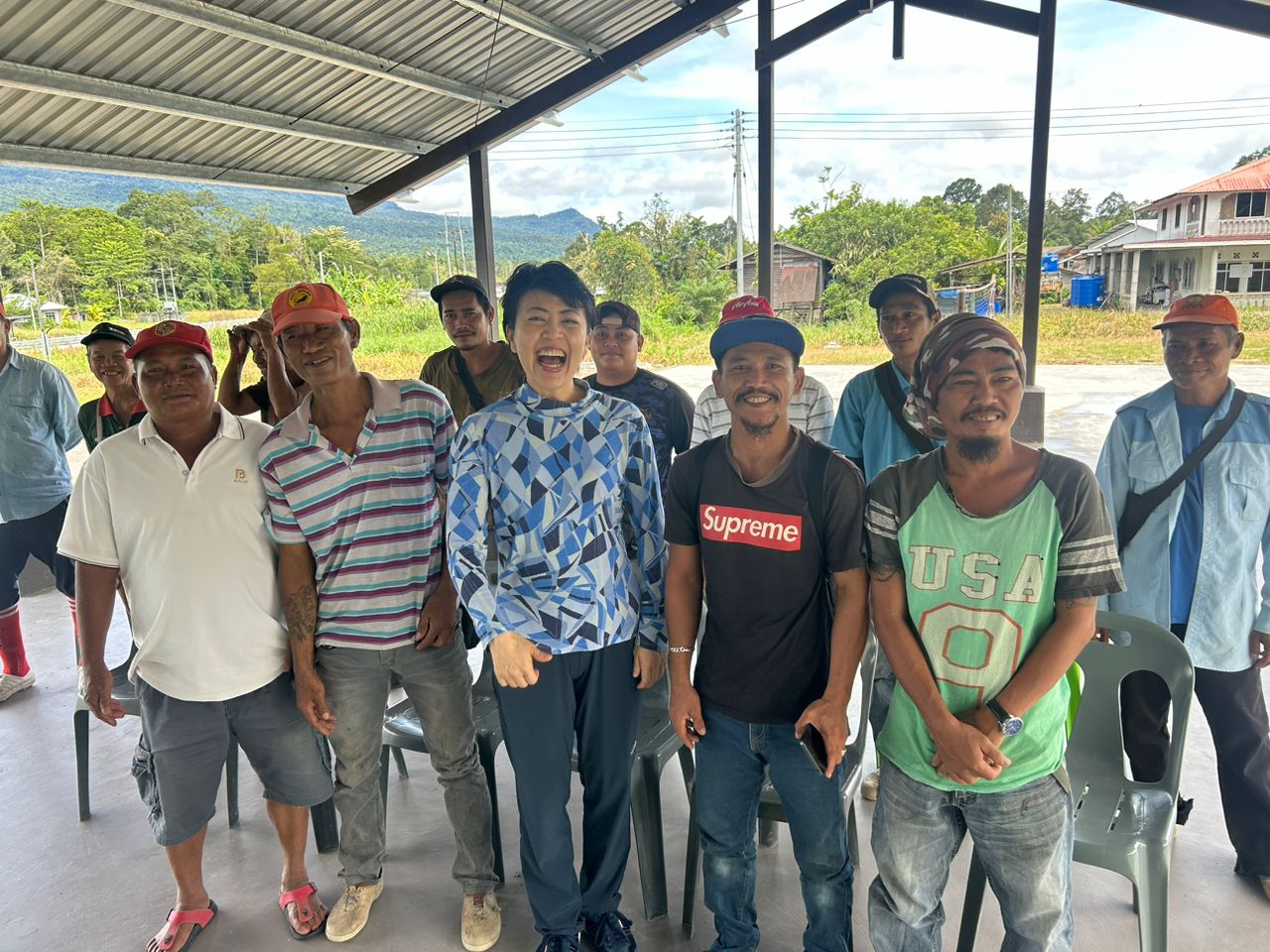
Inside the Michi-no-Eki with villagers from Sabal Kruin Baru
The station also displays handwritten memorial plaques signed by Datuk Snowdan Lawan, Sarawak’s Deputy Minister of Tourism, Creative Industry and Performing Arts (and the state assemblyman for the constituency where the project is based), and by JMA President Keiji Furuya.
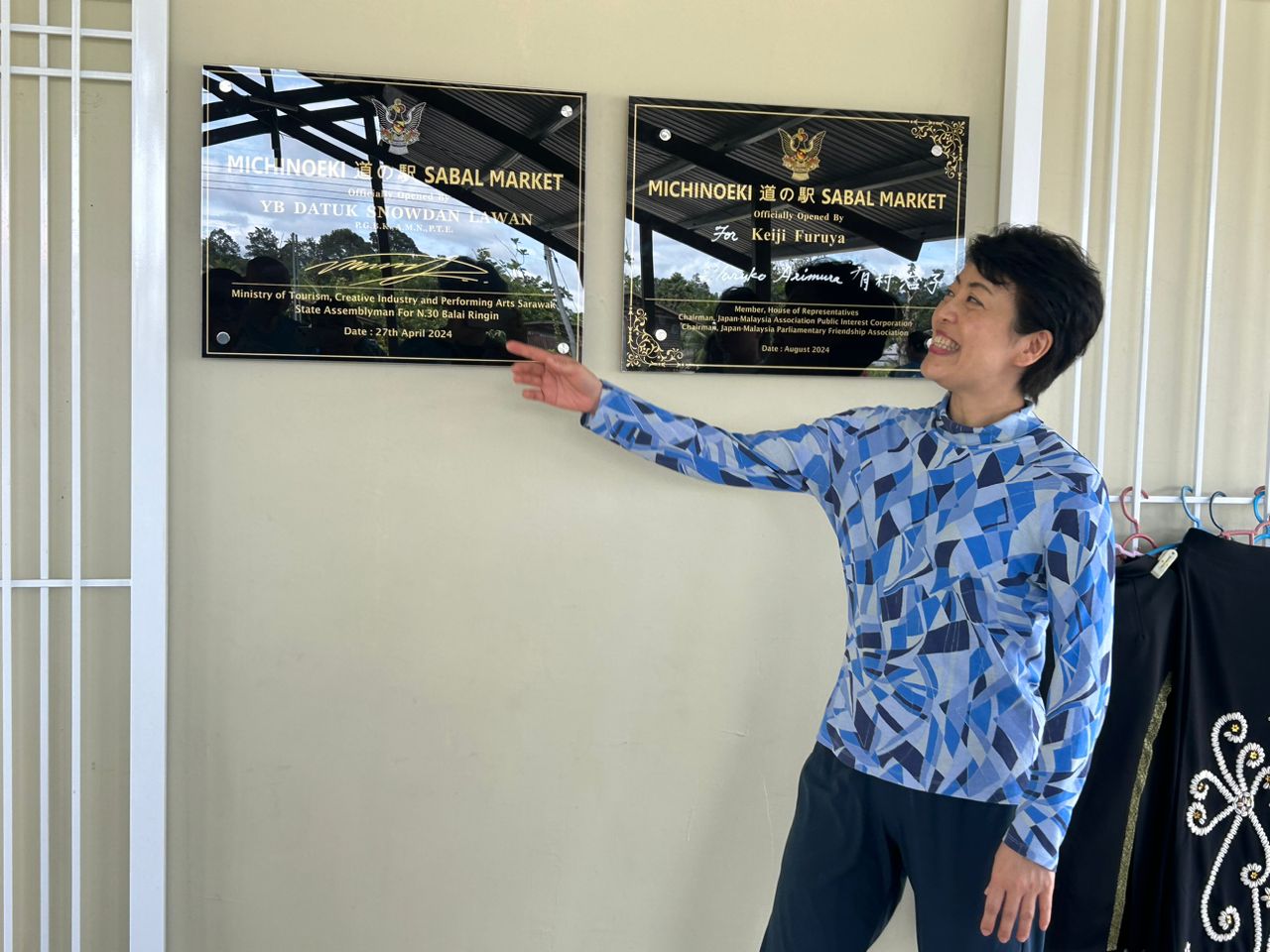
Left: Deputy Minister Snowdan Lawan’s signature. Right: President Furuya’s signature.
At the Michi-no-Eki, Vice President Arimura and Chairman Ogawa also planted commemorative trees.
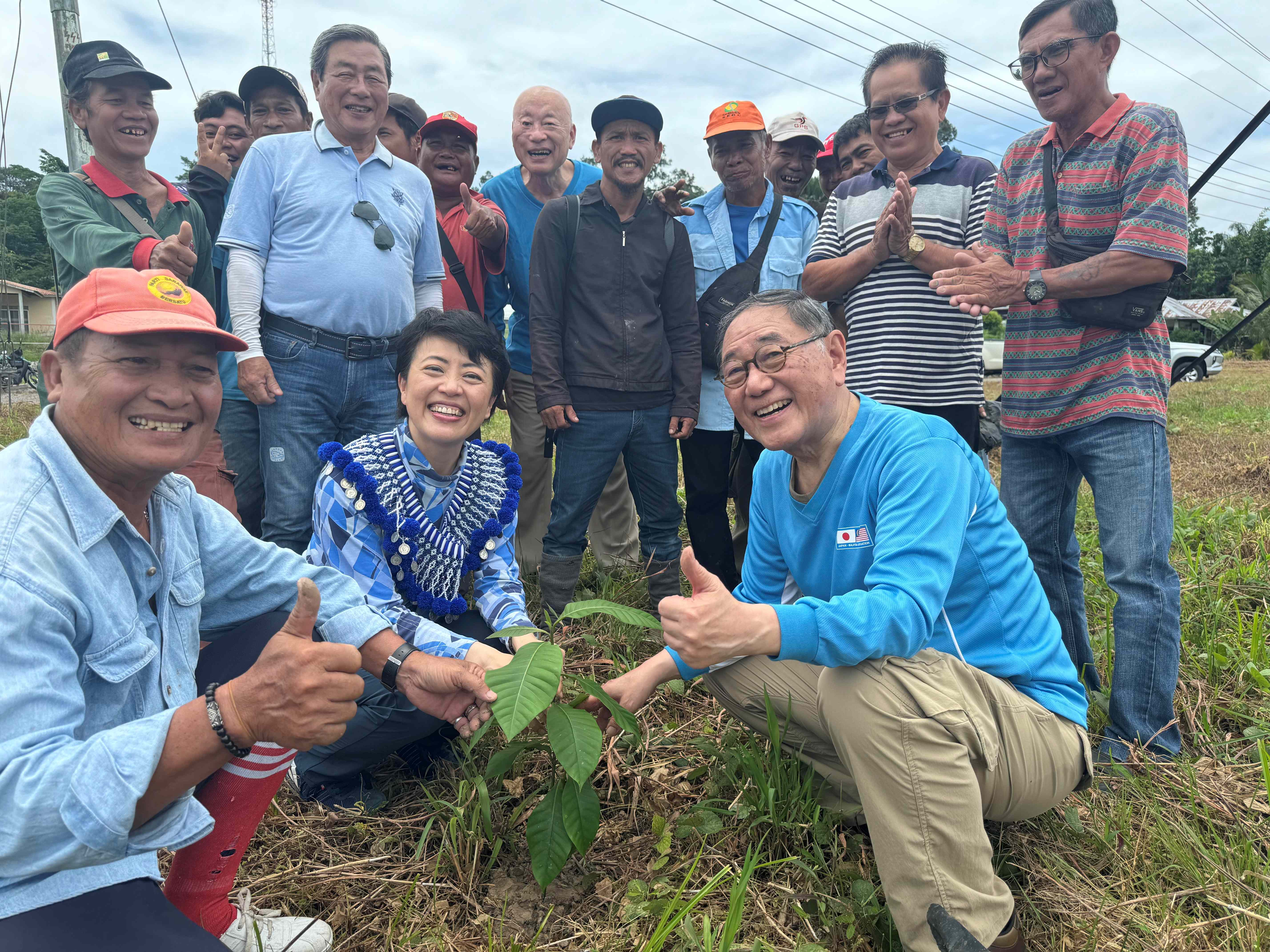
Commemorative tree-planting at the Michi-no-Eki
Sabal National Park is one of the Association’s principal planting sites, supported on the ground by villagers of the Iban community. Vice President Arimura and Secretary Watanabe also had the chance to meet and talk with Iban villagers during the planting work.
Vice President Arimura and Secretary Watanabe inspecting a tree-planting site inside Sabal National Park
The Birthplace of Our Tree-Planting Work
The Association has been carrying out rainforest restoration through tree-planting in Sarawak since 1995, and the place where it all began is the Balai Ringin Protected Forest in the Serian district. The seedlings planted there about thirty years ago were thin and small at the time, but they have since grown into massive, strong trees so thick that an adult cannot reach his fingertips around them with both arms.
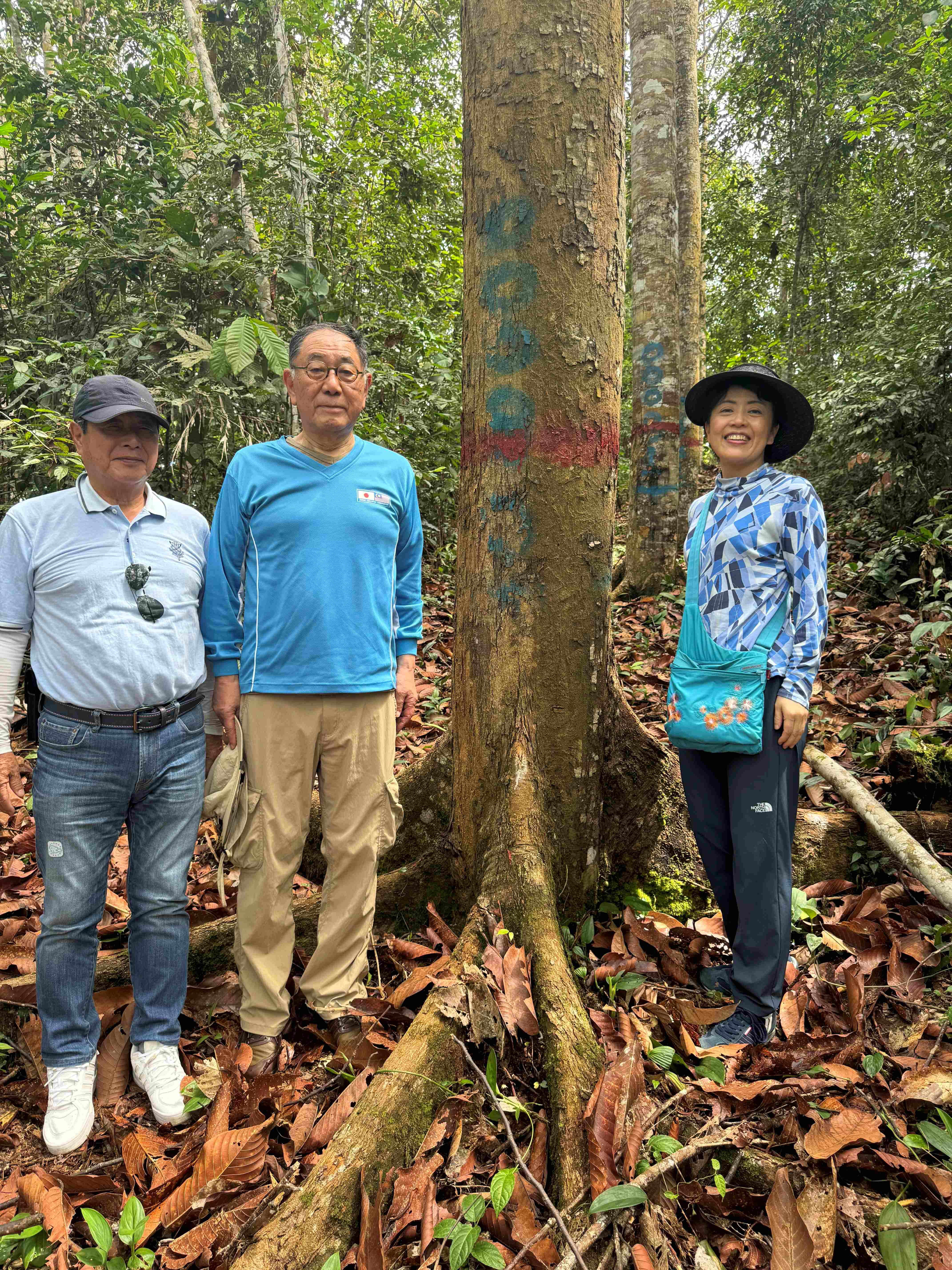
Trees planted around thirty years ago
Within the Balai Ringin Protected Forest, the area where the Association first began planting native species for rainforest restoration in 1995 has been designated by the Forest Department Sarawak as a seed bank — a forest area set aside to collect seed of native Dipterocarpaceae species — which it now maintains (the system is close to what Japan calls a “designated seed source”). What had been a forest area degraded by logging is today an important site for collecting seed of Engkabang Jantong, one of the principal native species of Borneo.
Visit to the Kuching Japanese Cemetery
In the city of Kuching, Sarawak, there is a Japanese cemetery that honors the memory of Japanese who died on Malaysian soil. The Kuching Japanese Cemetery is believed to have been established in the early 1900s; in 1965, headstones that had been scattered in various locations were brought together in one place and the site was put in order by caretakers. At this place of remembrance for those who came to Malaysia and lost their lives there, Vice President Arimura offered her prayers before the memorial monument.
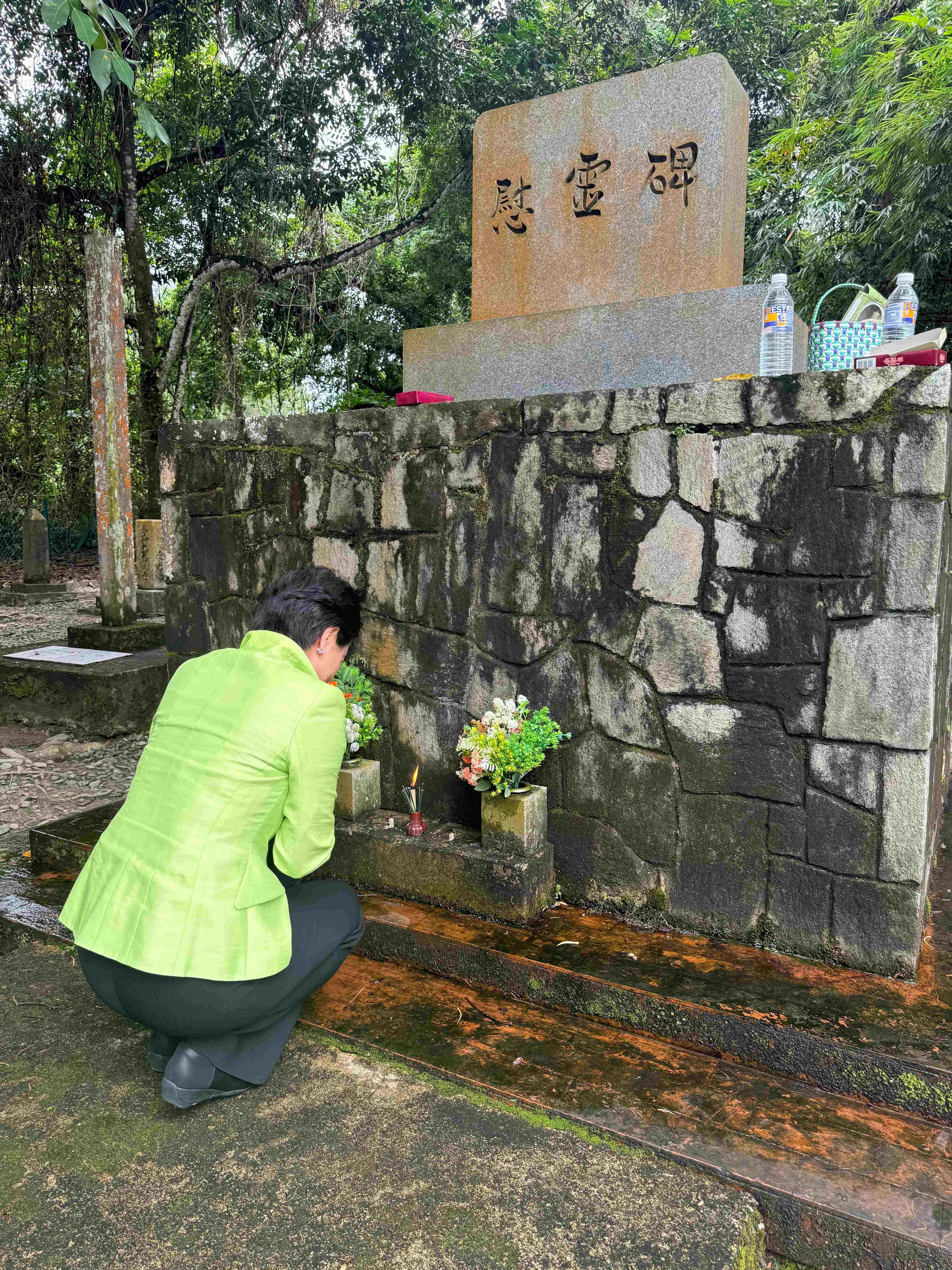
Paying respects at the memorial monument
Exchange with the Kuching Japanese Association
We held an exchange gathering with members of the Kuching Japanese Association — a community group for long-term residents in Sarawak, including expatriate staff of Japanese companies. The conversation ranged widely, from everyday life in Kuching to the business climate.
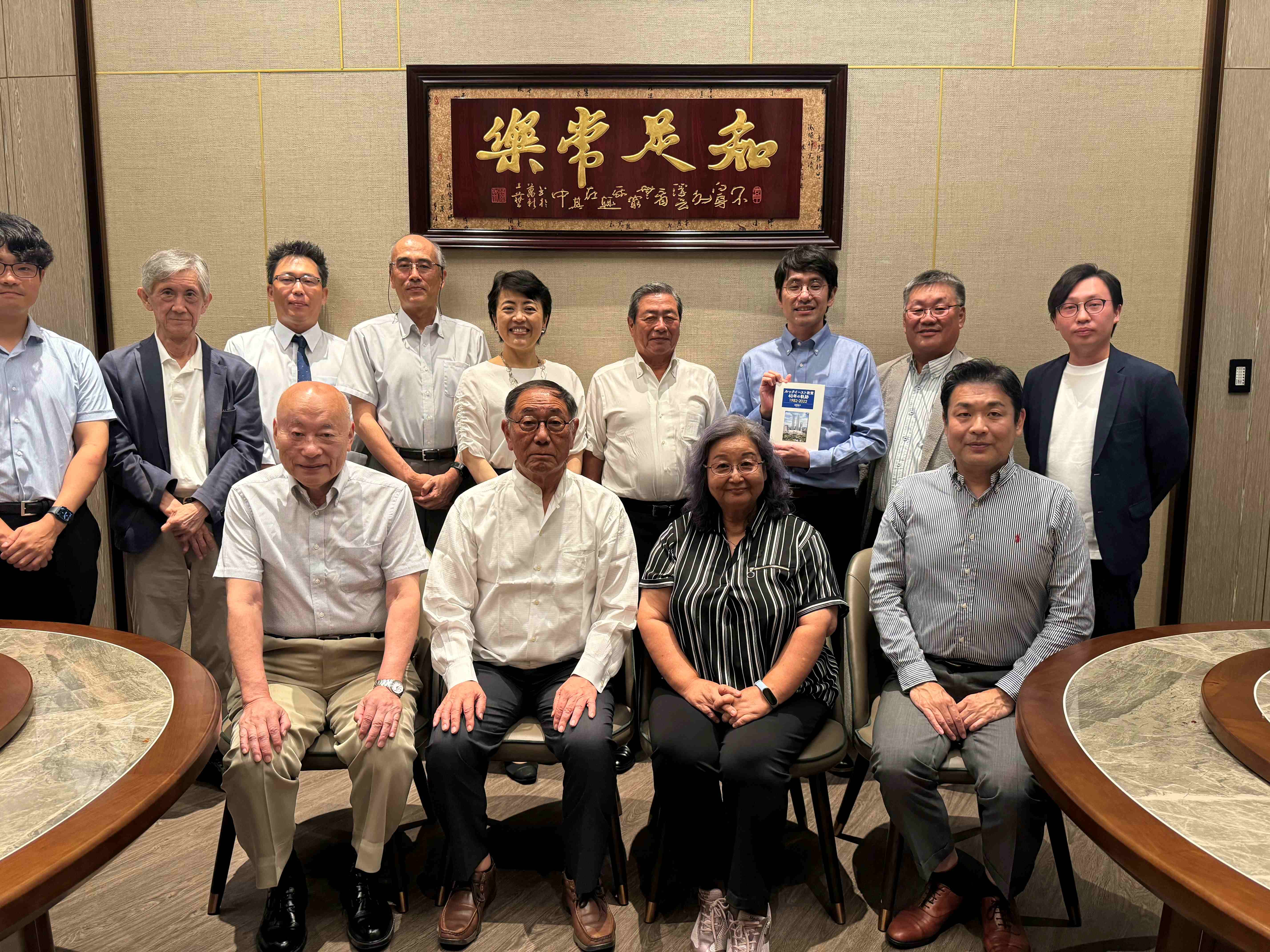
Exchange gathering with members of the Kuching Japanese Association
In Closing
All the arrangements for this round of courtesy calls and field visits — coordination with the Sarawak Premier’s Office and every other partner organization, as well as transport to and around our planting sites — were handled by Kazue Sakai, our local coordinator in Sarawak. Without the careful preparations of Ms. Sakai, who has spent close to half a century in Sarawak, Vice President Arimura and the rest of the delegation would not have been able to carry out such a smooth and meaningful program of visits. We take this opportunity to thank her wholeheartedly.
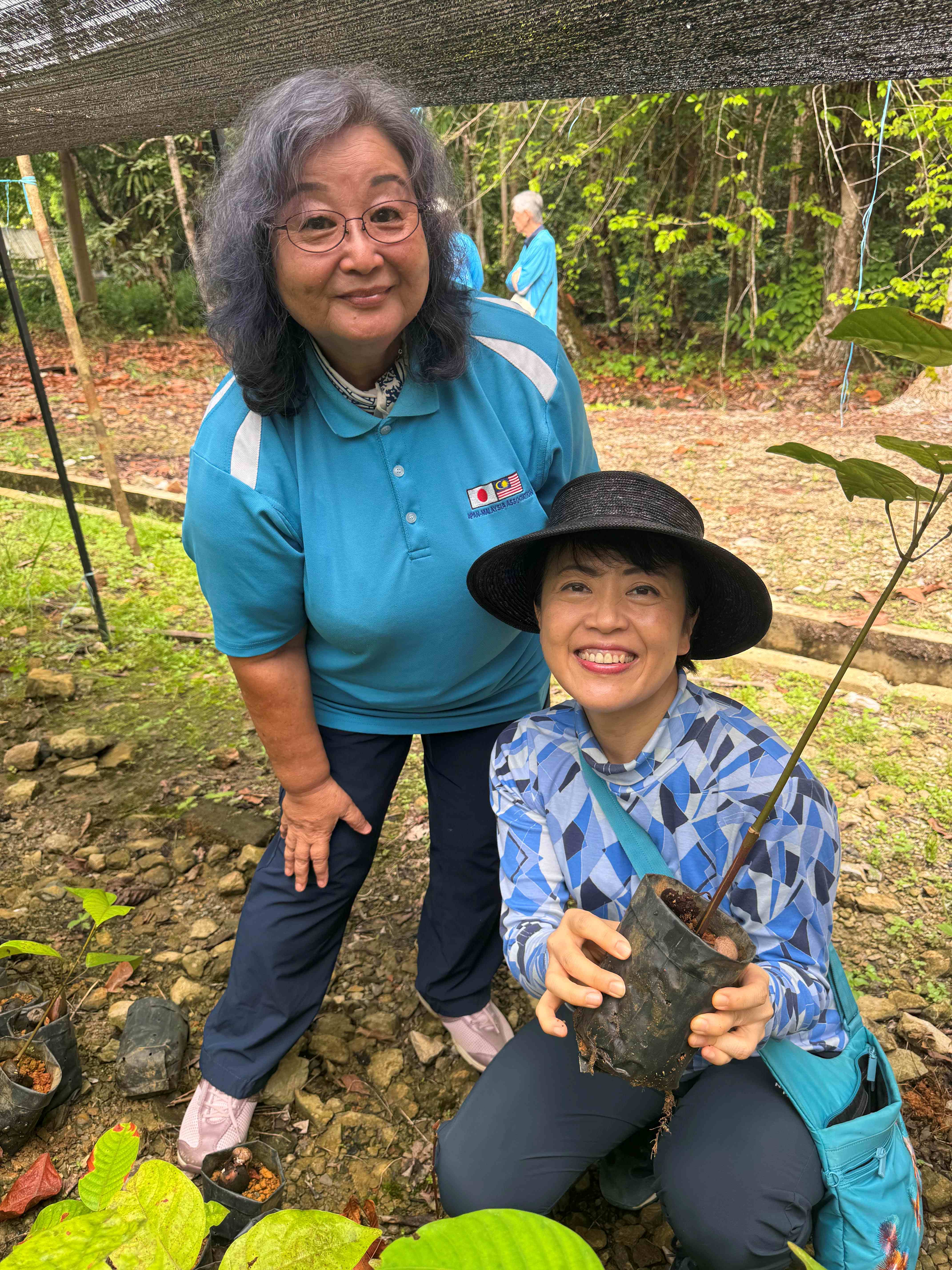
JMA Sarawak-based coordinator Kazue Sakai (left) and Vice President Haruko Arimura (right) at the Sabal Nursery Center in Sarawak, Malaysia.