
The Nippon Foundation Volunteer Center’s “Orangutan Forest Restoration Project” (1st & 2nd Batches)
The original of this article was written in Japanese and can be found here.
The Japan Malaysia Association, in partnership with the Nippon Foundation Volunteer Center (hereinafter “NF Volunteer Center”), has launched the “Orangutan Forest Restoration Project,” dispatching university students from across Japan to Sarawak, Malaysia, to plant trees and restore the tropical rainforest. The project will send approximately 15 student volunteers four times a year over ten years, working alongside Indigenous villagers to plant a target of 100,000 trees. Student recruitment is conducted through “Bokatsu!” (https://vokatsu.jp/), one of Japan’s largest volunteer platforms operated by the NF Volunteer Center, which also handles all student selection. The first batch was dispatched from February 6 to 17, 2024, and the second from March 5 to 16, 2024. Yuma Kosuga, Deputy Director of the Japan Malaysia Association, accompanied both batches, and his report follows.
Introduction
Hello, this is Kosuga from the Japan Malaysia Association. Having accompanied both the first and second batches of the “Orangutan Forest Restoration Project” carried out in partnership with the NF Volunteer Center, I would like to share the details of the project from the perspective of an accompanying staff member. This was my first time being involved in a project that gives students hands-on tree-planting experience on site, and throughout the days I spent not only fulfilling my role as the Association’s representative but also thinking — as an individual — about what I could do for the students. I am deeply grateful for the connection with the NF Volunteer Center, which gave me the opportunity to share in this rainforest restoration tree-planting work alongside students who have such bright futures ahead of them.
People are free to have their own reasons for volunteering and their own takeaways from the experience. But if exposure to a new environment like Malaysian Borneo helped these students broaden their horizons or break out of their shells in some way, nothing would make me happier.
With that, let me revisit the purpose and overview of the program, and then walk through the 12-day itinerary along with glimpses of the students and the tree-planting activities.
Purpose and Overview of the Program
The tropical rainforest that once covered Borneo in Southeast Asia continues to shrink due to deforestation and the development of oil palm and other plantations. As the rainforest disappears, so do the habitats of orangutans and countless other species, and native plants that could serve as the basis for new medicines are being lost from our world. While oil palm plantation development is one cause of rainforest loss, palm oil is also one of Malaysia’s most important industries, and it is deeply connected to our daily lives in Japan — used in everything from processed foods like instant noodles and snacks to everyday cosmetics.
For roughly 30 years, the Japan Malaysia Association has carried out rainforest restoration through tree planting in Sarawak. The goal of this program is to use that work as a starting point for students to learn about the environmental, industrial, and international issues surrounding the tropical rainforest, as well as the history and culture of Borneo, and to think about what we ourselves can do.
The key point is that this is “rainforest restoration” tree planting — not simply planting any tree, but planting native species to bring back the rich tropical rainforest that orangutans once called home. To plant native species, you have to collect their seeds and carefully raise the saplings; it then takes about 15 to 20 years for those saplings to grow large enough to bear fruit. From the fruit you can collect new seeds and raise new saplings, and it takes about another five years before those bear fruit — and in the meantime you must keep planting more saplings. This patient, painstaking work is what real “rainforest restoration” tree planting requires. Continuously planting native species is no easy task, and protecting the planted trees calls for measures such as designating the planting area as a national park and expanding activities within its boundaries. Above all, none of this is possible without the cooperation of the local people.
This “Orangutan Forest Restoration Project” was carried out with the kind support of the Japan Malaysia Association’s Sarawak-based coordinators — Mr. Sakai, Mr. Alex, and Ms. Aisha — through a variety of programs centered on tree planting. What made the strongest support possible for the students were the villagers of Tonnibong Village, located near Apeng National Park (the planting site). They are members of the Bidayuh community, an Indigenous people who have supported the planting activities for many years. Each student was paired one-on-one with a Bidayuh villager as a “buddy,” learning the work directly from these planting experts. Naturally, with the language and cultural differences, this meant the students experienced something truly stimulating — engaging in cross-cultural exchange with Indigenous people in the unfamiliar setting of Malaysian Borneo while devoting themselves to rainforest restoration tree planting.
The main activities of the program included a 12-day stay in Sarawak with sapling preparation and transport, volunteer planting work toward a target of 2,500 trees, camping and a night walk in the rainforest, orangutan observation at the Semenggoh Wildlife Centre, a tour of Kuching, and a reflection session at the end of the planting activities.
The 12-Day Program
Day 1:
The students departed Narita Airport in the morning, transferred to a domestic flight in Kuala Lumpur, and arrived at Kuching International Airport just after 9 p.m. By the time they reached Kuching, the students already seemed to be getting along well — making me think the selection process really had picked students who were eager to engage with others.
Our local coordinator met us at Kuching International Airport with a bus. After taking a group photo to mark our safe arrival, we headed straight to a hotel in Kuching. With an early start the next morning, everyone went to bed right away.
Day 2:
We left the Kuching hotel in the morning and headed to the Semenggoh Wildlife Centre in Sarawak. About 30 semi-wild orangutans live there, roaming freely in the vast forest on the property — there are no cages — so whether you can meet one is left to chance. I had been worried about whether they would appear, since I felt it was important for the students to see orangutans right at the start of the “Orangutan Forest Restoration Project.” As it turned out, both the first and second batches got to see orangutans, including the boss of the centre, who came out to greet us!
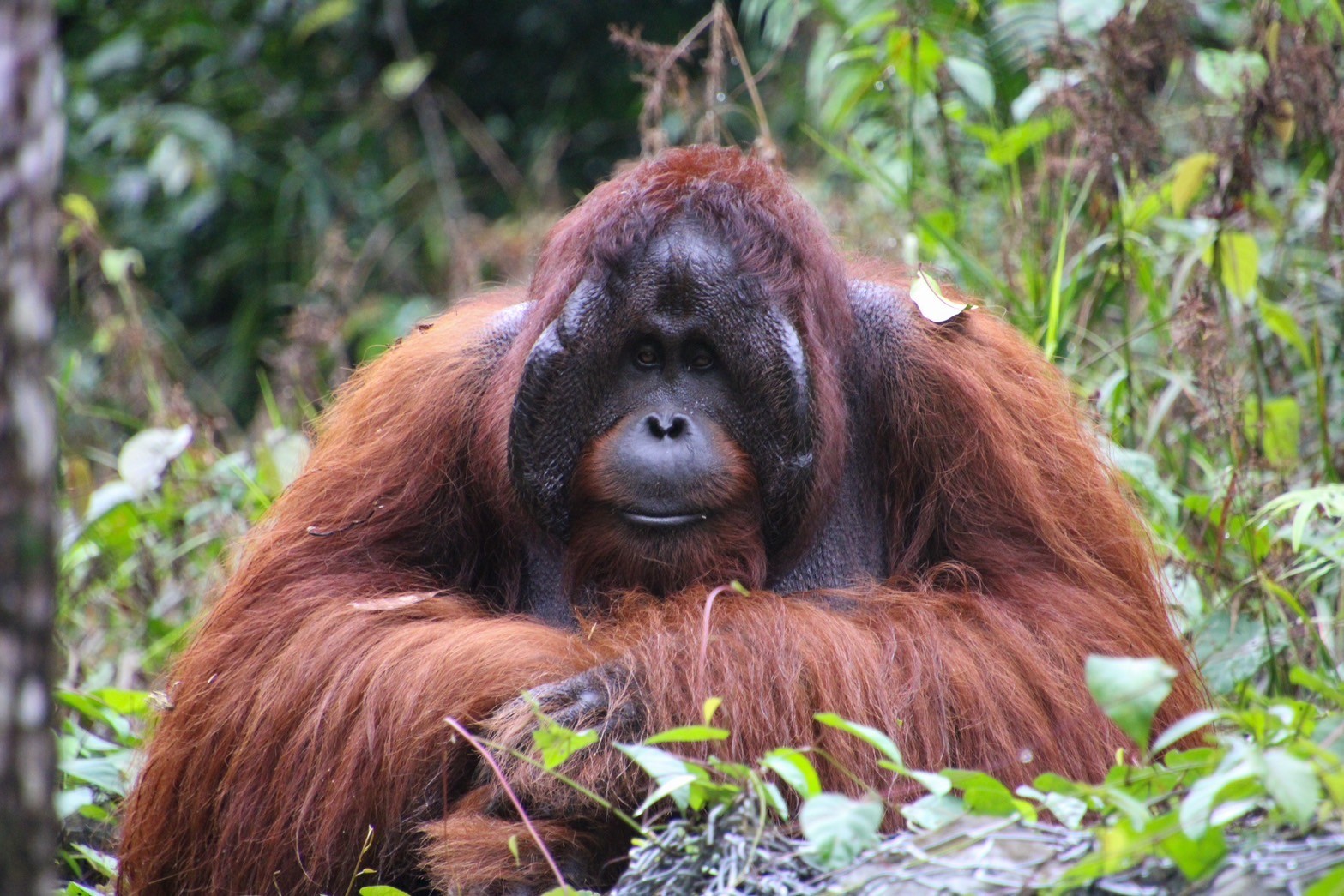
The boss of the centre, photographed by a student
Around 11 a.m. we had a briefing led by Mr. Ashraf, Regional Manager of the Sarawak Forestry Corporation — the government body that oversees national parks in Sarawak — who explained the activities of the centre and the Corporation. The briefing was conducted in English, and the students actively asked questions in English during the Q&A session.
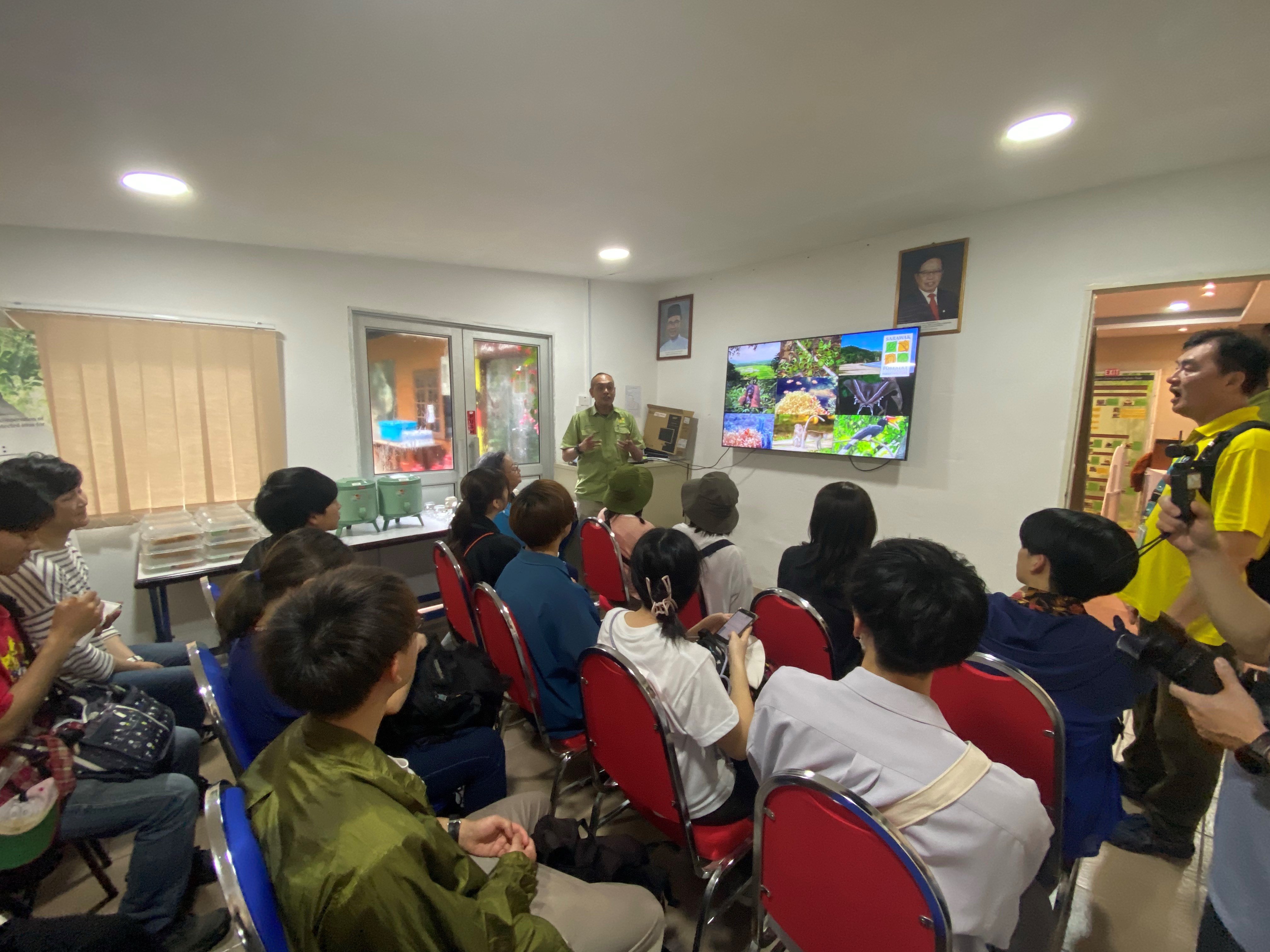
Briefing at Semenggoh
For lunch we ate “laksa” and “kolo mee,” two of Malaysia’s signature noodle dishes, and in the afternoon we toured Kuching. In the evening we went to a local restaurant, and after dinner the students and staff introduced themselves in a separate room. Each person shared their name, university, major, and a few words about why they had joined the volunteer program — a great way to learn about the people they would be planting trees with, and a wonderful start to the journey.
Day 3:
In the morning we moved from Kuching to Serian, our base for the rest of the program, and from there headed straight to the planting site at Apeng National Park. We got off the vehicles at the park entrance and the students walked the roughly 3.9 kilometers from the entrance to the facility. This was a program element suggested by the local coordinator — the idea being that walking through the rainforest would let the students experience nature with their eyes, ears, and skin. As we walked, the coordinator explained the trees, plants, and animals, and the history of tree planting in Apeng National Park, allowing the students to see firsthand how the rainforest is being restored from what had been bare ground. They were thrilled to encounter plants and animals they would never see in Japan, and at times they were so engrossed in taking photos that the walk took longer than planned.
In the afternoon, the students and Indigenous villagers introduced themselves at the facility, buddy pairs were announced, and we began preparations for planting. Together with their buddies, the students helped lay out the lines used for line planting — which spaces the saplings evenly — and transported saplings. The students and their buddies had only just met, so things were still a bit awkward. The real planting work would begin tomorrow.
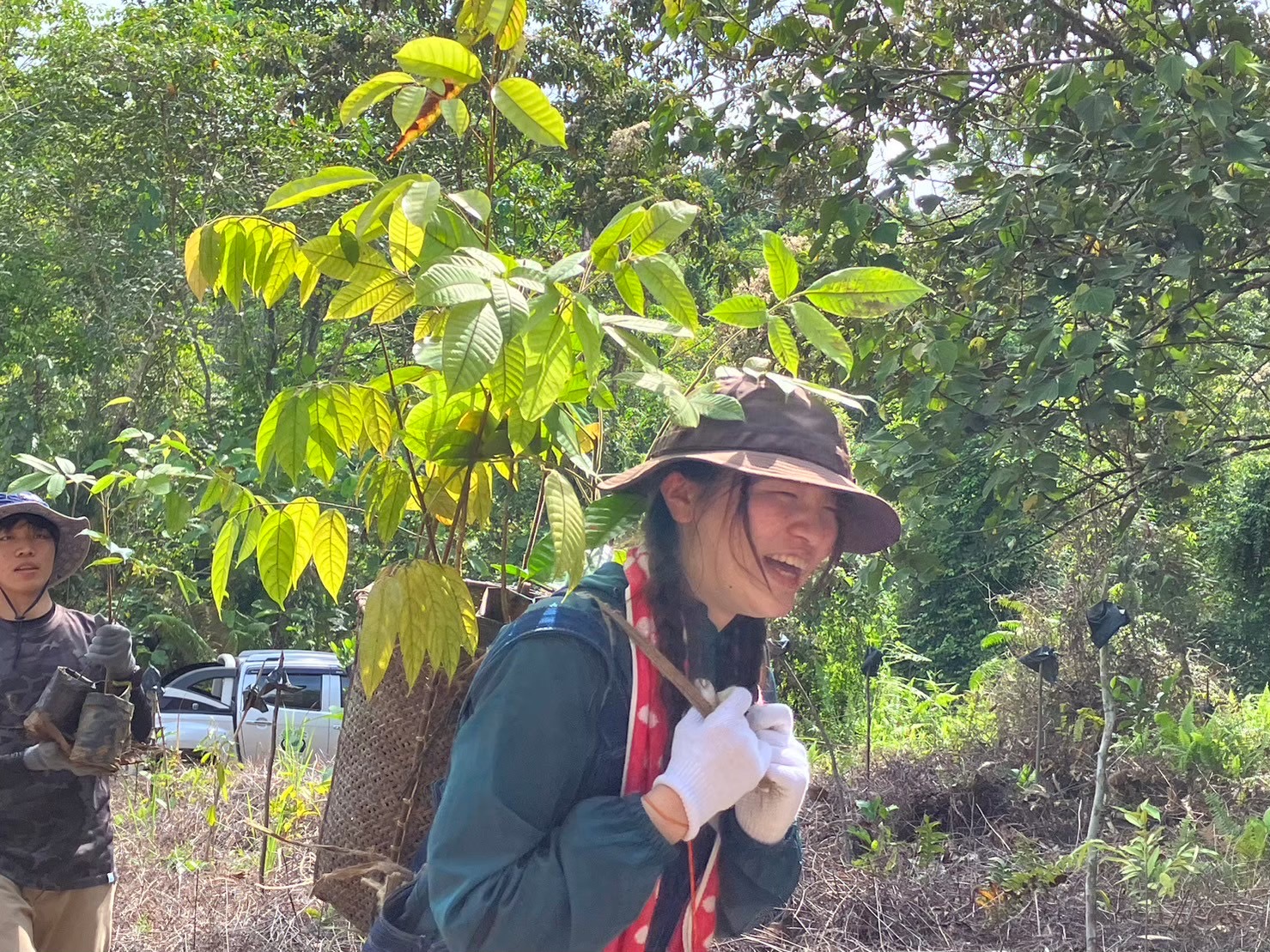
Transporting saplings
Day 4:
We headed from the Serian hotel to Apeng National Park, and spent both morning and afternoon planting trees. Under clear skies that defied the rainy season, the students dug holes for the saplings with guidance from their buddies, carried saplings, and planted them. Digging the holes was the hardest part — using your whole body in the subtropical heat soon had everyone drenched in sweat. The Bidayuh villagers used traditional knives to clear the dense undergrowth, and the buddies removed thorny plants and troublesome insects as needed. Staying hydrated was essential.
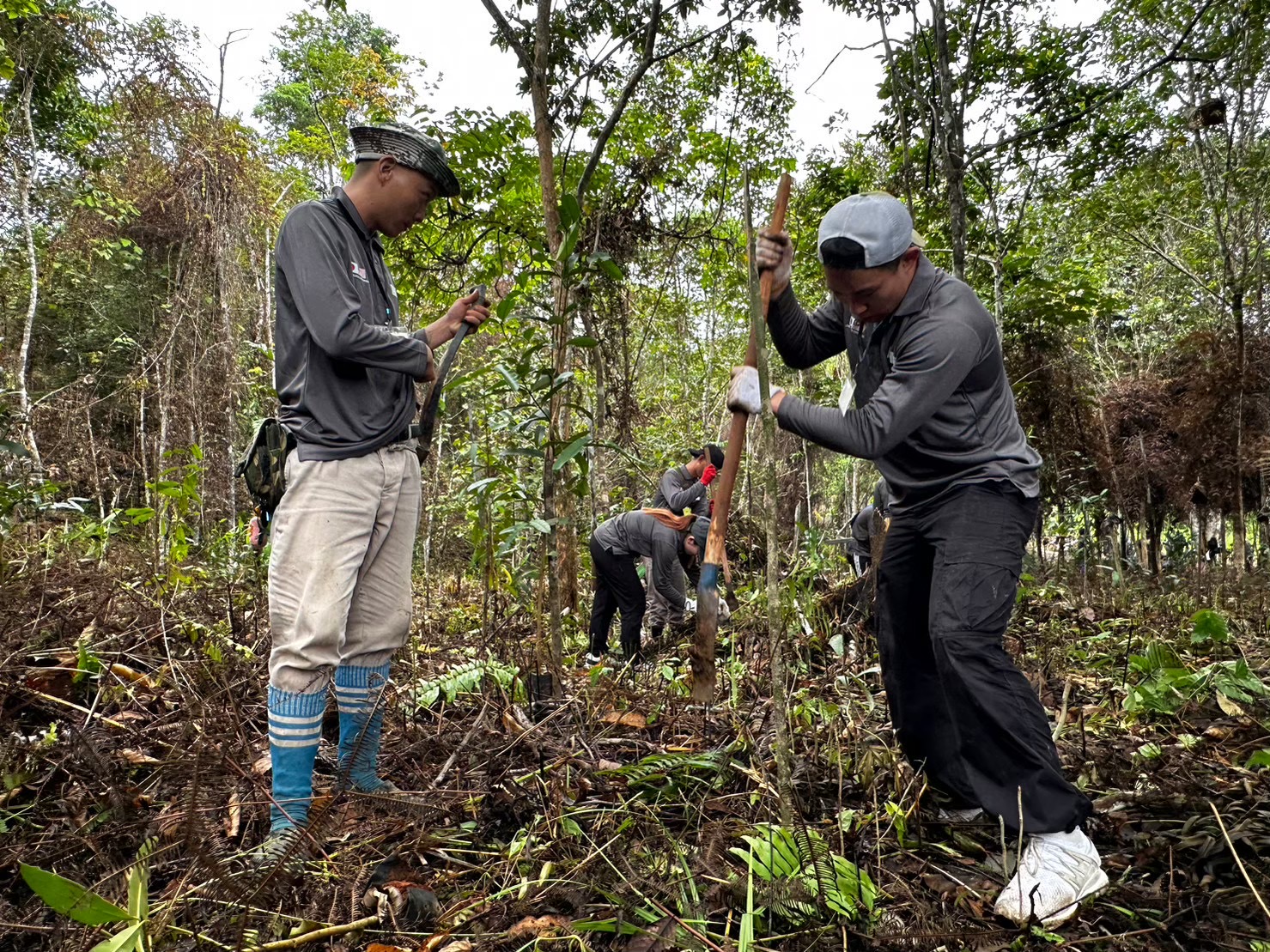
Digging holes for planting
That day we split the students into Groups A and B. Group A stayed overnight in the national park, while Group B (who would stay the following night) returned to the Serian hotel. Group A joined the villagers in foraging for wild vegetables, gathering bamboo, and cooking Bidayuh dishes together. When the cooking allowed for a break, the students and villagers played sepak takraw and badminton — both popular in Malaysia.
After moving their bodies and playing together, the students and the villagers became much closer. Sports really are a wonderful thing. Then came dinner. The Bidayuh dishes were a huge hit with the students! Having worked hard at planting all morning and afternoon and then played sepak takraw and badminton, everyone was very hungry — which surely added flavor — but it was wonderful to see them all saying how delicious the food was.
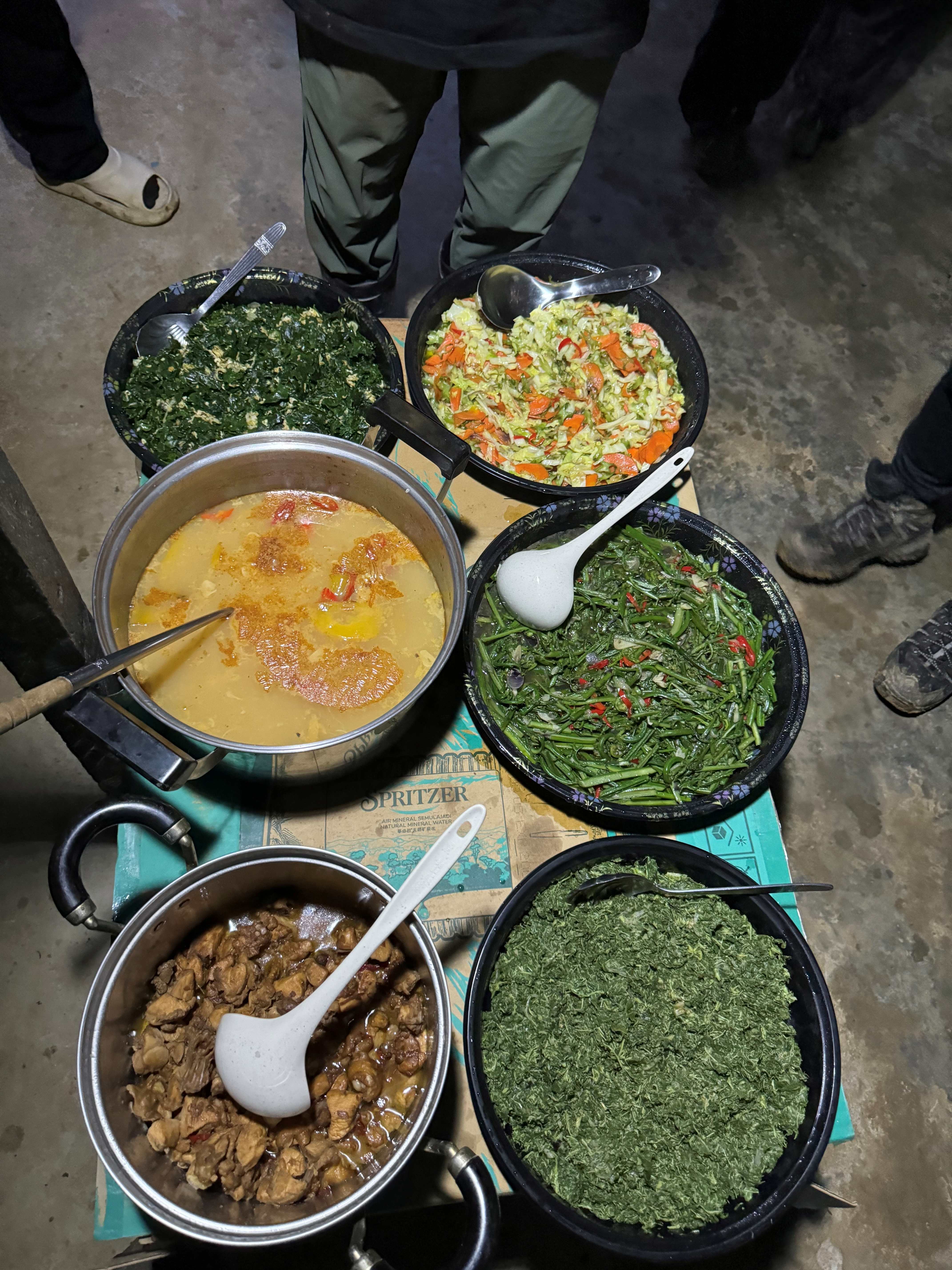
Bidayuh cuisine
That night came the night walk: traversing the Apeng National Park rainforest in pitch darkness with only flashlights to guide us. The villagers walked in front and behind to ensure safety, and the local coordinator accompanied us with the greatest care. Creatures that don’t appear during the day came out, and the students who got to see fireflies and tarsiers were deeply moved. Of course, fire ants and other less pleasant things were also under our feet, so the students got to experience the rainforest in all its rigor too.
Day 5:
In the morning, Groups A and B met up at Tonnibong Village, where the Bidayuh villagers live, and we purchased tropical fruit saplings for planting. In Tonnibong, the women lead the cultivation of saplings of tropical fruits like durian and rambutan, and we have built a flow whereby the Japan Malaysia Association buys these saplings and plants them. The students experienced this process firsthand, and in the afternoon they helped transport the purchased saplings to the planting site.
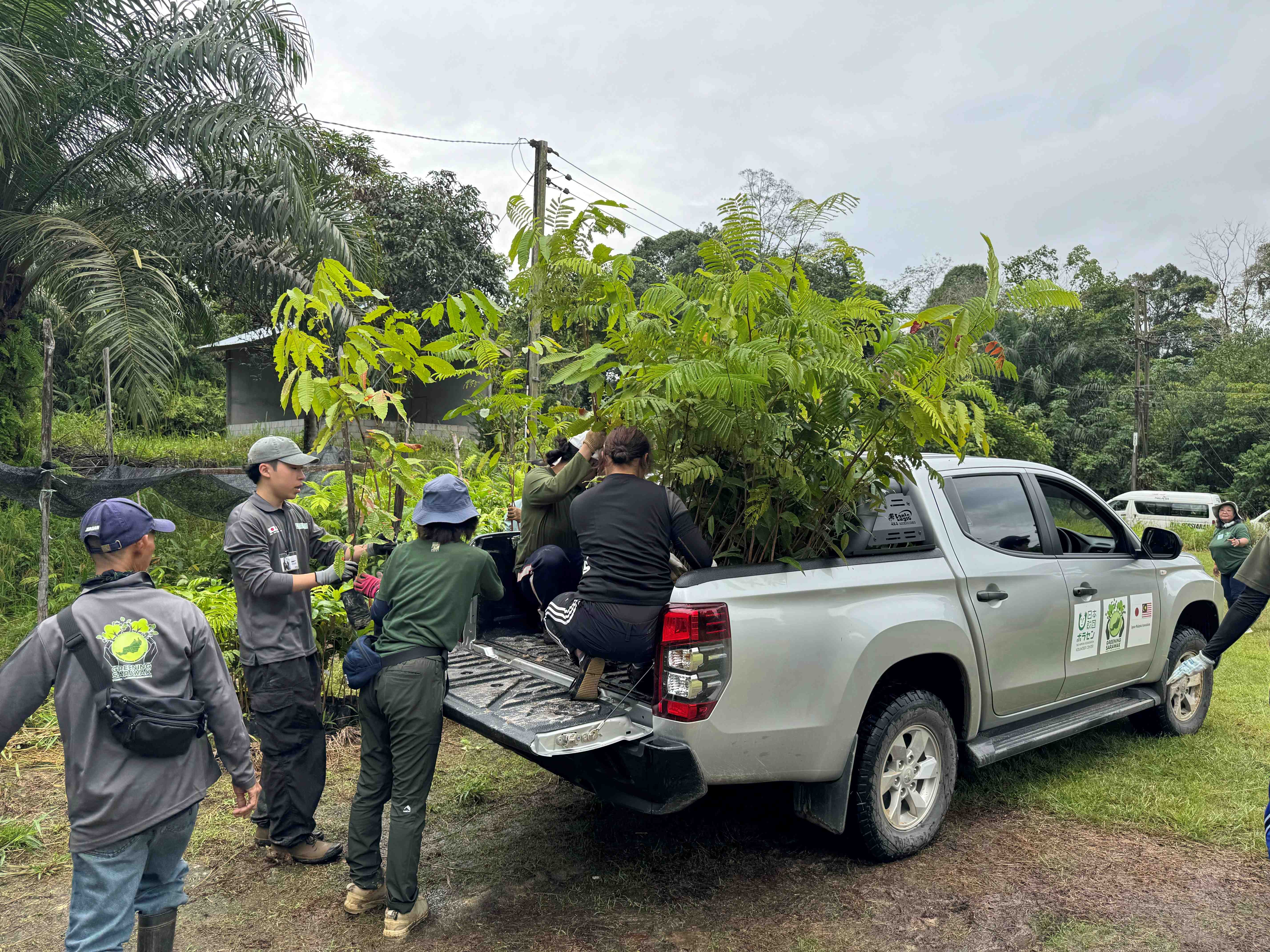
Purchasing saplings at the village and loading them onto vehicles
That night it was Group B’s turn to stay in Apeng National Park, while Group A returned to the Serian hotel. Group B also loved the Bidayuh cuisine, and they too had a wonderful night walk. It’s funny — insects you’d absolutely scream at in Japan only get an “oh, that’s a big one” reaction here in Malaysia.
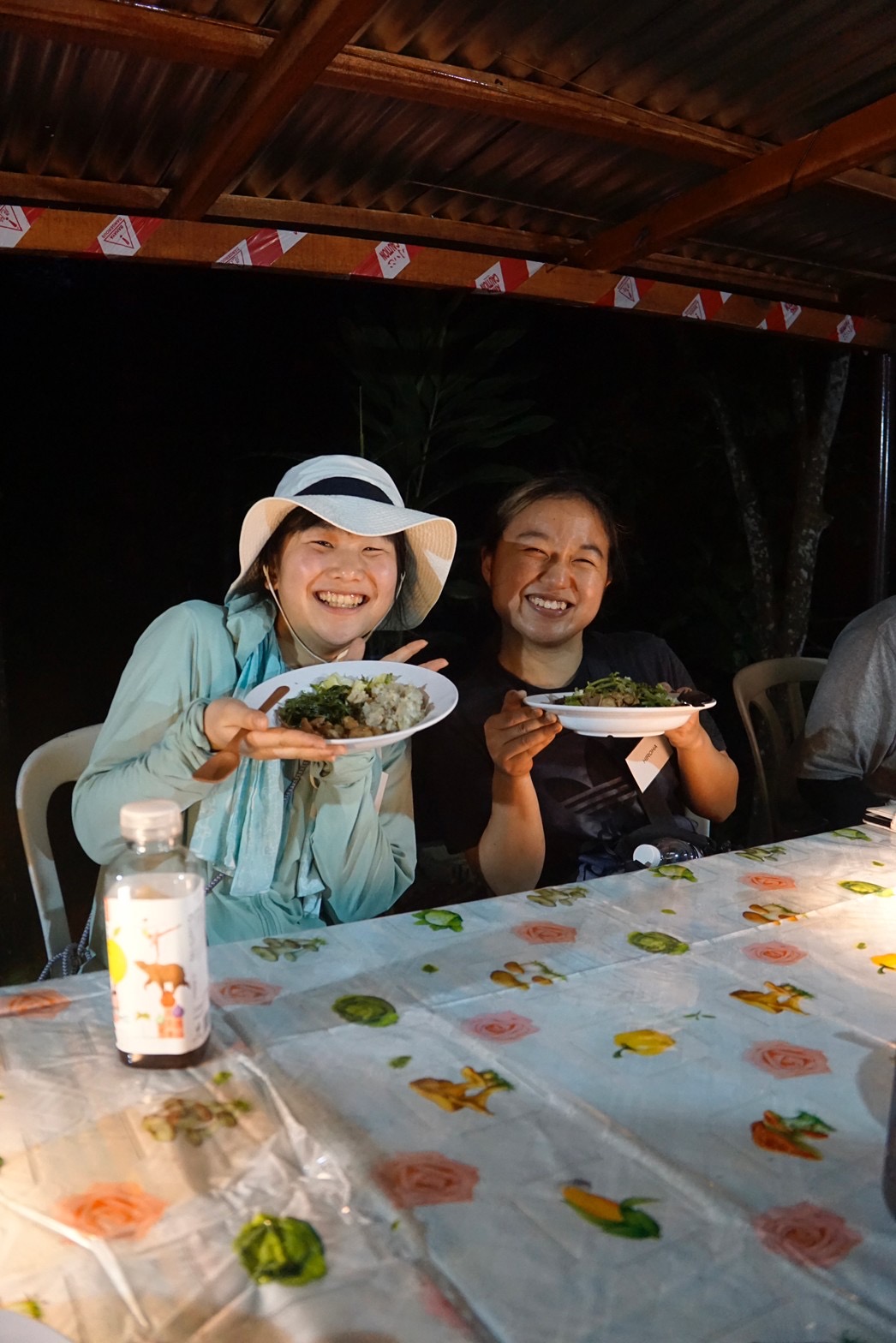
Dining at the rainforest facility
Day 6:
Groups A and B reunited at Apeng National Park, and we spent both morning and afternoon planting trees. While the overnight in the rainforest had been a precious experience, it had also been a long day in unfamiliar surroundings, and a bit of fatigue showed on the students during planting. There were brief pauses when rain stopped the work, but the students seemed to enjoy the rain in their own way — I felt their resilience.
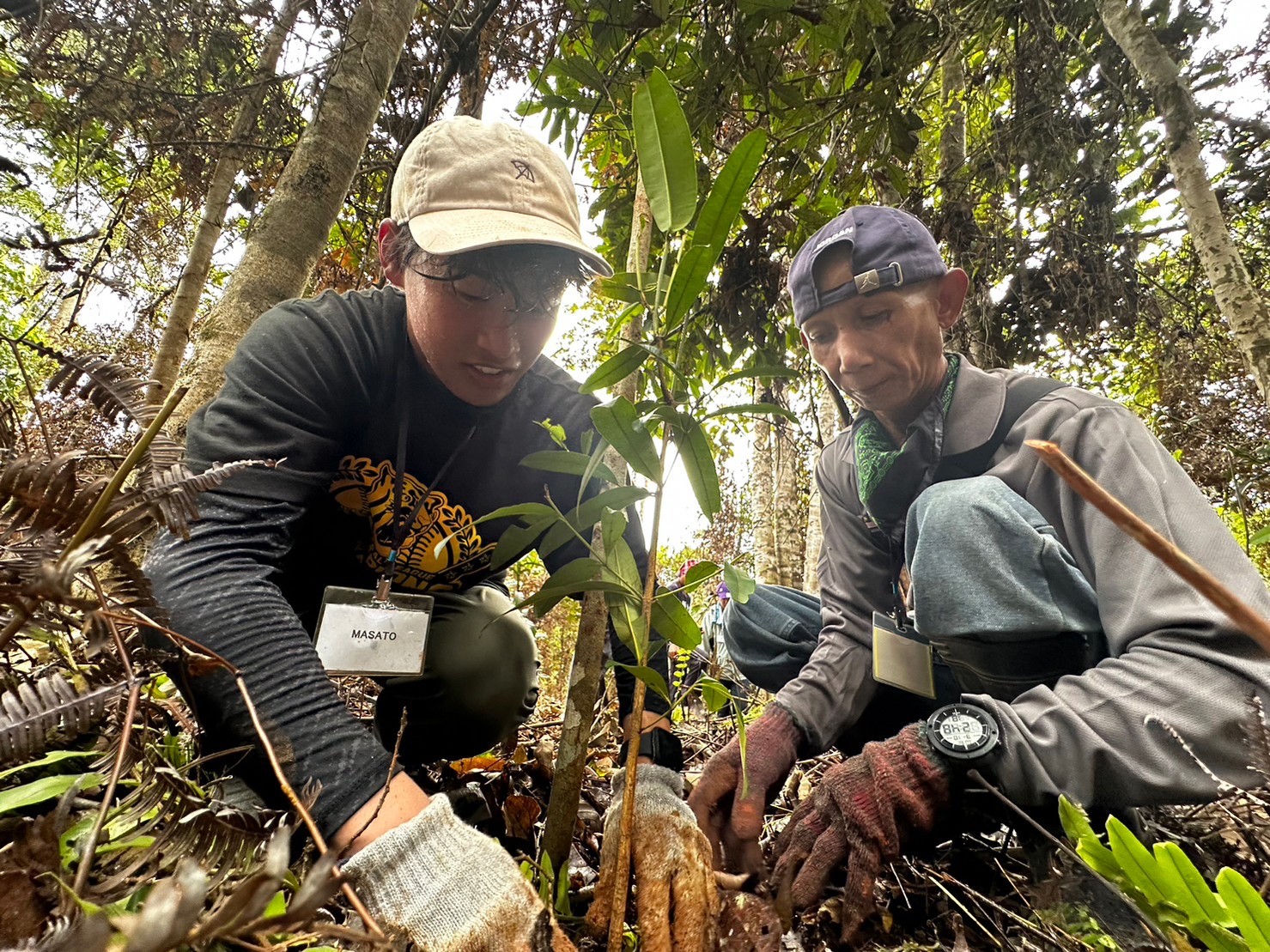
Planting trees with their buddies
Day 7:
In the morning we visited Tonnibong Village to see how the Bidayuh people live and to tour their houses. Beyond just observing, the students harvested rambutan, experienced drying the village’s specialty pepper, harvested rice, and tried part of the oil palm harvesting process (trimming the leaves around the fruit). Oil palm is an important industry and source of income, yet it is also true that rainforest is being illegally cleared to plant it. While taking part in rainforest restoration, the students were able to see with their own eyes that oil palm also supports Indigenous livelihoods — surely an opportunity to start thinking about what the real issues around the rainforest are.
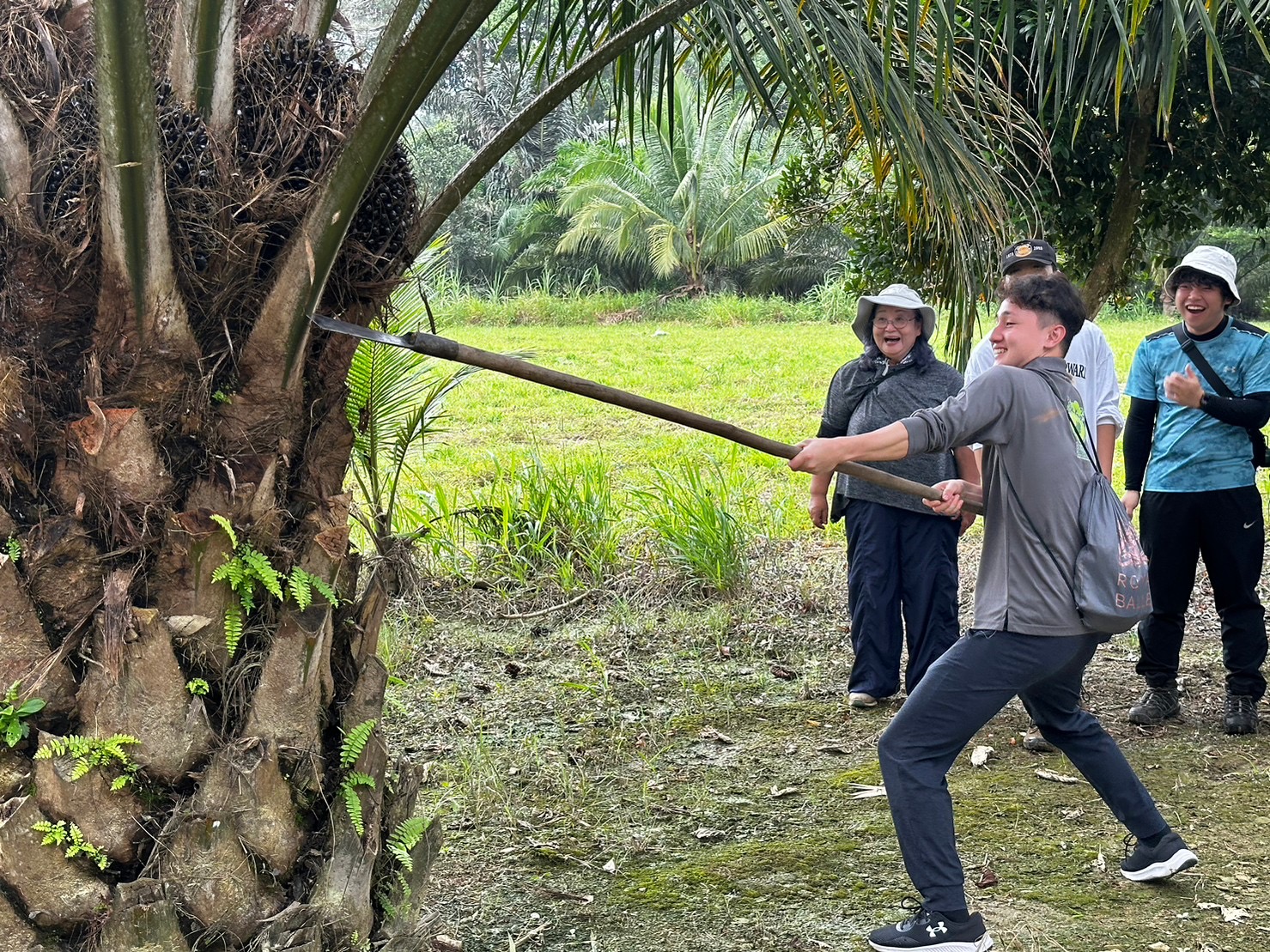
Oil palm harvesting experience
For lunch we were treated to a Bidayuh meal at the home of Paul, Tonnibong’s former village chief. With such warm hospitality, everyone ate their fill, and in the afternoon we returned to Apeng National Park to continue planting. Despite the rainy season, the weather stayed almost completely clear, much to the astonishment of both the local coordinator and the villagers, who said the rain had stopped the moment these students arrived. Perhaps thanks to that, the planting target of 2,500 trees — which we had thought ambitious — was now looking achievable, and the students’ motivation rose even higher.
Day 8:
From the morning at Apeng National Park, we marked previously planted trees, tended the sapling nursery, and did potting work to grow new saplings. Marking may seem unglamorous, but it identifies trees as ones we have planted, signaling to outsiders that the area is under active management — which also helps deter further illegal logging.
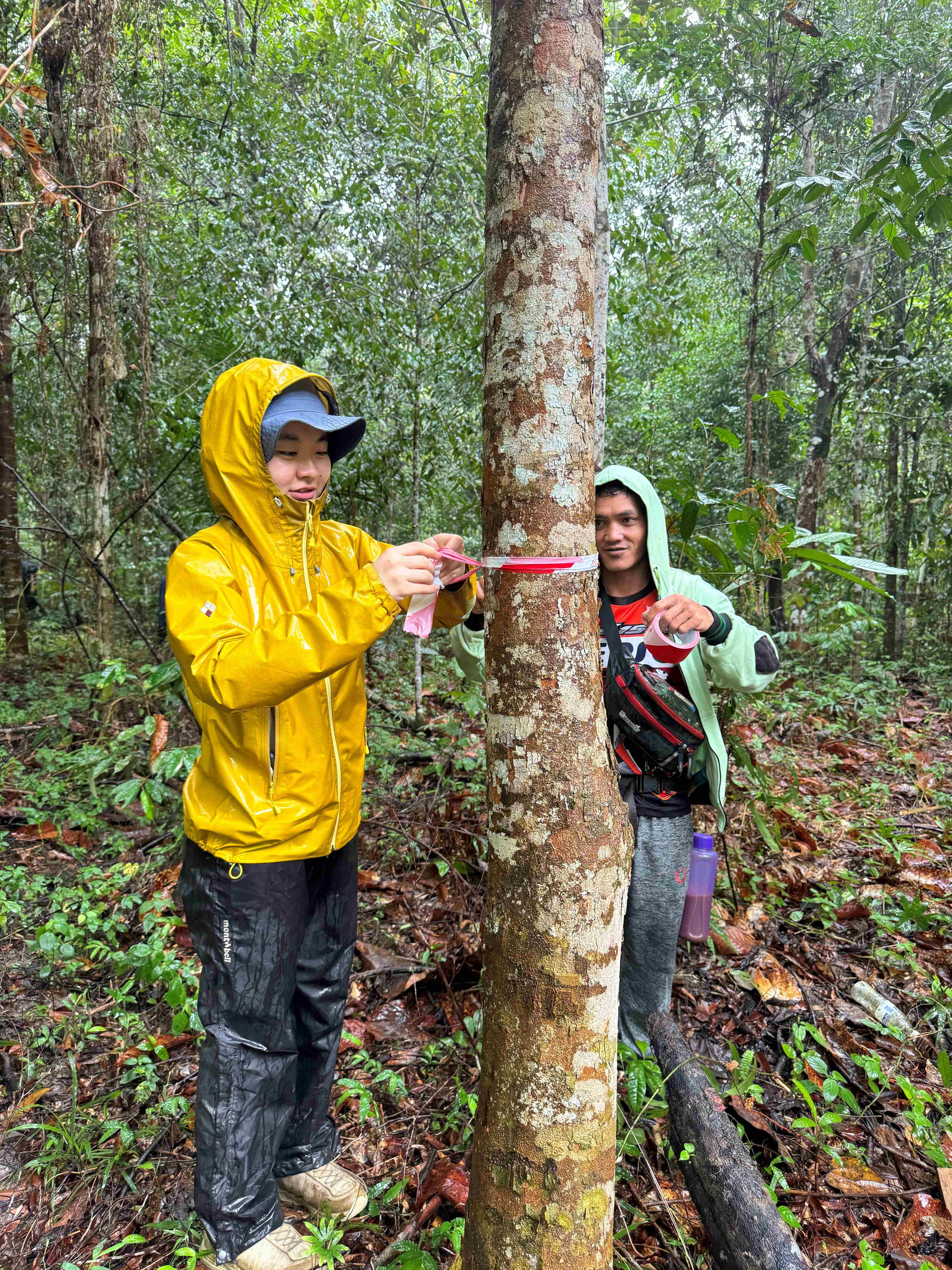
Marking work
Tending the nursery — pulling weeds from the pots, separating healthy saplings from those that had failed due to root rot, and fertilizing the thriving ones — is also unglamorous but vital for the future. The students carried out all of this work conscientiously, in cooperation with their buddies.
Day 9:
Since both the first and second batches had hit the 2,500-tree target, an additional program was added: a morning visit to an Iban longhouse. The students were able to experience cross-cultural exchange not only with the Bidayuh, with whom they had been planting, but with the Iban people as well.
We also visited a roadside station (“michi-no-eki”) being built in the Sabal area under the Japanese Ministry of Foreign Affairs’ “Grant Assistance for Japanese NGO Projects,” and the students were able to see Sabal’s large sapling nursery and its supply of roughly 40,000 saplings. Having worked toward their target of 2,500 trees, the students seemed to get a concrete sense of the scale of the 100,000-tree project.
Outside the formal program, during transit on this day the first batch happened to find several hundred seeds of the native dipterocarp species “engkabang jantong.”
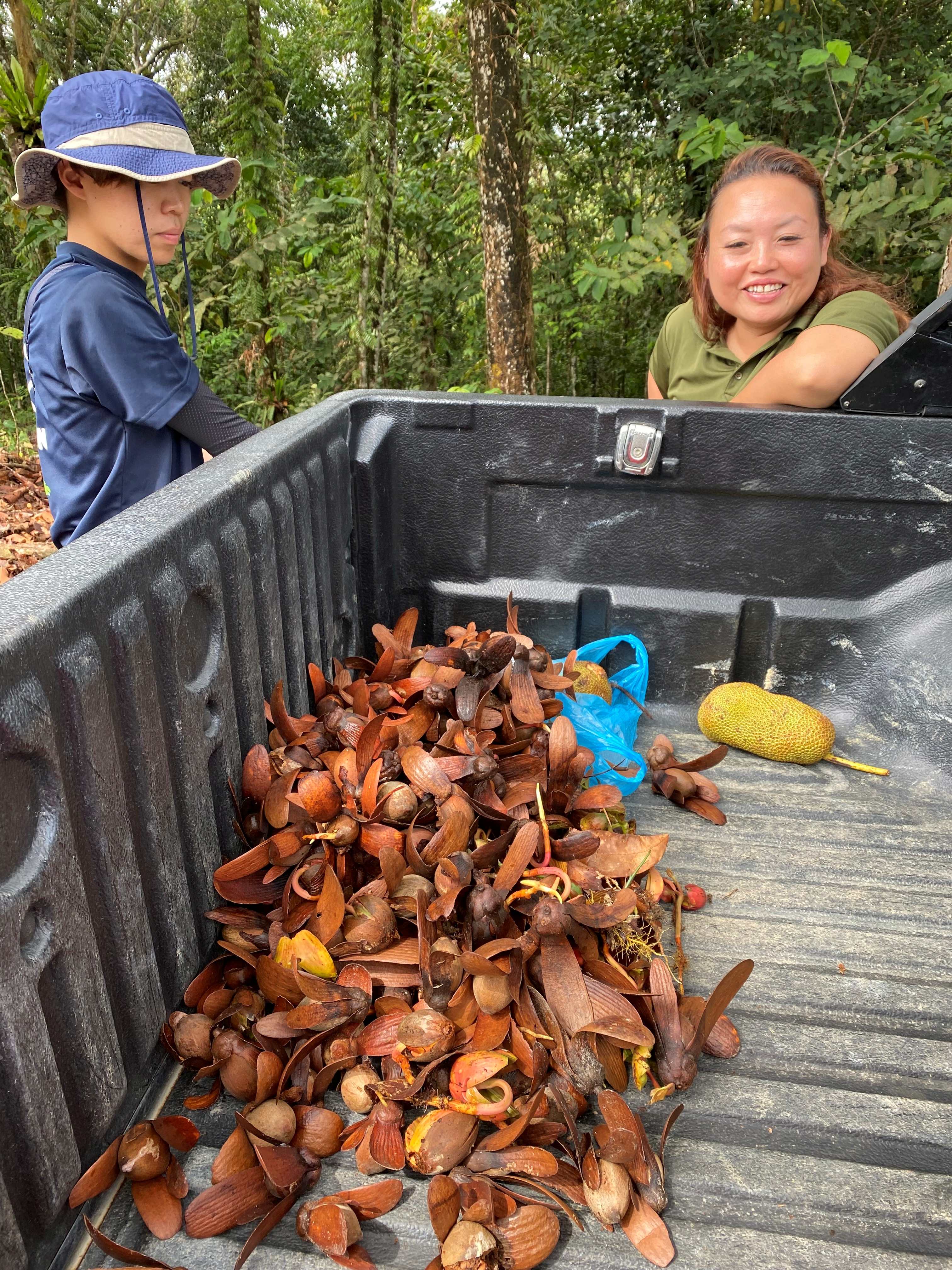
A collection of dipterocarp seeds
Native species seeds can only be gathered about once every five years, making them precious. The next time dipterocarp seeds can be picked up may well coincide with around the 20th batch of students. The local coordinator spotted them under the trees during transit, so we stopped on the spot to gather them. The first-batch students potted these seeds, and the second-batch students potted the rest that the first batch hadn’t finished. If these saplings grow well, the fourth batch (scheduled for around September 2024) may be the one to plant them. There’s something romantic about a planting baton being passed from one batch of students to the next.
In the afternoon we had a barbecue with the villagers — the students’ last day with them. By this point students and villagers had become close, teaching one another games, singing and dancing together, and sharing a wonderful time. After the barbecue came a farewell, where students gave letters to their buddies. The letters were read aloud and translated by the local coordinator, and the gratitude clearly came through. The buddies, it turned out, had prepared gifts of their own, so it ended up like a gift exchange — a deeply warm atmosphere. Some students cried at the parting, and I am certain that this was a friendship exchange that will stay with both the students and the villagers for a long time.
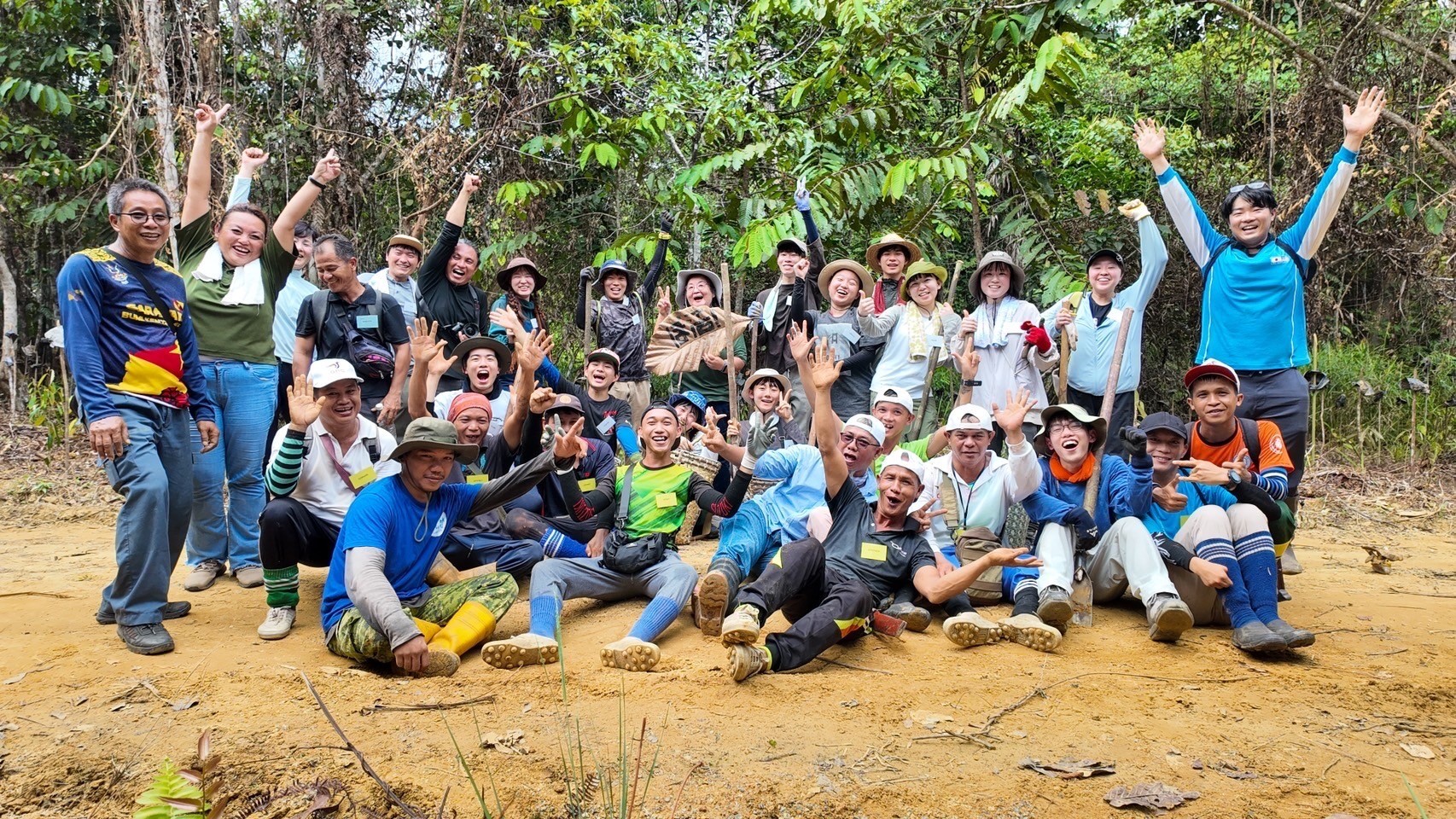
Group photo of the 1st batch
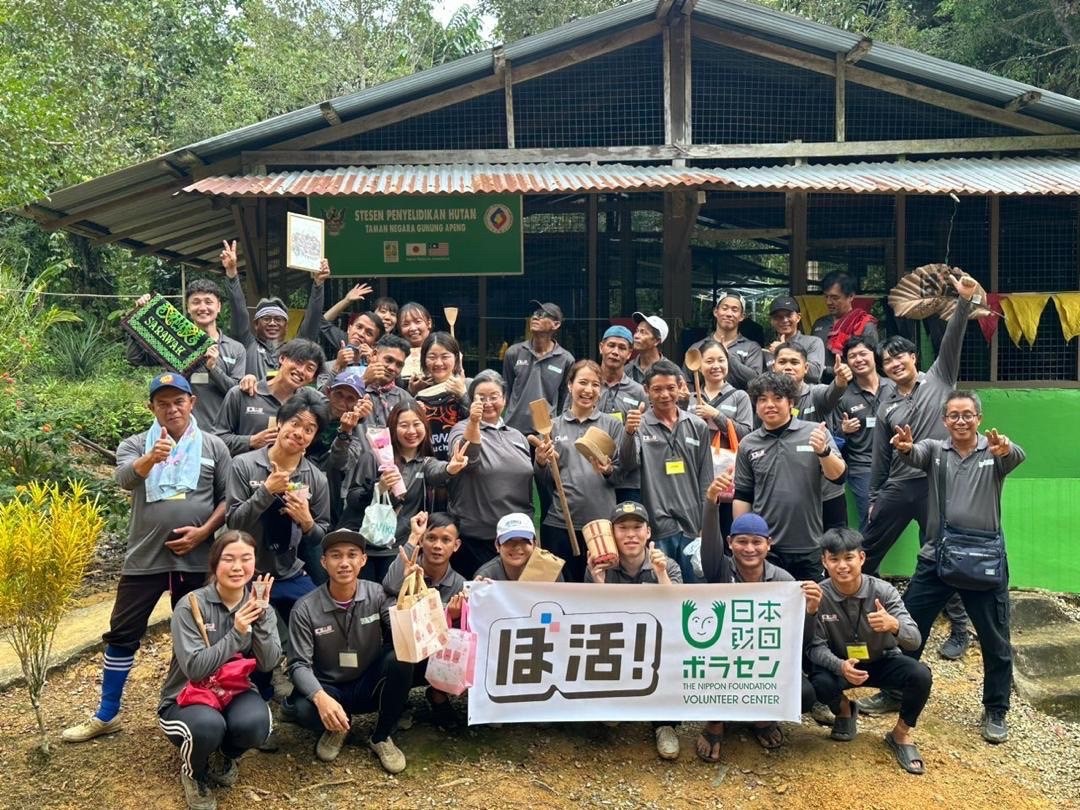
Group photo of the 2nd batch
Day 10:
The program wasn’t over yet, even after the planting was finished. In the morning we visited the Serian market, then moved to Kuching where the students had some free time. In the afternoon we headed to Damai Beach Resort for the “reflection session” that closed out the program.
The session was facilitated by staff from the NF Volunteer Center, who asked the students to think about three things: (1) one thing they had unexpectedly discovered about themselves, (2) something they admired about their buddy, and (3) something they wanted to challenge themselves to do next.
Listening to each student speak, I saw many of them make fresh discoveries — recognizing strengths and shortcomings they hadn’t been aware of, in a positive way — and noticing themselves break out of their shells. Their growth was visible, and it made me genuinely happy. This reflection session was a truly important part of the program.
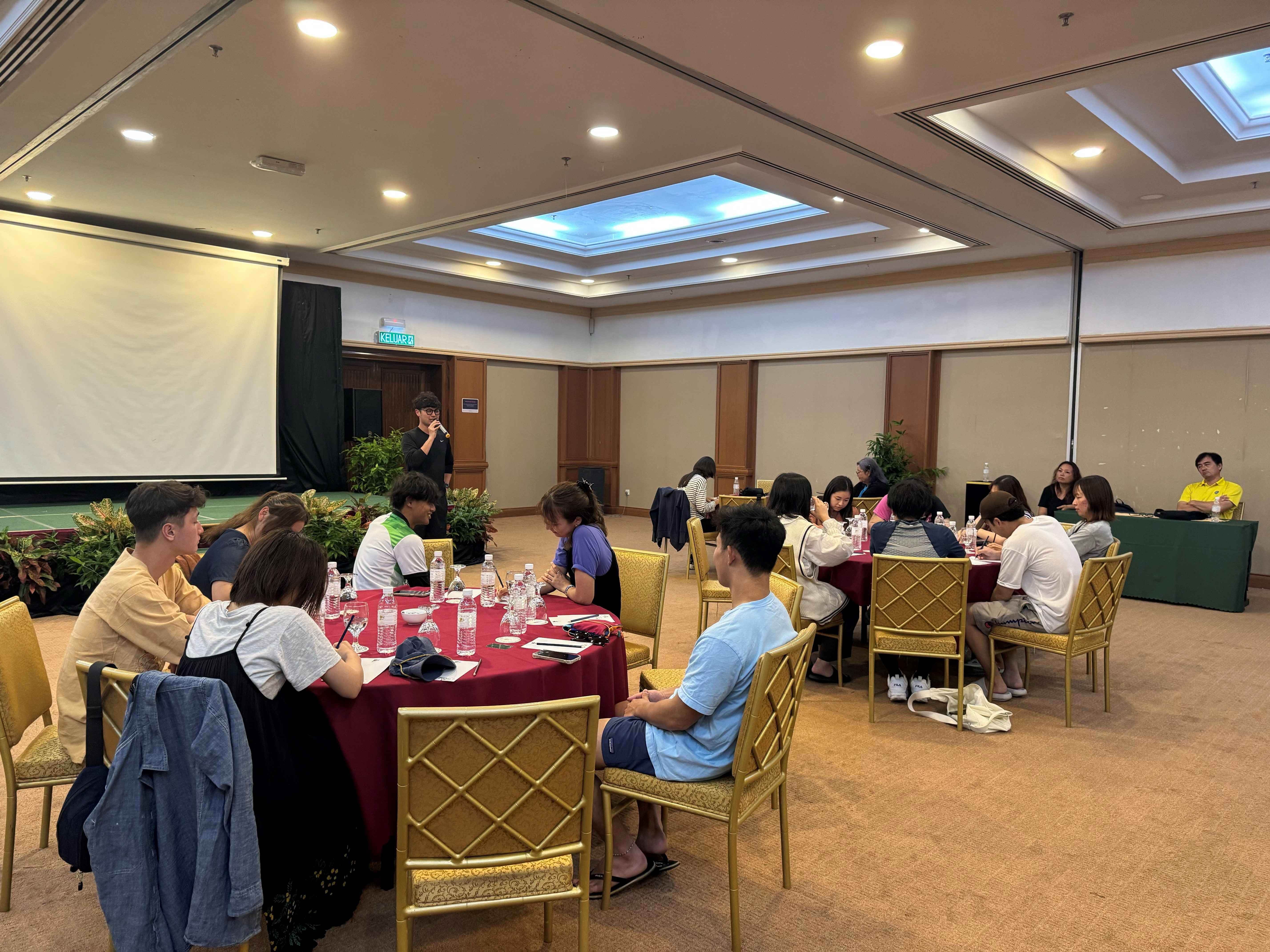
Reflection session
Day 11:
The program was nearing its end. We moved from Damai Beach Resort to Kuching and allowed time for souvenir shopping. There were some intentional differences in the schedules of the first and second batches for evaluation purposes; the second batch returned to Japan on the evening flight of this day.
Day 12:
The first batch flew home on an early-morning flight that day. The second batch arrived at Narita Airport that morning after a day-spanning journey, while the first batch arrived at Narita that evening. After confirming that everyone had made it home safely at Narita, we said our final goodbyes and brought the program to a close. Some students cried again at parting — and I remember feeling a warmth in my chest, thinking that even in just 12 days they had clearly lived something rich and meaningful.
That concludes the 12-day program. I hope I’ve been able to convey, even just a little, some of what these students experienced.
A Cross-Cultural Exchange That Benefits Both Sides
This “Orangutan Forest Restoration Project” only began this year, but in conversations with the students it was striking how high their satisfaction was. Some described it as “the most intensely lived time of my life” or “every activity we shared became an unforgettable treasure.” We adopted a system in which each student was paired one-on-one with a villager for planting, and judging by the students’ voices, this worked well for both the tree planting itself and the cross-cultural exchange. What made me especially happy was that the experience was also rewarding for the villagers — actively engaging with the students, proposing program ideas so the students could have a better experience. It became a “cross-cultural exchange” that gave both sides positive inspiration.
In Closing
I’ve heard through the grapevine that this project was set in motion after Chairman Yohei Sasakawa of the Nippon Foundation came across the Japan Malaysia Association’s newsletter. If that really was one of the catalysts, then producing the newsletter — patiently and carefully reporting on our activities to our members — is, I realize anew, important work that can lead to unexpected connections. I would be delighted if these humble words I’m writing here, and the experiences our students gained through this program, were one day to spark something new.
After the program, the students submit reflections to the NF Volunteer Center, and I had the chance to read every one of those heartfelt, vivid essays. Hearing from the students of both the first and second batches about the wonderful experiences and memories they took away gave me a sense of relief and renewed motivation in my work. This is a 10-year project, which on simple arithmetic means there will be up to a “40th batch.” At the pre-program briefing for the students, the NF Volunteer Center shared a message: “Don’t compare yourself to others.” I thought this was a wonderful message for students embarking on volunteer work abroad for the first time, and I take it to heart not only for the students but for everyone on the operations side of this 10-year project.
This project has only just begun, and the road ahead looks bright. We look forward to continuing the “Orangutan Forest Restoration Project” together with the NF Volunteer Center, and we appreciate your continued support.