
Sarawak Judo Diary: Ninth Exchange Visit in Kuching
The original of this article was written in Japanese and can be found here.
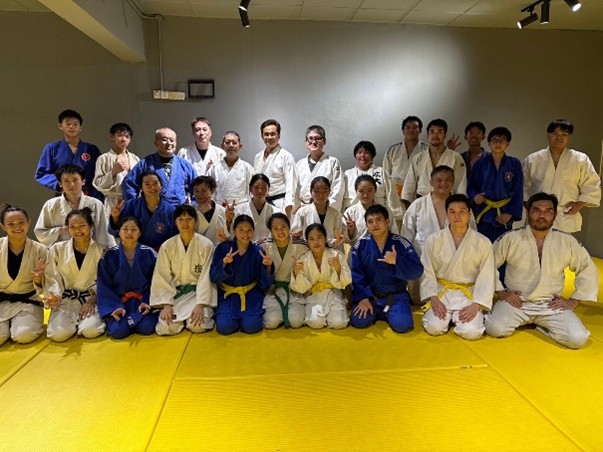
With the members of the Kuching judo community
This article was originally published in the Japan Malaysia Association (JMA) newsletter “Malaysia” Vol. 57 (issued May 25, 2025). It was contributed by Hiroshi Kawamoto, a teacher at Nanao Junior High School, Hatsukaichi City, Hiroshima Prefecture.
The Japan Malaysia Association (JMA) has been conducting rainforest restoration activities in Sarawak since 1995, and since 2011 has been promoting a range of cultural exchange programs — including those involving university students and volunteer participants — alongside its tree-planting work. Hiroshi Kawamoto, a junior high school teacher from Hatsukaichi City in Hiroshima Prefecture, was introduced to judo exchange with Sarawak through his involvement in the tree-planting activities. He has steadily continued these exchanges every year since. Following the resumption of activities in late 2023 after the COVID-19 hiatus, Mr. Kawamoto visited Kuching from late December through early January for his ninth judo exchange visit. We are pleased to share the account he submitted of that trip.
Introduction
As in previous years, I made my ninth visit over the New Year period, this time with two companions — a coach from my team and one of my former students. We also had the invaluable support of Mr. Takahashi, a longtime ally who is based in Kuala Lumpur and always accompanies us. Before departing, I had received input from Igarashi — who has been coaching in Sarawak since last year — on the key challenges facing judo there. With that in mind, I designed a training program focused on going back to basics: the fundamental principles of throwing and grappling techniques, the conditioning drills that build toward them, and solid repetition work. We flew out of Fukuoka Airport on December 29th via Singapore’s Changi Airport and arrived in Kuching.
A Warm Welcome from the Whole Group
Since we were only three people this time, I had been told that just Igarashi would be there to meet us at the airport. But when we came through the arrivals gate, Nyam and the whole usual crew were there waiting for us. I was genuinely moved to tears. They came straight to the hotel and helped us through check-in without a hitch — no trouble at all this time.
First-Ever Training Session at Sentosa Dojo
Practice session, December 30th
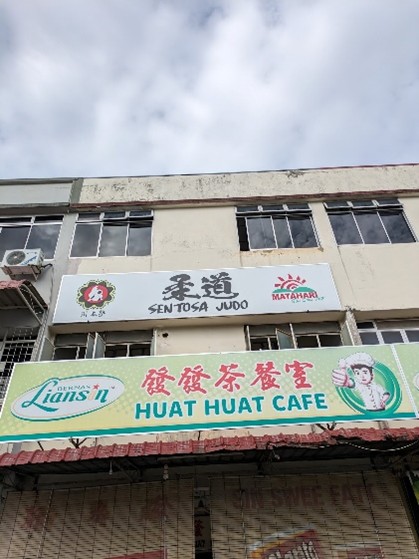
Sentosa Dojo
The junior members I first met when I started coming to Sarawak have grown into fully-fledged adults over the past ten years and now play a leadership role for the newer members. It was genuinely inspiring to see. I was also delighted to notice some of them training in the judogi I had brought as gifts over the years.
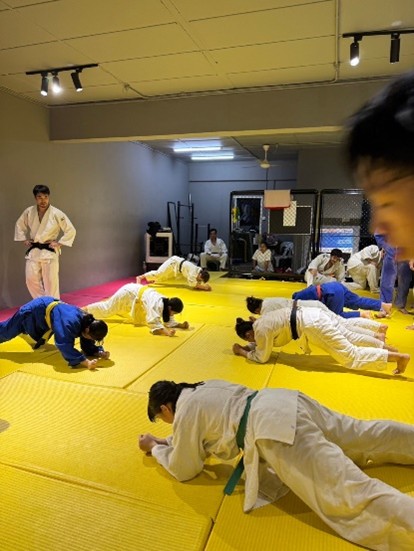
Core conditioning training
After the introductions, I showed everyone a video message from Hiraoka (one of my former students and a silver medalist in judo at the 2012 London Olympics — Ed.). He is currently on a language study program in Seattle, and everyone watched with great interest as he delivered his message in noticeably fluent English.
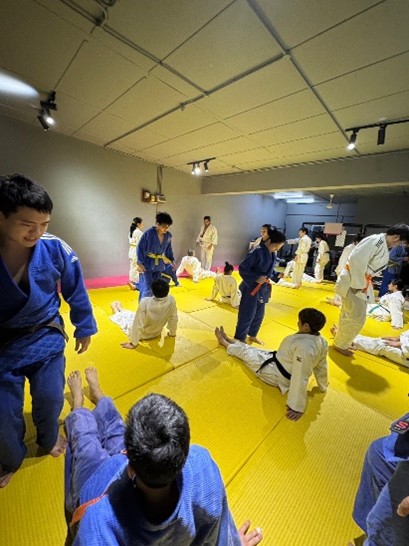
Senior members leading instruction
After warming up, we launched into the core-strengthening exercises I use as a warmup at my own school. Igarashi had told me this kind of fundamental conditioning was also an area where members needed work, so I took my time with it. I had brought along paper trays as training props, and we started with drills focusing on how to use the wrists, elbows, shoulders, and shoulder blades.
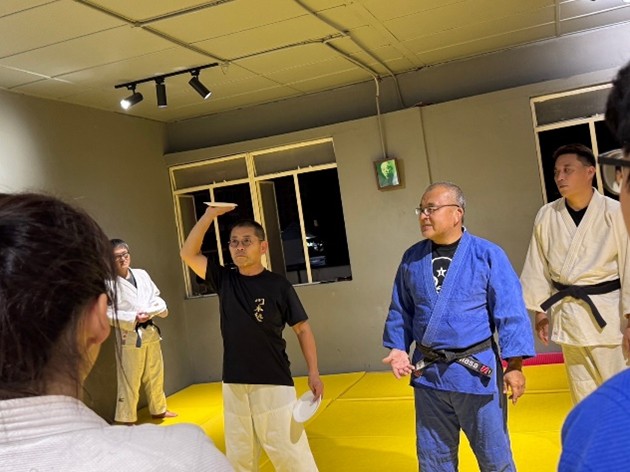
The author (third from right) explaining a training exercise
Because this isn’t the kind of thing people usually train consciously, everyone struggled through it with puzzled expressions. After that, we moved into footwork drills — also something quite different from their usual routine, so they found those challenging too.
For ground technique, we focused on reversal methods that my own students specialize in, repeating them in drills before moving into randori — free sparring.
This was my ninth visit, and the improvement is undeniable. But when it comes to technique, I felt strongly that members need to understand the underlying concepts and principles before drilling anything repeatedly — not just go through the motions.
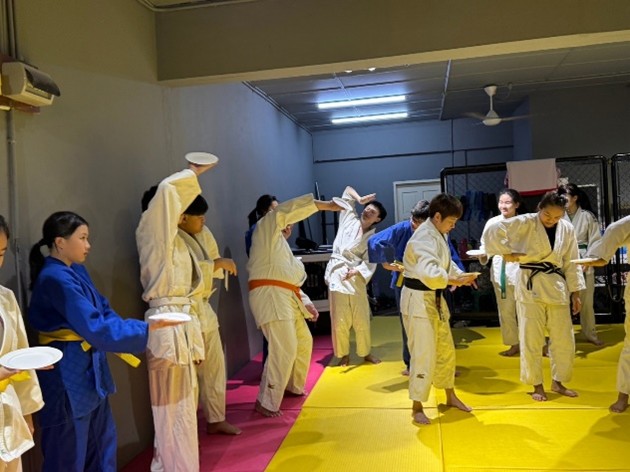
Training with paper trays
A Look at the New Kawamoto-Juku Dojo
Nyam kept saying to me, “Sensei, new dojo,” and I wasn’t sure what he meant — but it turned out that a new training space was being built very close to the existing Sentosa Dojo, and it was considerably larger than the current one. It was still under construction, and we ended up working together to figure out where the tatami mats should go. One of the coaches I brought along is a trained architect, so he was able to get into the specifics — measurements, layout, the whole thing. It looks like this will be the venue for my next visit.
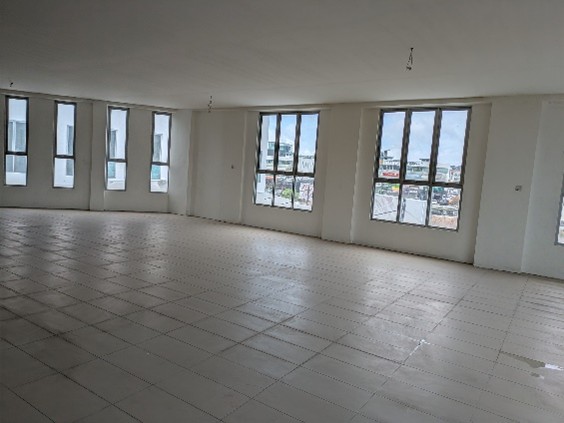
Interior of the new dojo (under construction)
Nyam is apparently based in Sibu for work at the moment, and during our visit he raised the idea of rotating future visits between Sabah, Sibu, and Kuching — each of which has people I have worked with who are involved in judo instruction there. I’m looking forward even more to what future visits might bring.
A Greeting from the Orangutans
For the first time in a few years, I was taken to the Semenggoh Wildlife Centre to see the orangutans.
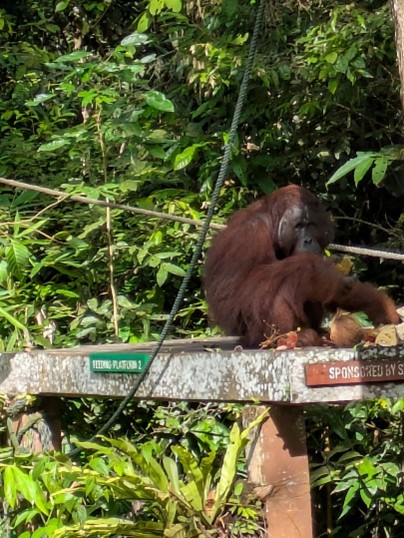
An orangutan makes an appearance
We were told that sightings aren’t always guaranteed at this time of year. But as we moved deeper into the reserve, a staff member waved us over and pointed — and there, right in front of us, was an orangutan. Further along at the feeding platform, another one swung down from deep in the forest on a rope. We couldn’t have timed our visit better, and it made for a very happy moment.
Practice Sessions: December 31st and January 1st
The core aim of this visit was to go back to basics and teach them thoroughly, so the bulk of our training time was devoted to conditioning and repetition drills. Plenty of excellent technique is accessible online with a simple search these days. But those techniques can only be mastered when there is solid theory and fundamental physical skill behind them. That was the message we tried to drive home across both standing and ground work during this visit. The Sentosa Dojo was somewhat cramped given the number of participants, but in hindsight, a session focused on this kind of foundational work was probably the right fit for the space.
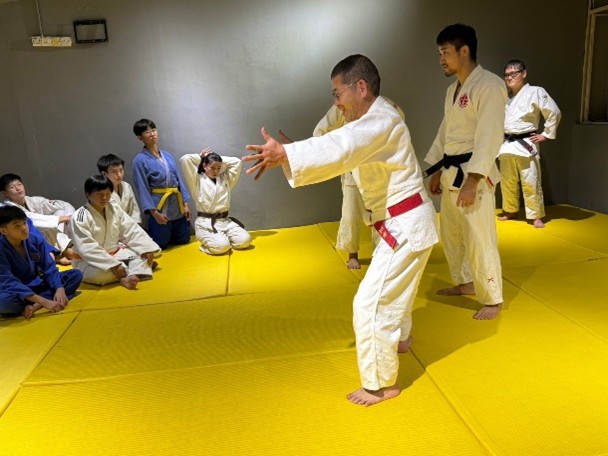
The author (center) coaching
With randori, only two or three pairs can work at a time, which means a lot of people end up standing around watching. Add in the significant gaps in skill level and motivation across the group, and it’s a real challenge to keep everyone engaged — something I felt acutely at Sentosa Dojo this time.
With the members of the Kuching judo community
Until the new dojo is ready, I hope the members — with Igarashi at the center — will use the training menu I left as a guide and focus on building their basic fitness and fundamental technique.
The previous visit had the luxury of a larger venue, but that won’t always be the case. If the group can rebuild its training approach for the space they actually have, that will lead to steady improvement regardless of the facilities.
Closing Thoughts
During this visit, I learned that Igarashi’s contract — originally for one year — had been extended by two years. Igarashi has the physical ability and technical skill of someone who could still compete at the highest level. That extension is a testament to the goodwill of Nyam and everyone else on the local side who made it happen. It’s a great opportunity for Igarashi personally, and an enormous one for judo in Sarawak.
That said, there is still plenty of work to be done before results at competitions improve. My hope is that this visit serves as a catalyst, and that Igarashi — now staying on as a dedicated coach — continues to raise the level of the program. I also hope that Sarawak judo will continue to grow and flourish in the years ahead. And I want to keep doing whatever small part I can to help Sarawak become the number one judo team in Malaysia.
As I reflect on this visit, what strikes me again is how much I owe to so many people for making this kind of judo coaching work in Kuching possible — beginning with Mr. Morishima, who first created this connection, and extending to the Japan Malaysia Association and the many wonderful people on the ground in Sarawak. I am truly grateful. The timing of the next visit is yet to be determined, but it will be the tenth — a milestone. For as long as my body holds up, I intend to stay connected to judo in Sarawak.