
Roadside Station Michinoeki Sabal Market Opens in Sarawak
The original of this article was written in Japanese and can be found here.
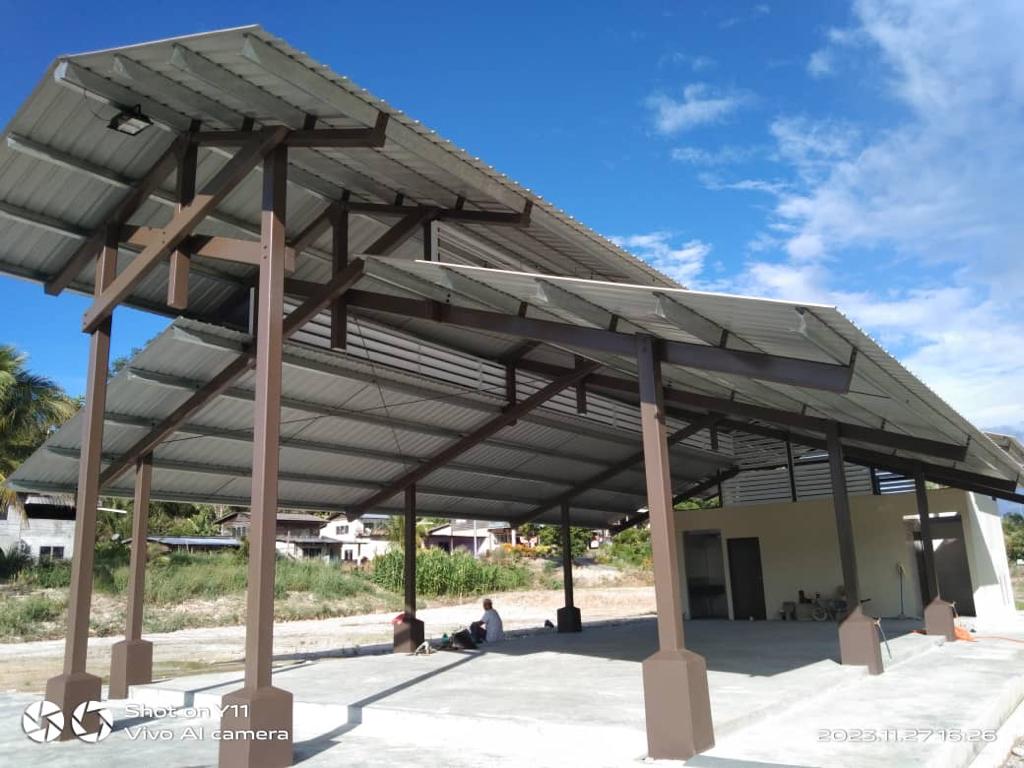
Opening ceremony of the Roadside Station (“Michi-no-Eki”) in Sarawak
*This article was originally published in the Japan Malaysia Association’s bulletin “Malaysia” Vol. 55 (issued on August 31, 2024).
Since the end of March 2021, the Japan Malaysia Association (JMA) has been carrying out the “Project for Improving Living Conditions through Water Environment Development in Indigenous Residential Areas of Sarawak State,” utilizing the “Grant Assistance for Japanese NGO Projects” (hereinafter “N-Ren”) — a scheme under which the Ministry of Foreign Affairs (MOFA) provides Official Development Assistance (ODA) funds to economic and social development projects that align with Japan’s ODA policy. Thanks to the improved daily living margin gained from this water environment improvement, the village women began cultivating fruits and vegetables and producing traditional sweets. As part of the living-improvement program accompanying the water environment improvement, we therefore developed a “Michi-no-Eki” (Roadside Station) along the national highway near the village to sell local products.
While the first phase of this N-Ren project concluded at the end of March 2024, an opening ceremony for the “Michi-no-Eki” was held on Saturday, April 27, 2024, as the culmination of the first-phase N-Ren project. From our Association, Chairman Takakazu Ogawa, Auditor Shigenobu Nishida, Director Takashi Moribayashi, Director Fumiaki Koizumi, Advisor Hikaru Moromizato, and Deputy Director Yuma Kosuga attended. Here, we present a report from the field.
Introduction
This is Kosuga from the Japan Malaysia Association. As part of the living-improvement program under MOFA’s N-Ren project, we developed a “Michi-no-Eki” — a facility for selling village products with attached public restrooms, covering 367.8 m² — on state-owned land along the national highway in the Serian District of the Samarahan Division, Sarawak.
To widely publicize, at the bilateral government level, that this Michi-no-Eki was completed as a project outcome made possible through “support from the Japanese government” and “cooperation from a Japanese NGO” via the N-Ren scheme, and to inform the local community that will actually maintain, manage, operate, and make use of the facility, we held a grand opening ceremony for the Michi-no-Eki.
I attended together with Chairman Ogawa and other members of our Association, so I would like to share how this large-scale opening ceremony unfolded. Since we had already inspected the construction status of the Michi-no-Eki in September of last year, I would first like to review the overview and key points of the facility, and then describe the events of the opening day.
Overview of the “Michi-no-Eki”
Thanks to the small-scale dam construction and water-supply piping installed under the N-Ren project, villagers can now obtain drinking and household water year-round. We reasoned that establishing a facility to sell village products such as fruits and vegetables grown using this abundant water would further improve villagers’ livelihoods, and so we developed this Michi-no-Eki. The abundance of water also made it possible to install flush-type public restrooms. Since public restrooms in Malaysia are pay-to-use, the village organization accumulates not only proceeds from product sales but also restroom usage fees, enabling self-sustaining maintenance and management of both the water-supply system and the Michi-no-Eki. We located the Michi-no-Eki along the national highway precisely to attract general restroom users, with the aim that those who stop by will also purchase village products. To improve convenience for restroom users, we also developed an access road and parking area (735 m²) leading to the Michi-no-Eki.
After consultations with relevant parties, the facility was named “Michinoeki Sabal Market,” and operations began in late March 2024.
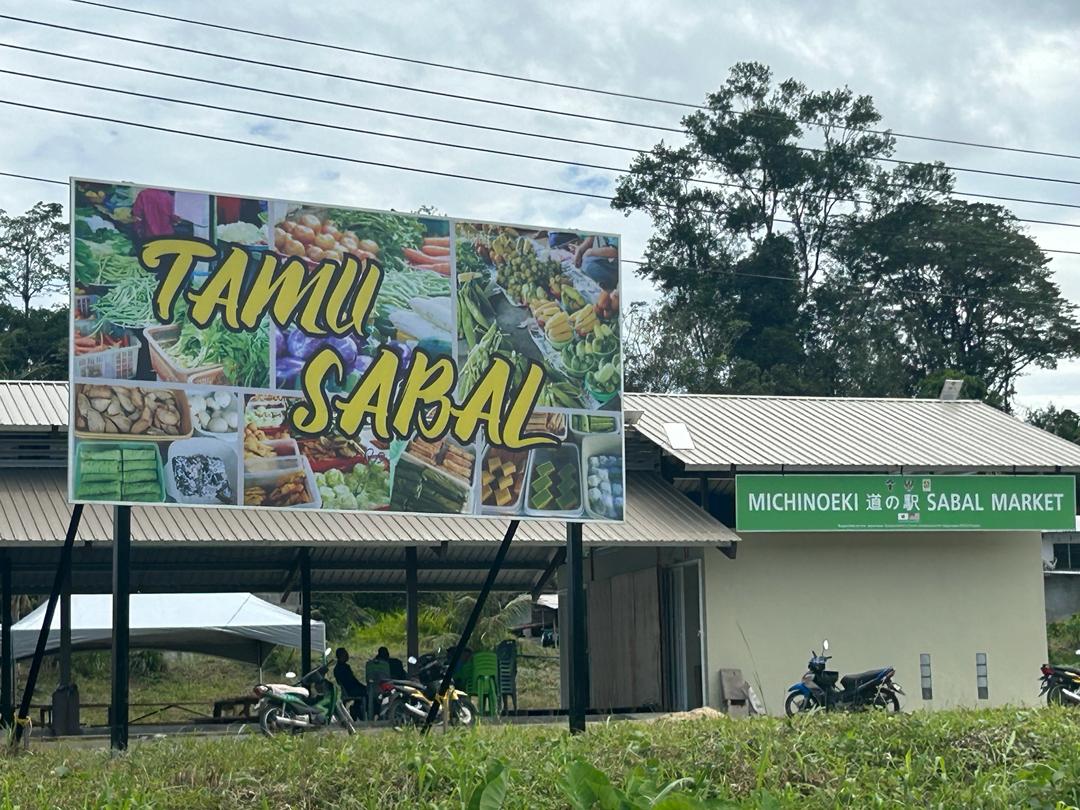
Signage of the Michinoeki Sabal Market
Installation of a Barrier-Free Restroom
Because this Michi-no-Eki was developed through “support from the Japanese government” and “cooperation from a Japanese NGO,” we set out to introduce Japan’s clean restroom culture. Kazue Sakai, JMA’s In-Sarawak Coordinator, and her team held detailed meetings with the construction workers and villagers to help them understand this approach. They also organized workshops on maintaining clean restrooms, supporting villagers in building a self-sustaining management system.
A key feature is that, in addition to men’s and women’s restrooms, a “barrier-free restroom” was also installed. Public restrooms accessible to wheelchair users and people with mobility difficulties are still rare in Malaysia, and we hope that this — together with the Japanese “Michi-no-Eki” concept — will serve as a model case for the future.
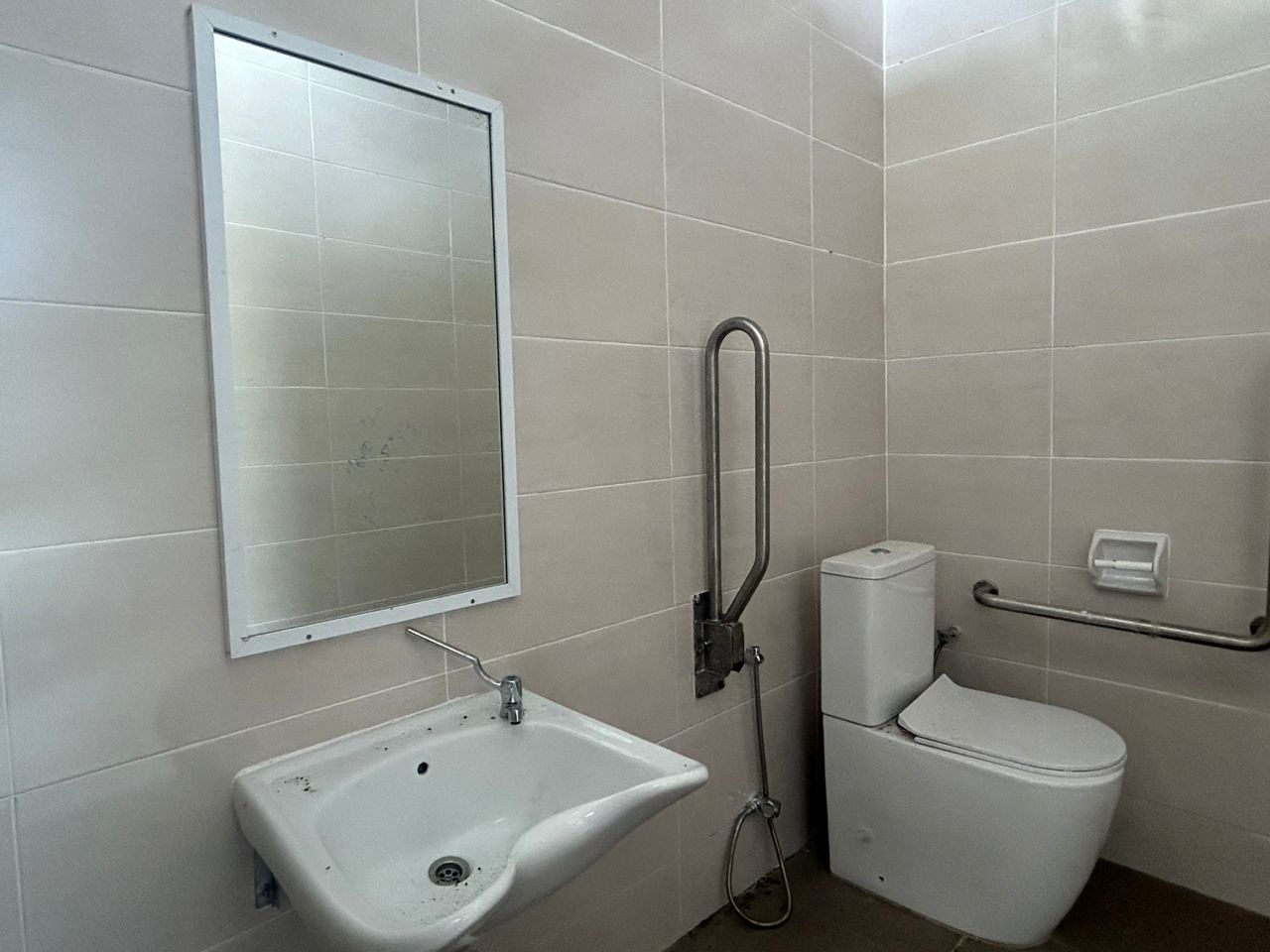
Barrier-free restroom
Overview of the Opening Ceremony
Now, let me describe the opening ceremony itself. The ceremony was held on Saturday, April 27, 2024. Representing the Government of Malaysia, attendees included Dato Snowdan Lawan, Deputy Minister of Tourism, Creative Industry and Performing Arts of Sarawak (and State Legislative Assemblyman for the project area), and Dato Sri Doris Sophia Brodi, Member of the Federal Parliament (for the project area). Representing Japanese government agencies in Malaysia, Mr. Yoshito Yamashita, Head of the Consular Office of Japan in Kota Kinabalu, was present, along with our Association’s Chairman Ogawa. Approximately 300 people attended in total, including representatives from the Sarawak Forestry Department, Sarawak Forestry Corporation, the Serian District Office, and local village chiefs and residents.
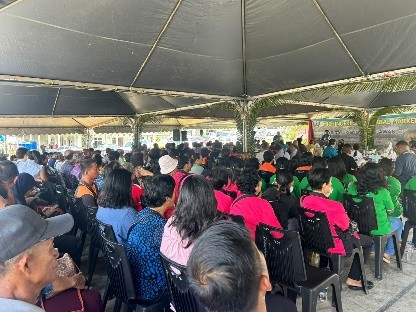
The lively atmosphere of the ceremony
It was a significant occasion to have so many attendees centered on State Assemblyman Snowdan and Federal MP Doris — both elected from the area where our Association conducts its tree-planting activities — together with officials from Japanese and Malaysian government agencies involved in the planting activities, administrative personnel, and, above all, numerous members of the local village community.
Through this opening ceremony, we hope that the local villagers feel a deep attachment to the Michi-no-Eki, recognize that many people are supporting them, and find motivation to carry out self-sustaining maintenance and management for years to come. Nothing could please us more.
Schedule and Content of the Opening Ceremony
The opening ceremony proceeded according to the following schedule.
Guests arrived at 9:00 a.m., VIPs at 9:30 a.m., and the opening speeches began at 10:00 a.m. The opening speech and overall master-of-ceremonies duties were handled by Ms. Betty, a former elementary school teacher in the tree-planting activity area who, since her retirement, has been cooperating with our planting activities.
Next came a speech by Chairman Ogawa of our Association. The full text is presented below.
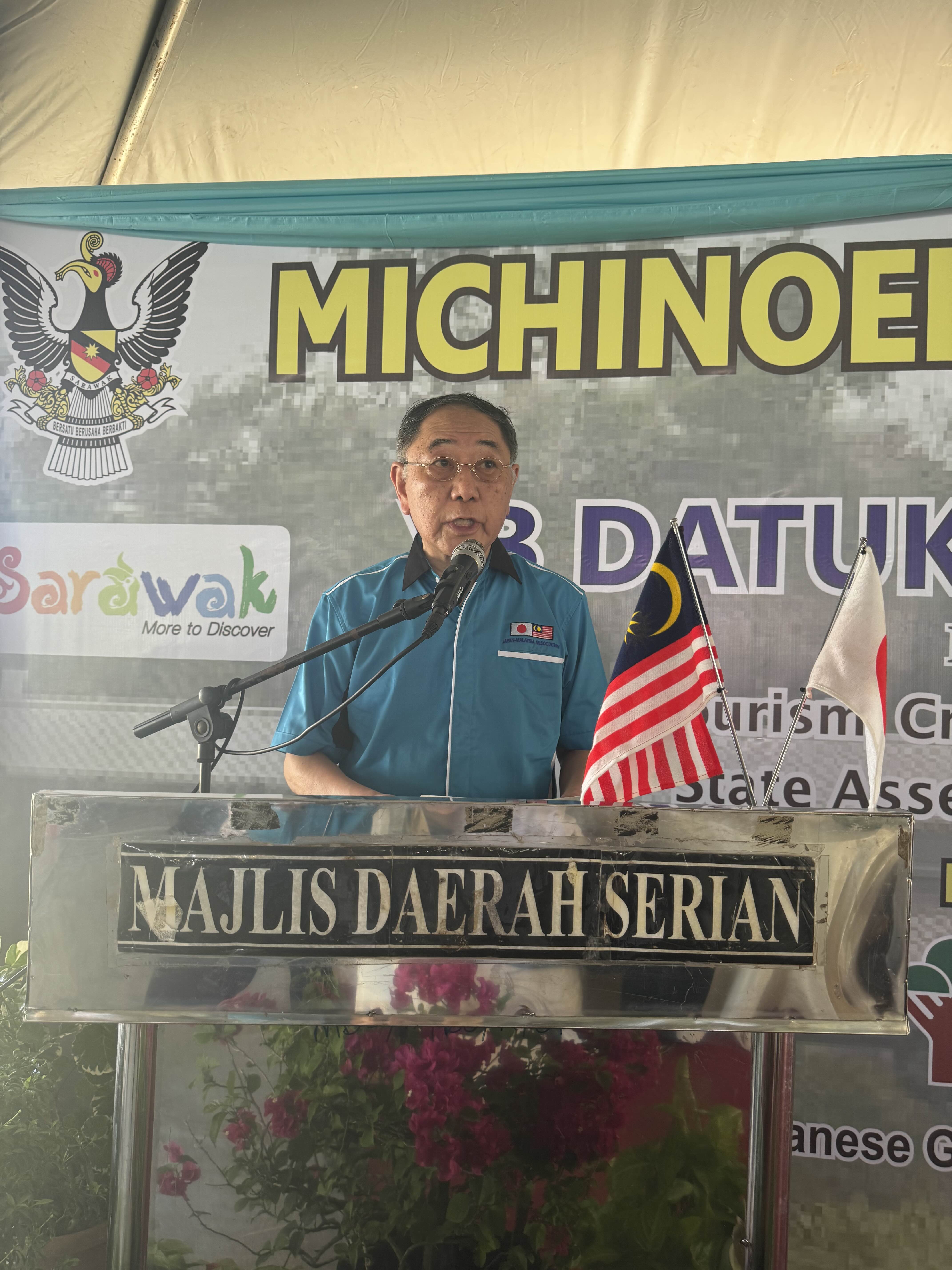
Chairman Ogawa
Ladies and gentlemen, good day. I am Takakazu Ogawa, representative of the Japan Malaysia Association. Thank you, Dato Snowdan and all of you, for joining us today.
Our organization was founded in 1956, and since 1995 we have been carrying out tropical rainforest regeneration projects here in Sarawak. Throughout this time, we have been deeply indebted to Dato Sri Awang Tengah and Dato Len.
The Brazilian Amazon and the rainforests of Borneo are treasures of the world. Together with all of you, we have planted 900,000 trees. This was made possible thanks to Madam Sakai, and I would like to express my gratitude for everyone’s cooperation up to now. Forests and water are the foundation of human life. In Japan, too, river water is protected as water for daily life. Our Association has also developed two small-scale dams and one water-supply pipeline in Sarawak, providing “water supply.” And today, we hand over this “Michi-no-Eki” to all of you. We hope it will be used as a marketplace for the local produce of this region.
In addition, starting this year, for the next 10 years, 15 Japanese students will come to Sarawak each time — four times a year, totaling 60 students annually — to participate in tropical rainforest regeneration activities. Last November, I had the honor of meeting Prime Minister Anwar Ibrahim and reporting on these rainforest regeneration projects, for which we received his understanding. I conveyed to the Prime Minister that, under the Sarawak State Government, our projects are proceeding smoothly thanks to the cooperation of the local communities, the Forestry Department, the Forestry Corporation, and Universiti Sarawak (UNIMAS). At that time, the Prime Minister suggested that “if students are coming from Japan, please also include Malaysian students,” and we intend to implement this suggestion in the future.
Finally, I would like to mention that our Association translates Malaysian books and publishes them in Japan. We have published titles such as “Halal,” “Sharia Law,” and “Bangsa Malaysia,” and we are working to introduce Malaysian culture to Japan. Planting trees in Malaysia, supplying water, and introducing Malaysian culture to Japan — we will continue these efforts going forward. I close my remarks by asking for your continued cooperation with our Association’s activities in Sarawak. Thank you very much.
Next, Mr. Yoshito Yamashita, Head of the Consular Office of Japan in Kota Kinabalu, gave a speech representing the Japanese government agencies in Malaysia.
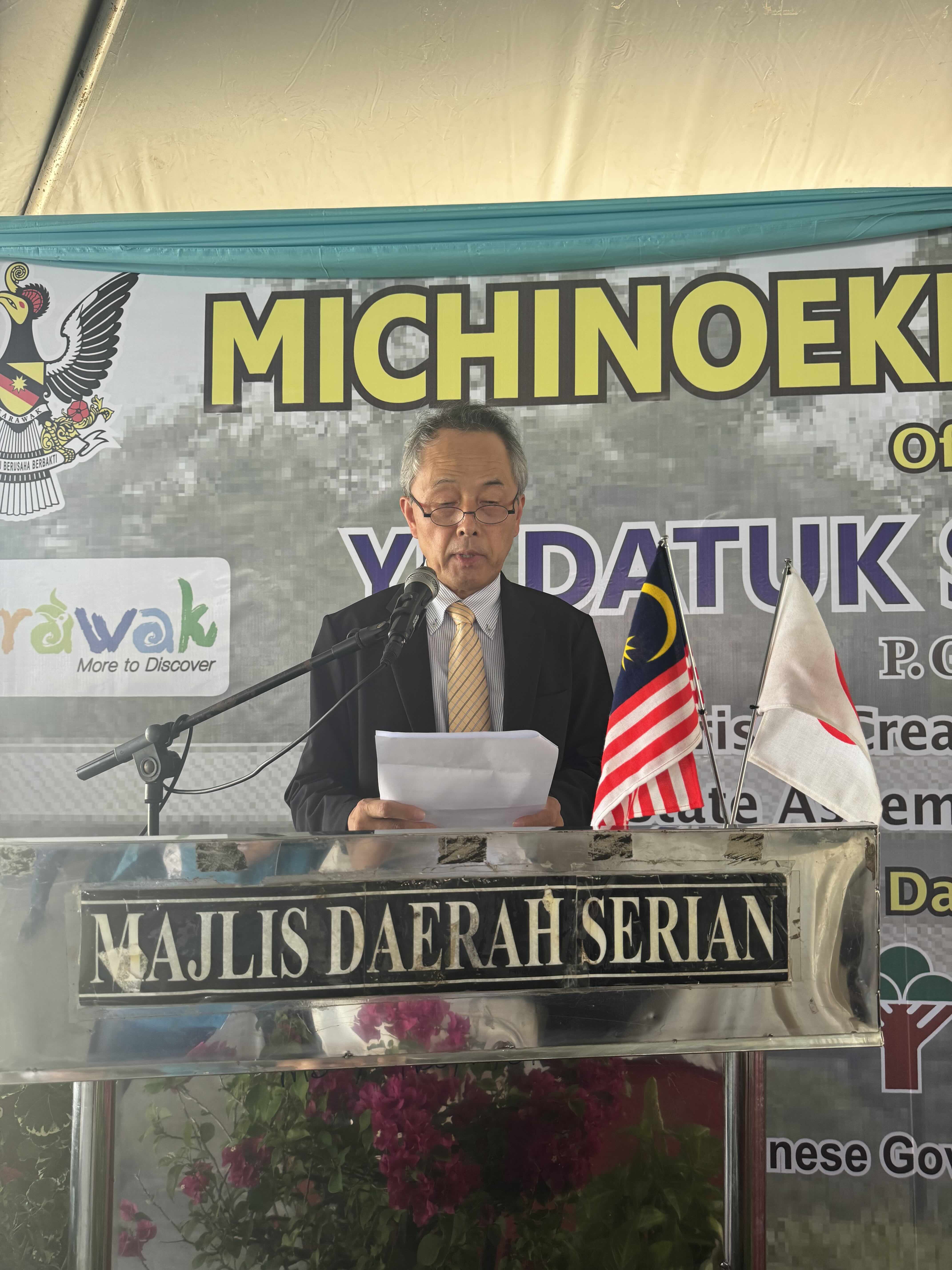
Mr. Yamashita, Head of the Consular Office of Japan in Kota Kinabalu
Finally, the guest of honor, Sarawak State Assemblyman Snowdan, delivered his speech. After speaking in Malay, he kindly explained the content in English as well, expressing gratitude for our Association’s tree-planting activities.
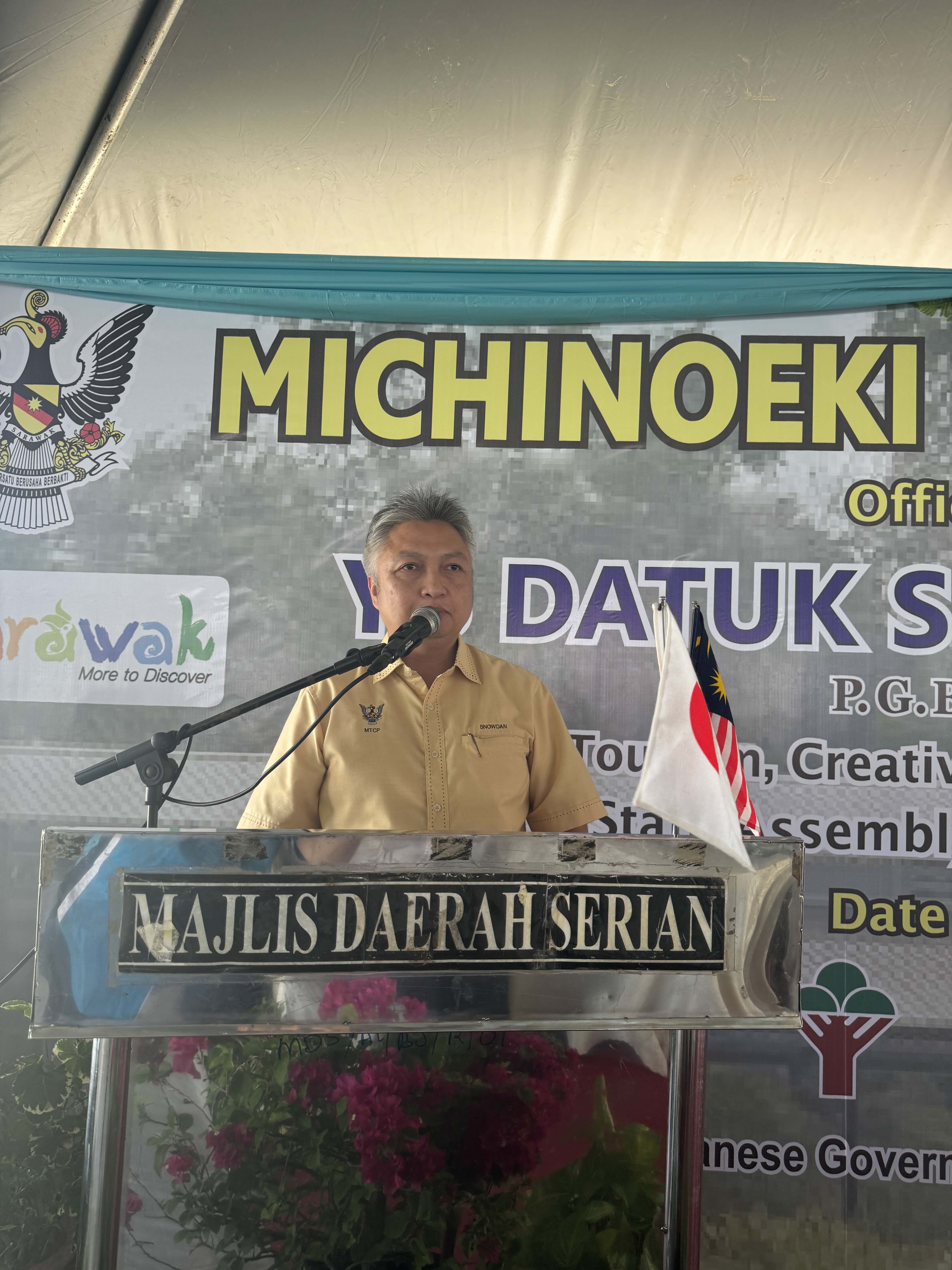
Sarawak State Assemblyman Snowdan
Following all the speeches, gifts were presented, and State Assemblyman Snowdan, the guest of honor, signed the memorial plaque of the Michi-no-Eki.
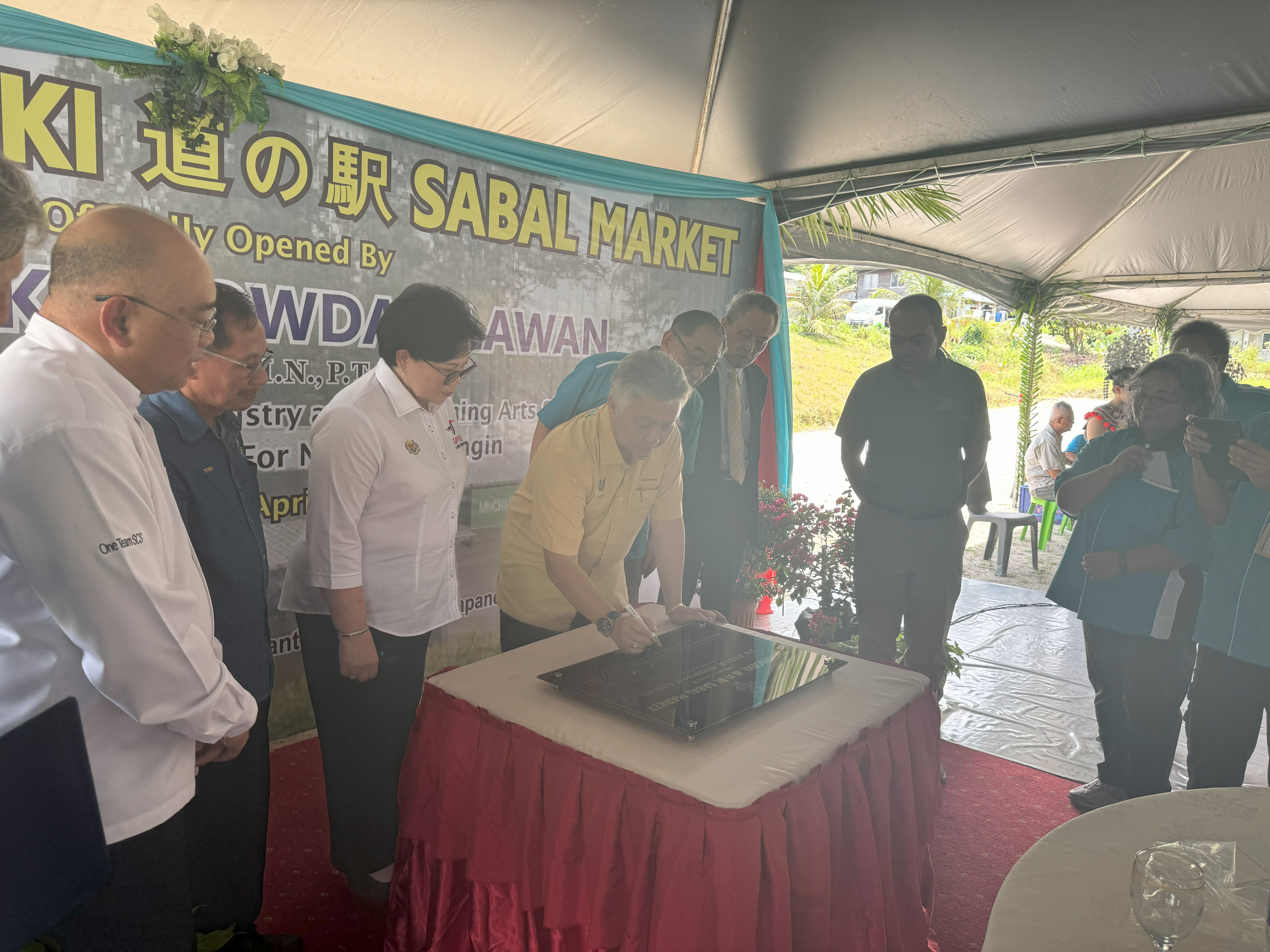
Signing the memorial plaque
As JMA’s President Keiji Furuya and Vice President Haruko Arimura were unable to attend this opening ceremony, signed personal letters entrusted by both were handed over by Chairman Ogawa to State Assemblyman Snowdan (center) and Federal MP Doris (left).
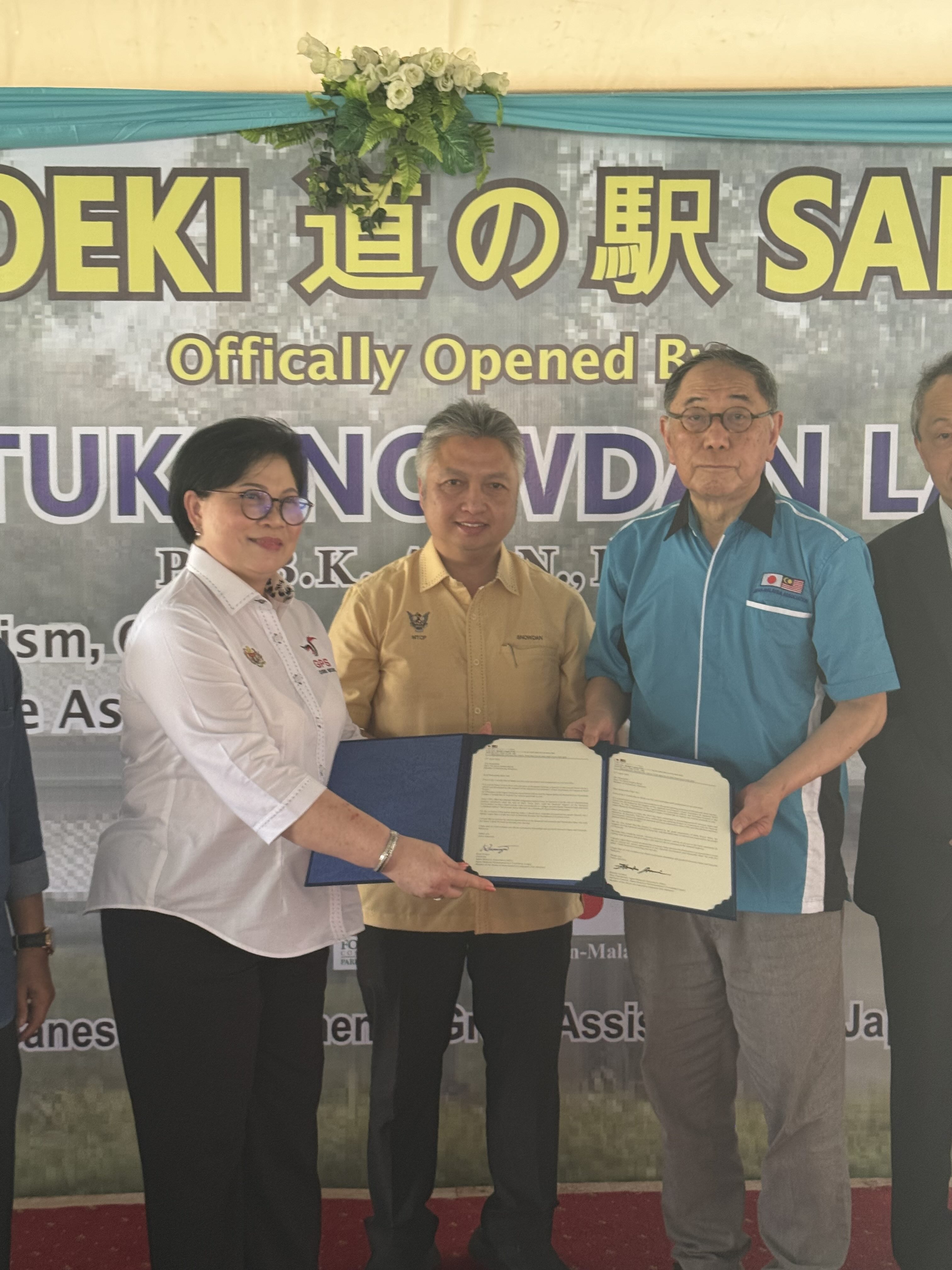
Presentation of personal letters
Afterward, a ribbon-cutting ceremony for the Michi-no-Eki was held, and State Assemblyman Snowdan and Federal MP Doris toured the local product sales area and the public restrooms. Amid the lively atmosphere of the ceremony, the two actively interacted with the villagers.
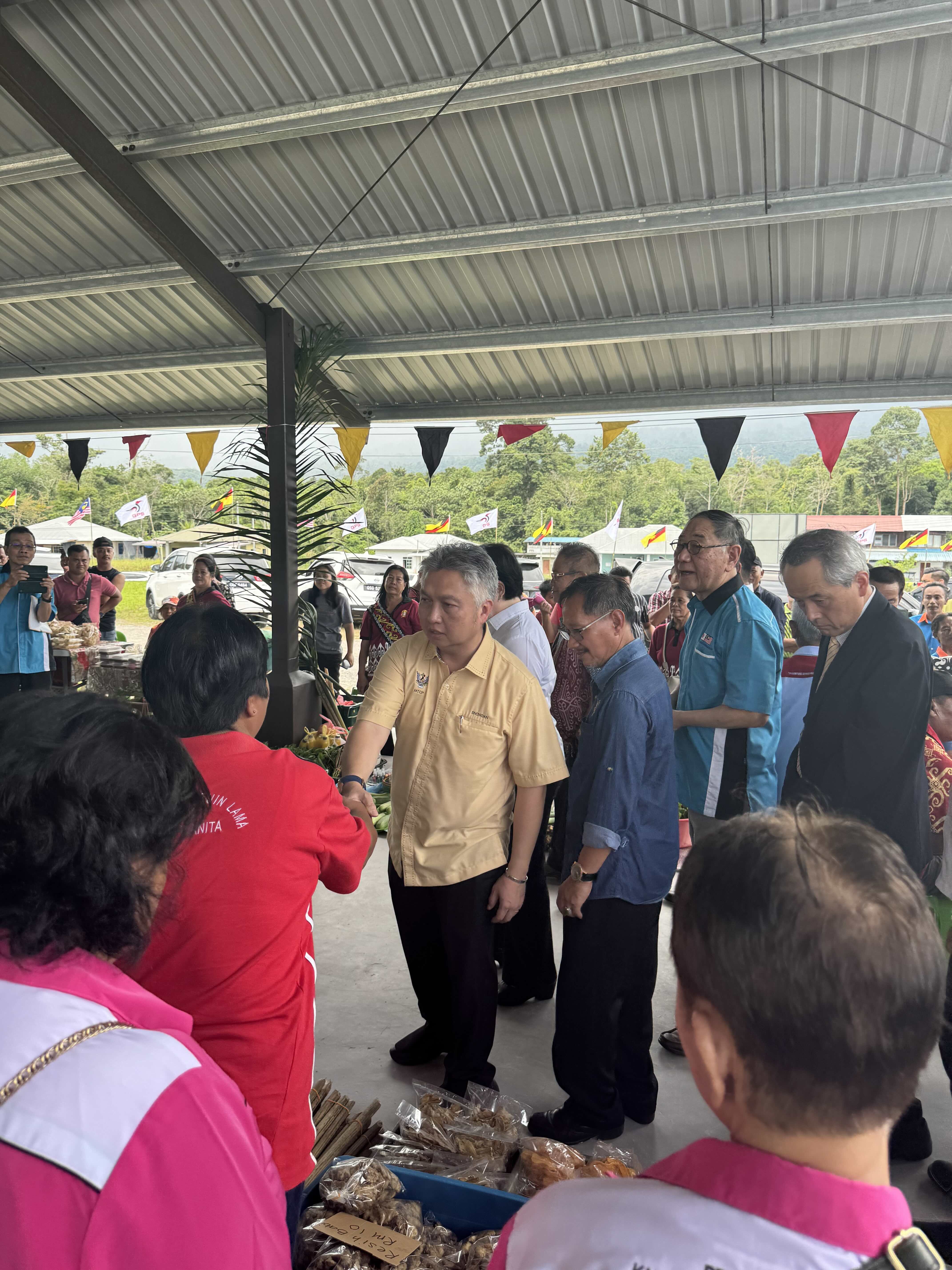
Inspection of the Michi-no-Eki and interaction with the villagers
Finally, everyone gathered around tables to share a meal. All relevant parties were able to interact, and the ceremony came to a successful close. Through this opening ceremony, we shared the achievements of the N-Ren project with both the state and federal governments, and we hope it may serve as a model for other regional village-living-improvement programs run by the government. From preparation through to the day itself, this opening ceremony was made possible through the tremendous efforts of JMA’s In-Sarawak Coordinators Kazue Sakai, Aisha, and their team. We would like to take this opportunity to express our heartfelt thanks.