
Japan Foundation Volunteer Center “Orangutan Forest Regeneration Project” — Field Report: 5th and 6th Cohorts
※ This article originally appeared in the Japan Malaysia Association’s membership journal Malaysia, Vol. 57 (published May 25, 2025), and the article was written in Japanese and can be found here.
The 5th and 6th cohorts at the planting site, Sarawak
The Japan Malaysia Association (JMA) has been partnering with the Nippon Foundation Volunteer Center (hereafter “Nippon Foundation VolCenter”) since 2024 to send university students from across Japan to Sarawak, Malaysia, where they work alongside indigenous villagers to plant trees as part of the “Orangutan Forest Regeneration Project.” The project sends approximately fifteen student volunteers four times a year over ten years, with a goal of planting 100,000 trees. Student recruitment is handled through “Bokatsu!” (https://vokatsu.jp/), Japan’s largest volunteer platform, operated by the Nippon Foundation VolCenter, which also manages all student selection. The 5th cohort took place from February 10 to 21, 2025, and the 6th cohort from March 10 to 21 of the same year. As with the first through fourth cohorts, JMA’s Deputy Director Yuma Kosuga accompanied the group. The following is his report.
Introduction
This is Kosuga from the Japan Malaysia Association. I accompanied the 5th and 6th cohorts of the “Orangutan Forest Regeneration Project,” run in collaboration with the Nippon Foundation VolCenter. Once again, we incorporated new activities this time — including a visit to an oil palm plantation and a “wilding” exercise — while also carrying out rainforest restoration work alongside local university students from Universiti Malaysia Sarawak (UNIMAS) and Swinburne University of Technology Sarawak Campus, giving us rich opportunities for international exchange.
The first through fourth cohorts used a method called “line planting,” but for the 5th and 6th cohorts we switched to a different approach known as “dense planting” (the Miyawaki Method). This report covers both the new activities and the planting methods used in our rainforest restoration work.
Line Planting vs. Dense Planting
Line planting — also called “line planting” on site — is the method recommended to us from the outset by the Sarawak Forestry Department, the government body responsible for managing forest zones in Sarawak. When we began our rainforest restoration activities, the Department encouraged us to use this approach for replanting native Dipterocarpaceae species into secondary forests that had been cleared of native trees. As the name suggests, the method involves marking out rows at regular intervals and planting along those lines. Because the trees are spaced out systematically, it allows for careful cultivation of species whose numbers have declined through logging or competition — even when the number of seedlings is limited.
Dense planting, by contrast, packs trees closely together — hence the name. It is also known as the “Miyawaki Method,” after the late ecologist Dr. Akira Miyawaki, Professor Emeritus at Yokohama National University, who passed away in 2021. His approach involves “mixing multiple native species and planting them densely, recreating the kind of survival competition that occurs naturally.” The major advantage is speed of growth: by replicating natural competitive conditions, trees reportedly grow several times faster than they otherwise would. Dense roots also form more readily, making the method especially effective when vegetation needs to be restored quickly on degraded bare land, or in waterlogged soils near riverbanks where firm root anchorage is crucial. The planting sites for the 5th and 6th cohorts were around a small dam built as part of a water improvement initiative. Clearing a corridor for the heavy machinery used in dam construction had temporarily opened up the area to sunlight, which threatened the shade-dependent native species in the surrounding forest. To restore shade quickly and protect those species, we decided to try dense planting for this site.
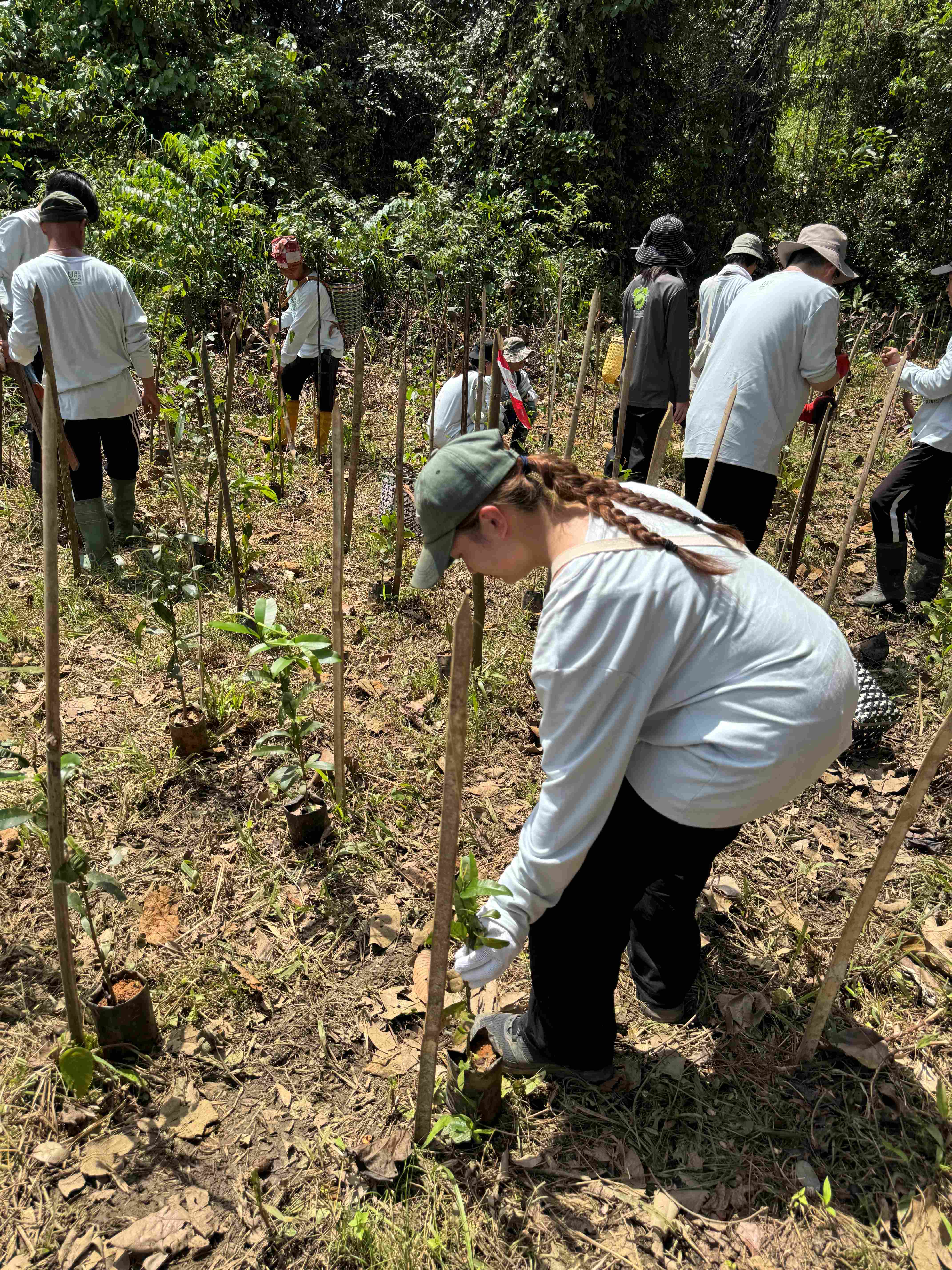
Preparing for dense planting
Looking at the two methods side by side, dense planting may seem to have more advantages — but because you are planting several times more trees per unit area, you also need far more seedlings, which drives up logistics and overall costs. And since the method works by creating natural competition, some trees will inevitably thrive while others do not — making it less suitable when the goal is to reliably restore a specific species. It is worth noting that the approach used on this occasion was not strict dense planting in the purest sense; it might be more accurate to call it a hybrid between dense and line planting.
Visiting an Oil Palm Plantation
Apen National Park — the site of our tree-planting work under the Orangutan Forest Regeneration Project — sits directly adjacent to a large private oil palm plantation. Clearing land for oil palm farming is frequently cited as one of the drivers of tropical deforestation, yet palm oil derived from the oil palm is one of Malaysia’s most important industries and an indispensable import for Japan as well. Around Apen National Park, “environment” and “industry” are clearly demarcated, each keeping to its own territory — a rare zone where the two genuinely coexist.
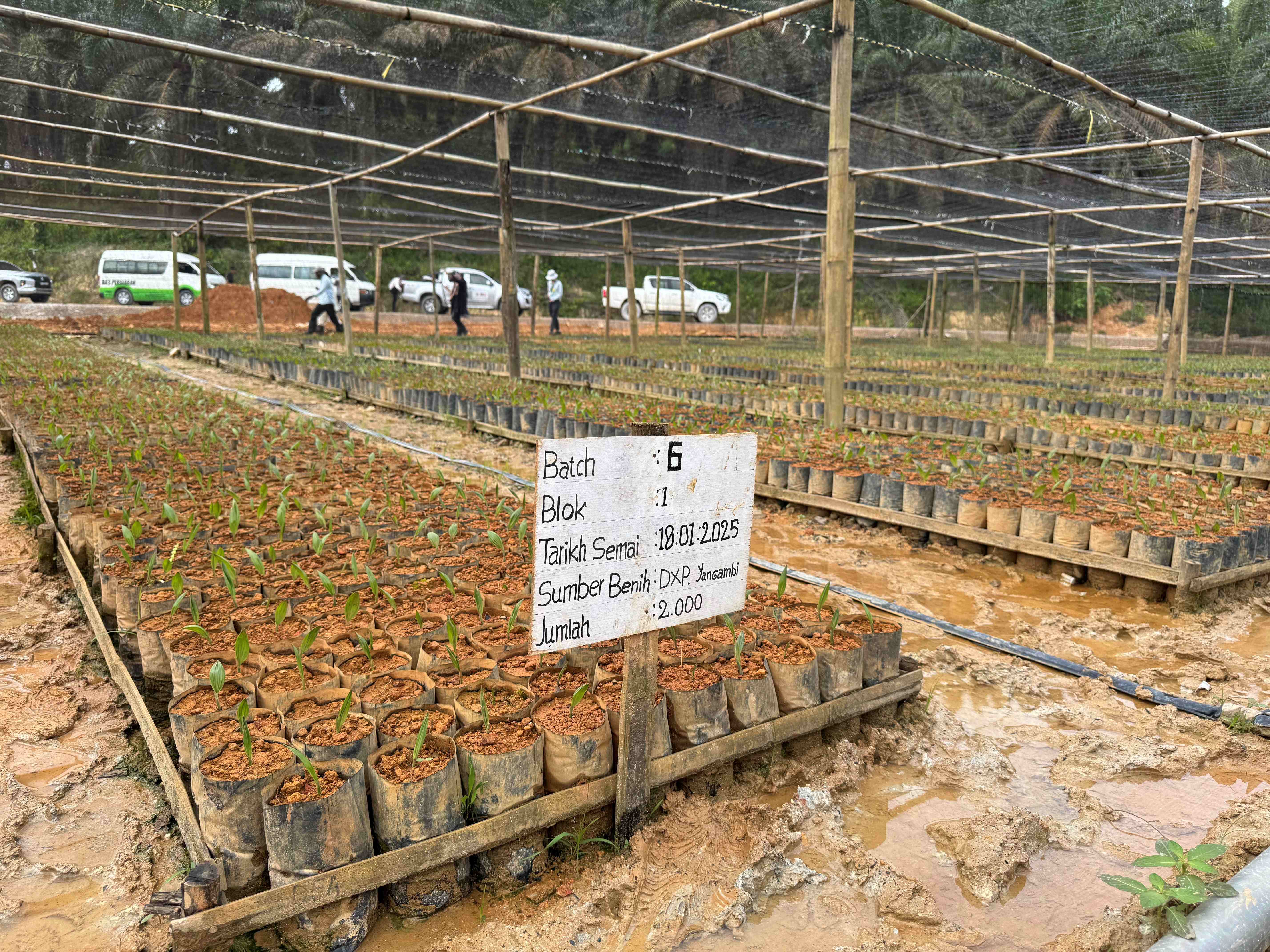
Oil palm seedlings
During the 5th cohort, the plantation manager generously gave us special permission to visit. Students were able to see firsthand what oil palm cultivation looks like and how a plantation of this scale operates as one of the country’s major industries — giving them an opportunity to consider, with their own eyes and on their own skin, the relationship between this industry and rainforest restoration, understanding both its role as a driver of deforestation and its importance to Malaysia and Japan alike. It is unusual for a private company operating an oil palm plantation to open its doors to outside groups; the fact that a company runnin