
Improving Livelihoods through Village Water Supply System Development and Building Networks among Relevant Organizations
The original of this article was written in Japanese and can be found here.
The Ministry of Foreign Affairs of Japan (MOFA) recognizes that international cooperation by Japanese NGOs provides grassroots-level support closely attuned to the needs of communities in developing countries. Under this framework, MOFA offers the “Japan NGO Co-financing Grant Aid” program, which provides Official Development Assistance (ODA) funding to Japanese international cooperation NGOs for economic and social development projects that they independently plan and implement in developing countries, in line with Japan’s country-level development cooperation policies. Since the end of March of this year, the Japan Malaysia Association (JMA) has been implementing a project under the FY2024 Japan NGO Co-financing Grant Aid program: the “Project to Improve Livelihoods through Village Water Supply System Development and Build Networks among Relevant Organizations in Indigenous Communities of Sarawak State.” The project is being carried out in areas surrounding Sabal National Park, in the Balai Ringin Sub-District of Serian Division, Sarawak.
Project Overview
In indigenous communities around Sabal National Park in Sarawak, the project aims to improve living conditions for indigenous villagers whose daily lives are strained by a fragile water environment. This will be achieved through the development of a “village water supply system” to improve water access, tree planting to protect water source areas, livelihood improvement programs that make use of the time freed up by better water access, community-led water management, and — in cooperation with relevant agencies — agricultural improvement and environmental hygiene education programs.
Project Site and Background
The Balai Ringin Sub-District, where the project is located, covers an area of 1,314 km² (roughly twice the size of Tokyo’s 23 wards), with a population of 15,165 people spread across 221 settlements, a population density of 12 people per km², a poverty rate of 19.9%, and water access figures of 23.1% from piped water and 76.9% from other sources (including village water systems). The areas farthest from town — those surrounding Sabal National Park — have no piped water and the highest rates of poverty (source: Sarawak State Statistics 2020). The communities around Sabal National Park (population approximately 3,000) are located roughly two hours by car from the state capital Kuching, near the Indonesian border, and consist of small Iban indigenous villages scattered across the landscape.
Sabal National Park sits within a protected forest reserve that the state government designated as a forest regeneration area on land previously logged and now covered by secondary growth. It was elevated to national park status in 2018. Since 2011, JMA has been working in collaboration with the Sarawak Forest Department, the Sarawak Forestry Corporation, Universiti Malaysia Sarawak (UNIMAS), and local communities to carry out tropical rainforest restoration through the planting of native species — including dipterocarps and indigenous fruit trees — in this forest reserve. During that time, chronic water shortages in the villages have been pressing on daily life, and residents have repeatedly called for improvements to their water environment, making this a key challenge that the project seeks to address.
Project Goals
· Water access in indigenous communities will be improved through the development of village water supply systems, giving residents reliable access to sufficient water for daily life.
· Freed from the burden of purchasing drinking water and spending time washing at nearby rivers, residents will have more capacity to improve their livelihoods — including through agricultural improvement programs.
· Community organizations will be established to manage and maintain the village water supply systems, enabling sustainable, self-directed operation.
· A collaborative network will be built among state government agencies, district offices, national universities, local NGOs, and village organizations, creating a framework for sharing project results and expanding them to other communities. Working with local NGOs, environmental and hygiene education programs will also be conducted at primary schools serving the target communities, deepening children’s awareness of forest conservation and sanitation so that the project’s gains can take root in the next generation.
Project Activities
The project is implementing the following activities in the target communities:
Target communities: Sungai Kela Village (an Iban indigenous village, population approximately 280; hereafter “Kela Village”) and Sabal Jaya Village (an Iban indigenous village, population approximately 120; hereafter “Jaya Village”) — a combined population of approximately 400.
1. Village Water Supply System Development
After briefing Sarawak state government agencies (Public Works Department, Forest Department, Sarawak Forestry Corporation, etc.) and explaining the overall plan to the target villages, the project team will conduct site surveys with contractors and specialists, draw up a water supply system development plan, obtain consent from the village organizations, and begin work.
Work includes developing an access road to the water source (1.2 km), constructing a weir (one location), replacing and laying deteriorated sections of the water intake pipe from the source to the village (0.5 km), and replacing connector fittings along the entire pipeline — all to improve the water environment.
Following construction, a self-managed water system organization will be established in the target villages, and a water source management workshop will be held.
To protect the water source, local NGO experts will guide the planting of 3,000 native saplings (including dipterocarp species) around the water source area and along the access road, followed by ongoing maintenance.
2. Village Survey and Agricultural Improvement Program
Interviews will be conducted to assess changes in water conditions and available time before and after the water supply system is installed, and the findings will be used to develop an agricultural and livelihood improvement program.
The program will then be discussed with the target villages and, upon agreement, implementation will begin.
3. Environmental and Hygiene Education Program: At two primary schools serving children from the target communities, an environmental education program will be held to explain the importance of village water supply systems and water source protection. The program will also include health and hygiene training covering handwashing, gargling, tooth brushing, and other basic practices.
Conditions in the Project Area
All activities are being carried out in accordance with Malaysia’s government Standard Operating Procedures (SOPs) established in the wake of the COVID-19 pandemic. The following is a progress report for the period from April through July of this year.
Recent Activities
● Village Water Supply System Development
In early April, the project team briefed Sarawak state government agencies — including the Public Works Department, Forest Department, Sarawak Forestry Corporation, Water Department, and Department of Mineral and Geoscience — as well as the district office on the planned project activities.
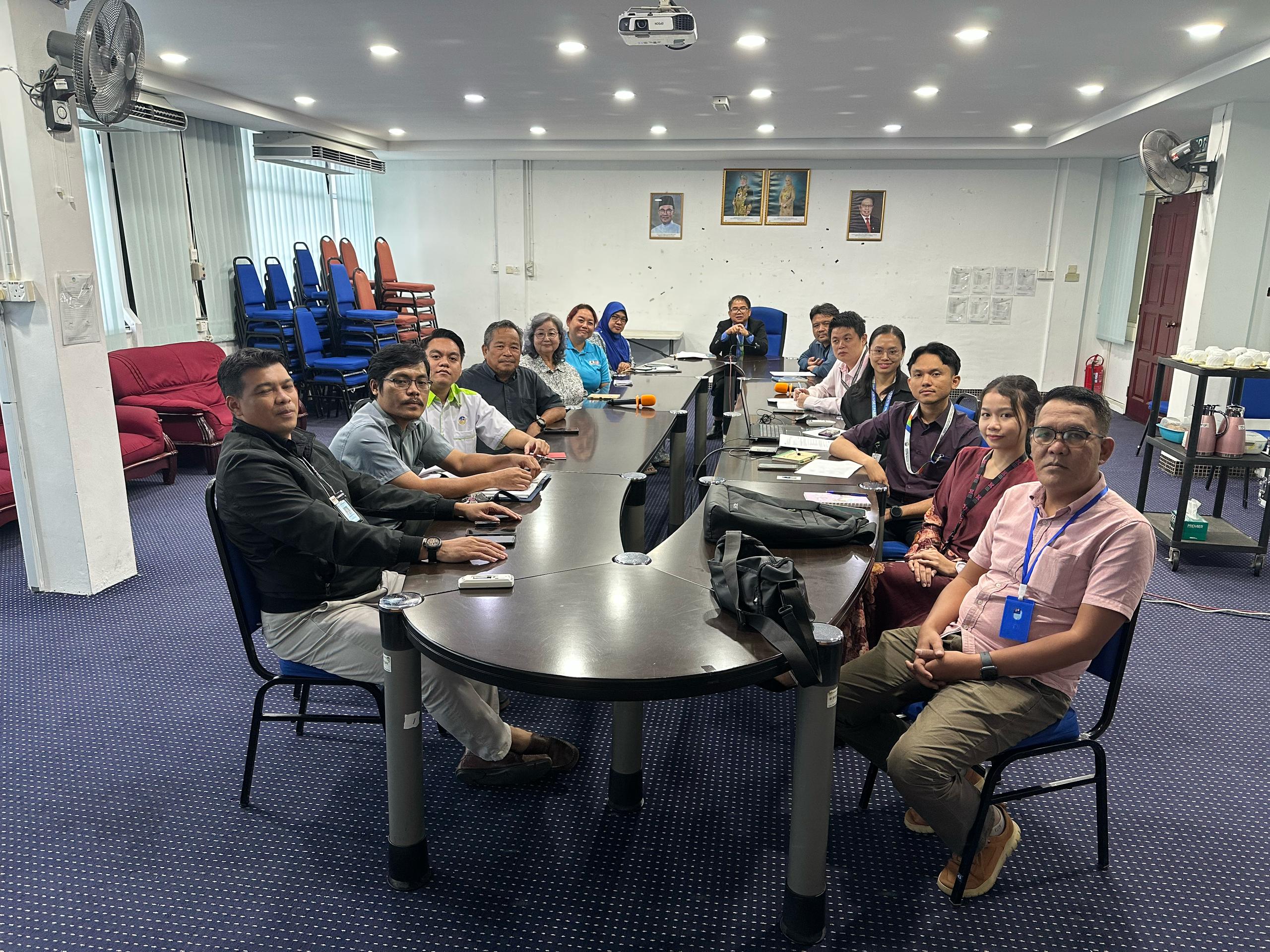
At the Department of Mineral and Geoscience
On Saturday, April 23, specialists, contractors, and village committee members conducted an on-site survey to assess the current condition of the water supply system.
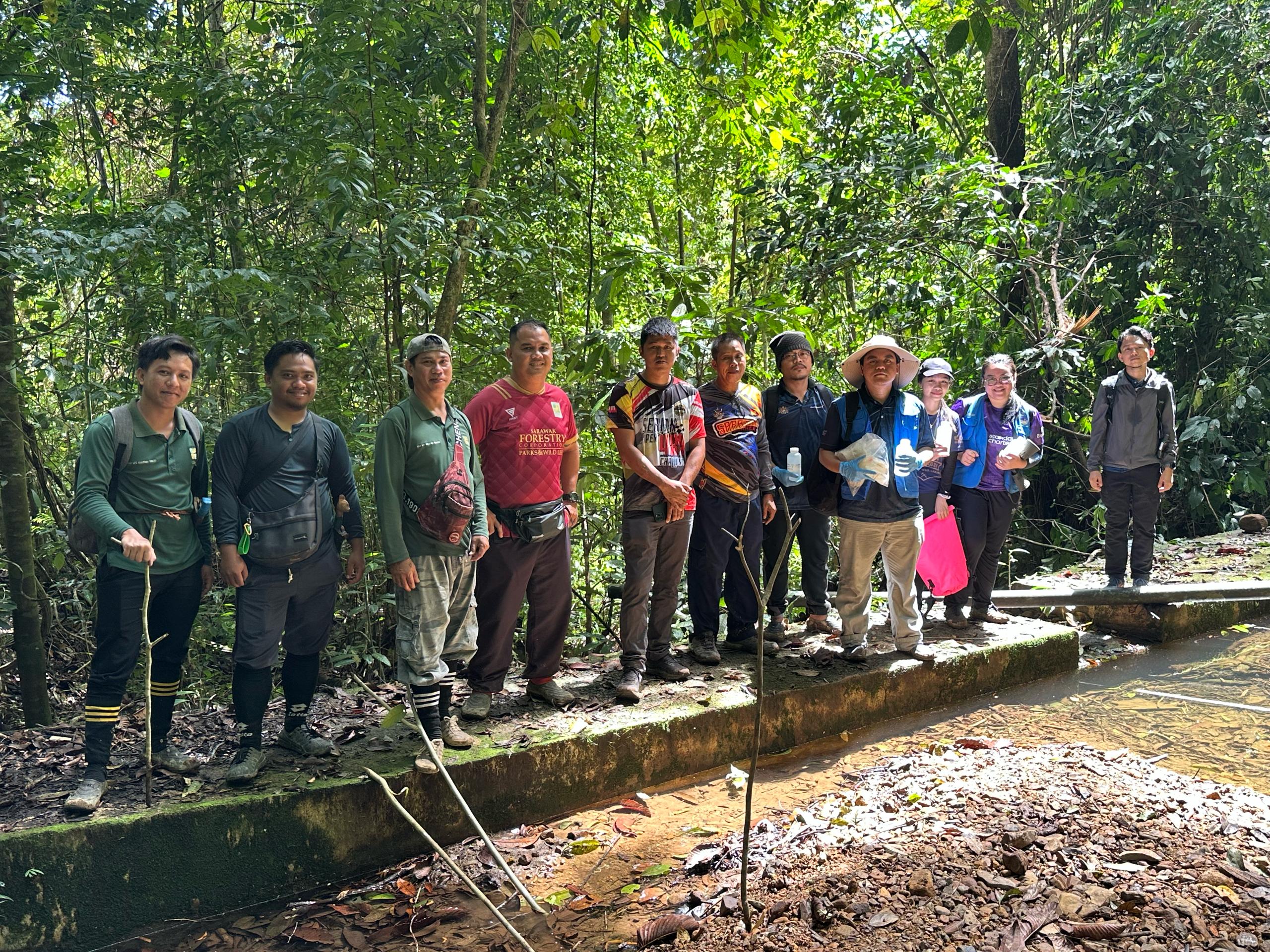
Inspecting conditions at the water source
The team assessed the condition of the access road route to the water source, located deteriorated sections of the existing intake pipe from the water source, and evaluated the site where the weir would be constructed. A joint inspection of water delivery conditions at households in the target villages was also carried out with all relevant parties.
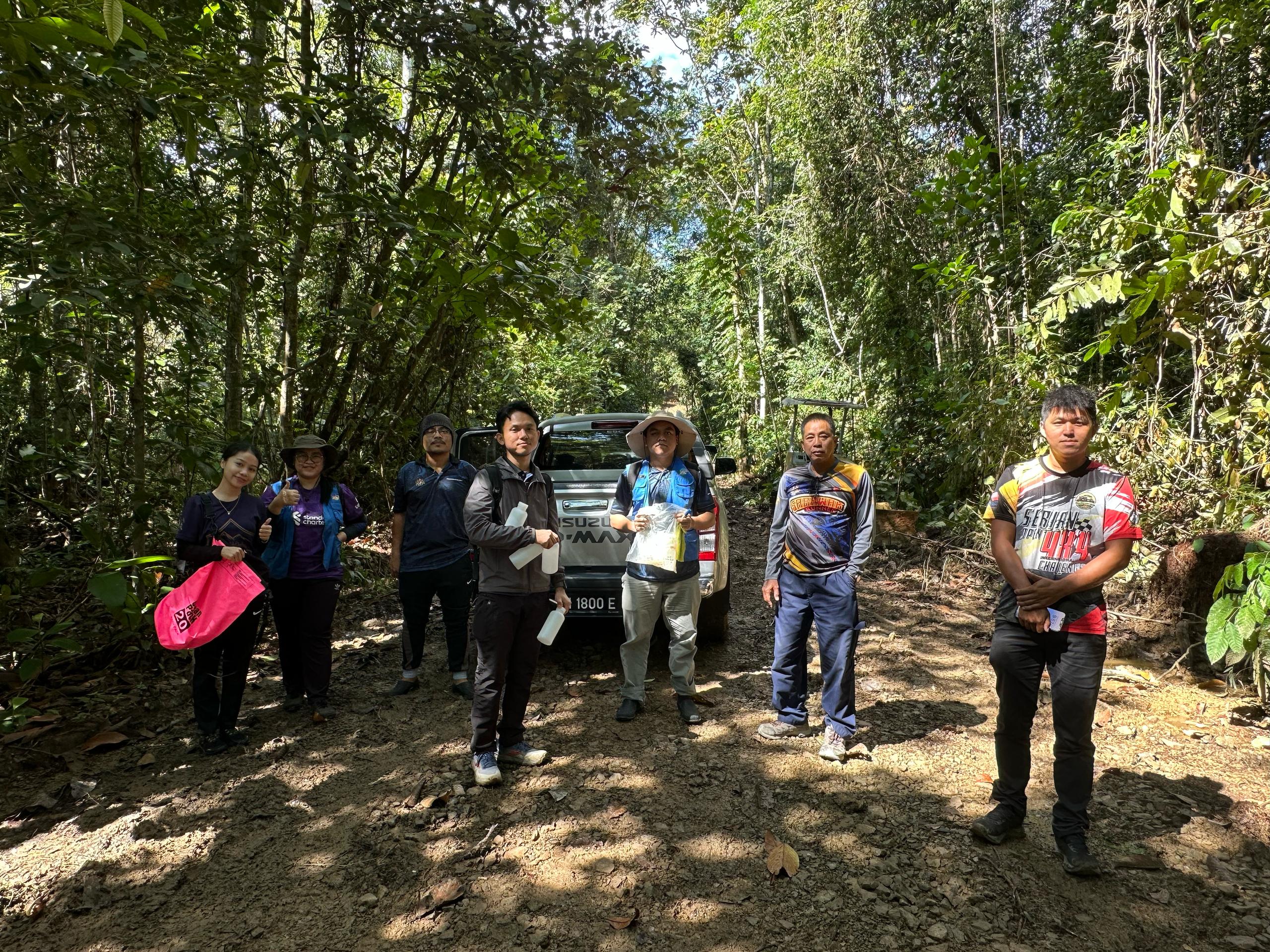
At the planned access road construction site
Water quality testing was also conducted at the target villages during the same visit. Results confirmed that the water source water is suitable for drinking when boiled. A follow-up survey will be conducted after the water supply system is installed to track changes in suspended matter and other indicators.
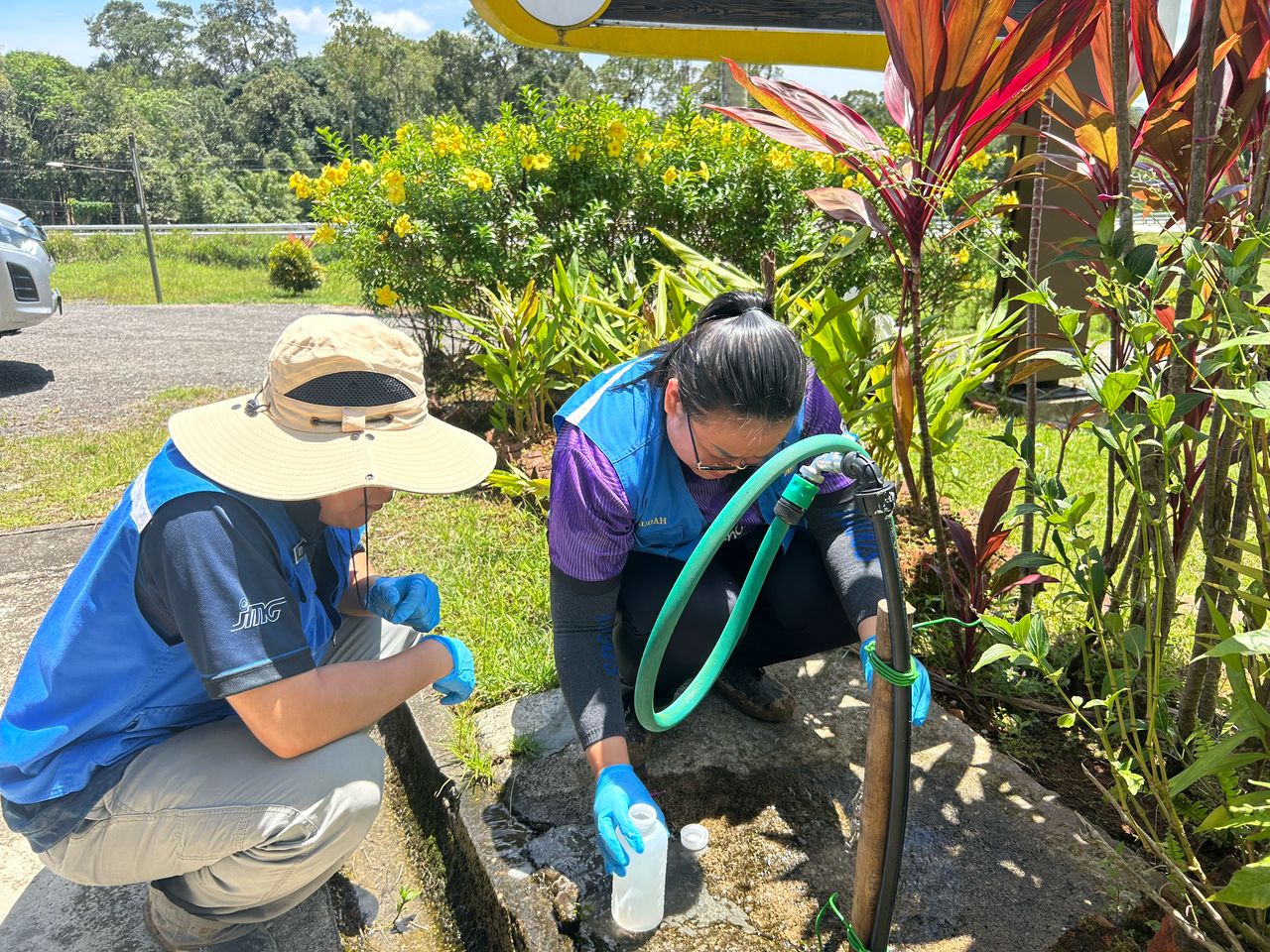
Checking water delivery conditions and collecting water samples
Following the survey, the team drew up a water supply system development plan together with the contractor and specialists. After review and approval by the village development committee, construction work on the village water supply system commenced.
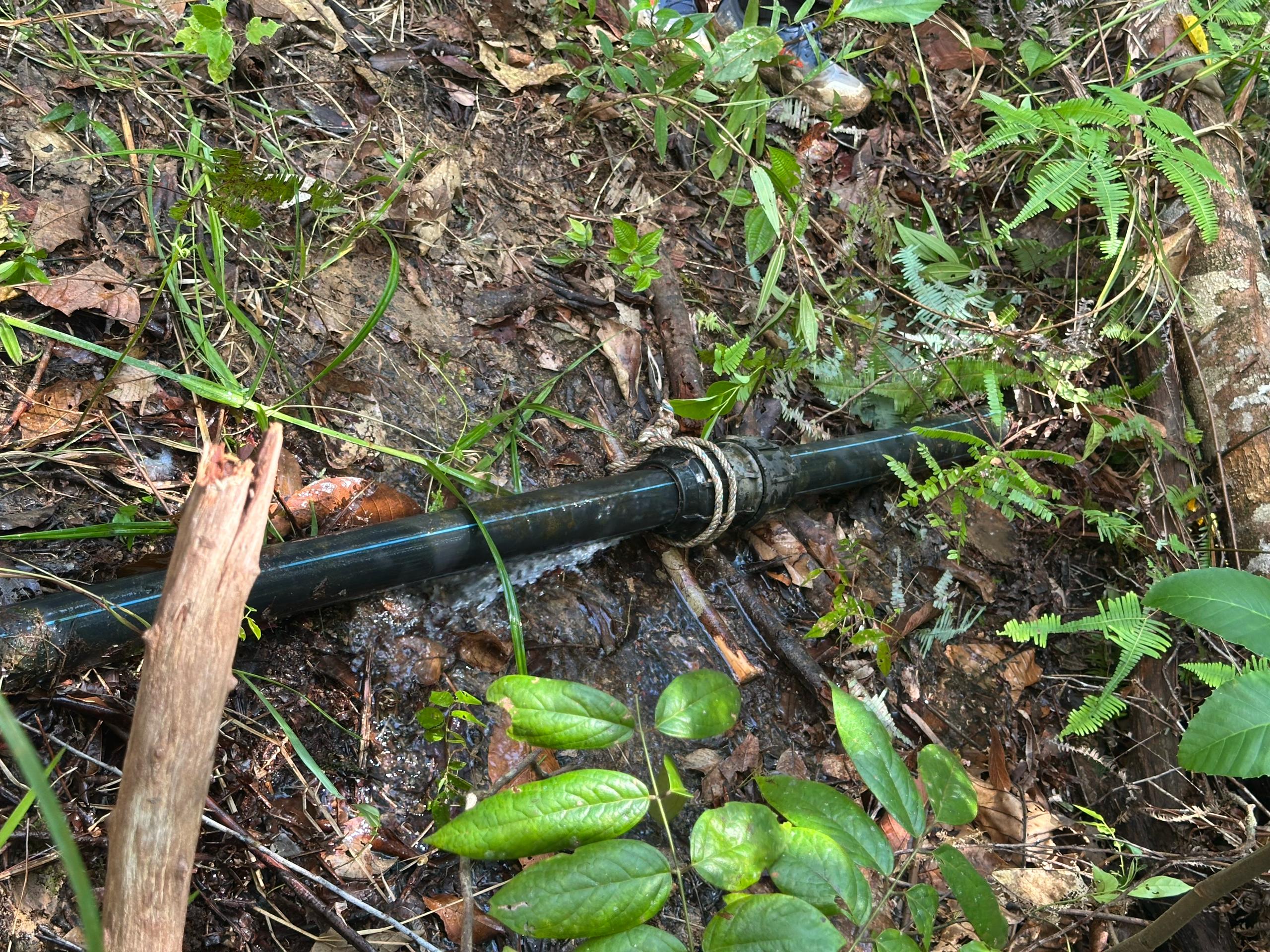
Water leaking from a deteriorated pipe joint
From early May, work began on improving the access road (1.2 km) along an old logging track, to enable the transport of weir construction materials to the water source inside Sabal National Park.
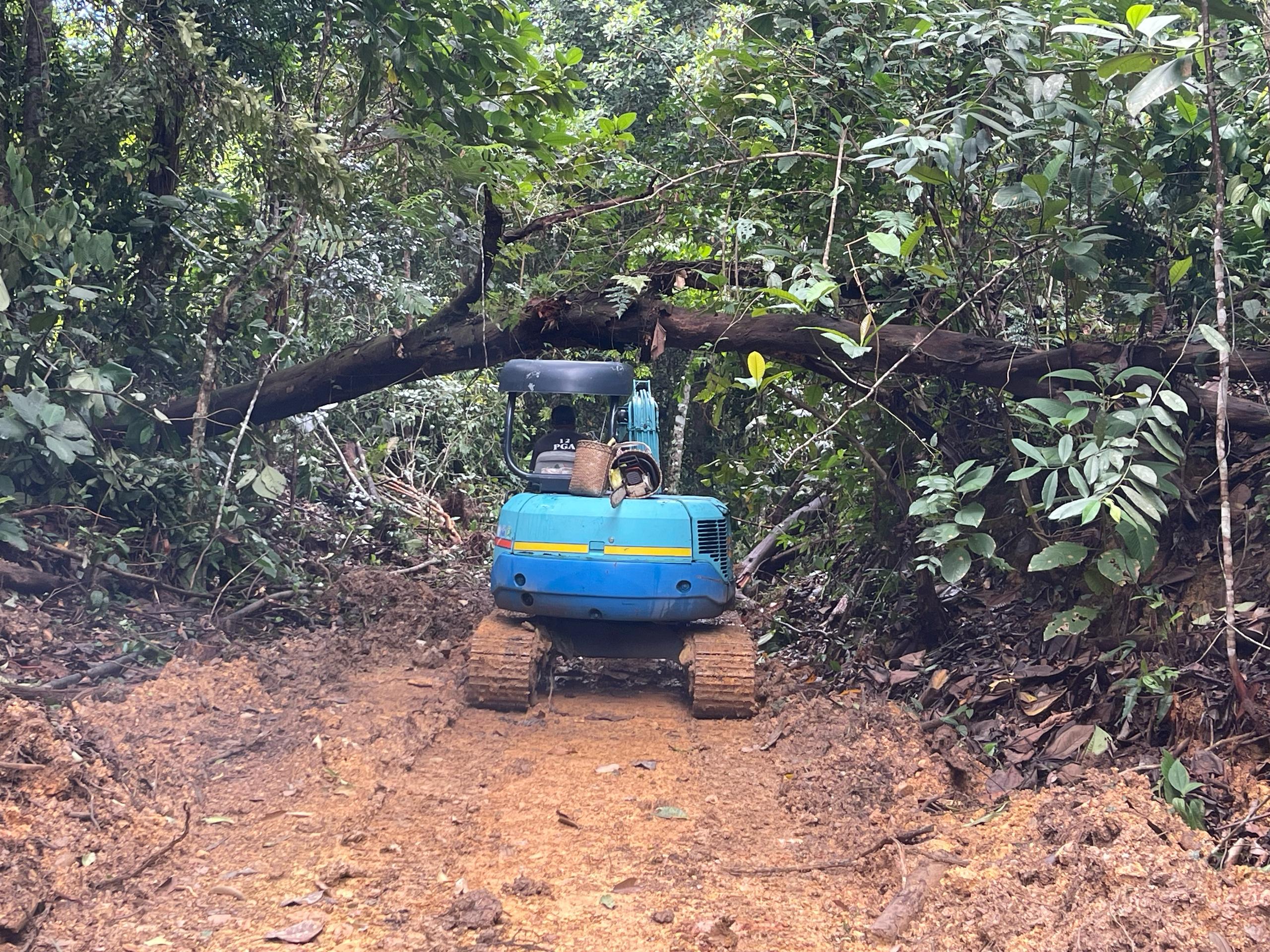
Access road construction work
Following guidance from the Sarawak Forestry Corporation, which administers the national park, the team worked with local specialists to minimize disturbance to the surrounding secondary forest and to proceed on the premise that the area would be returned to nature after the water supply system was completed. By mid-May, the newly prepared access road was being used to bring in materials for weir construction.
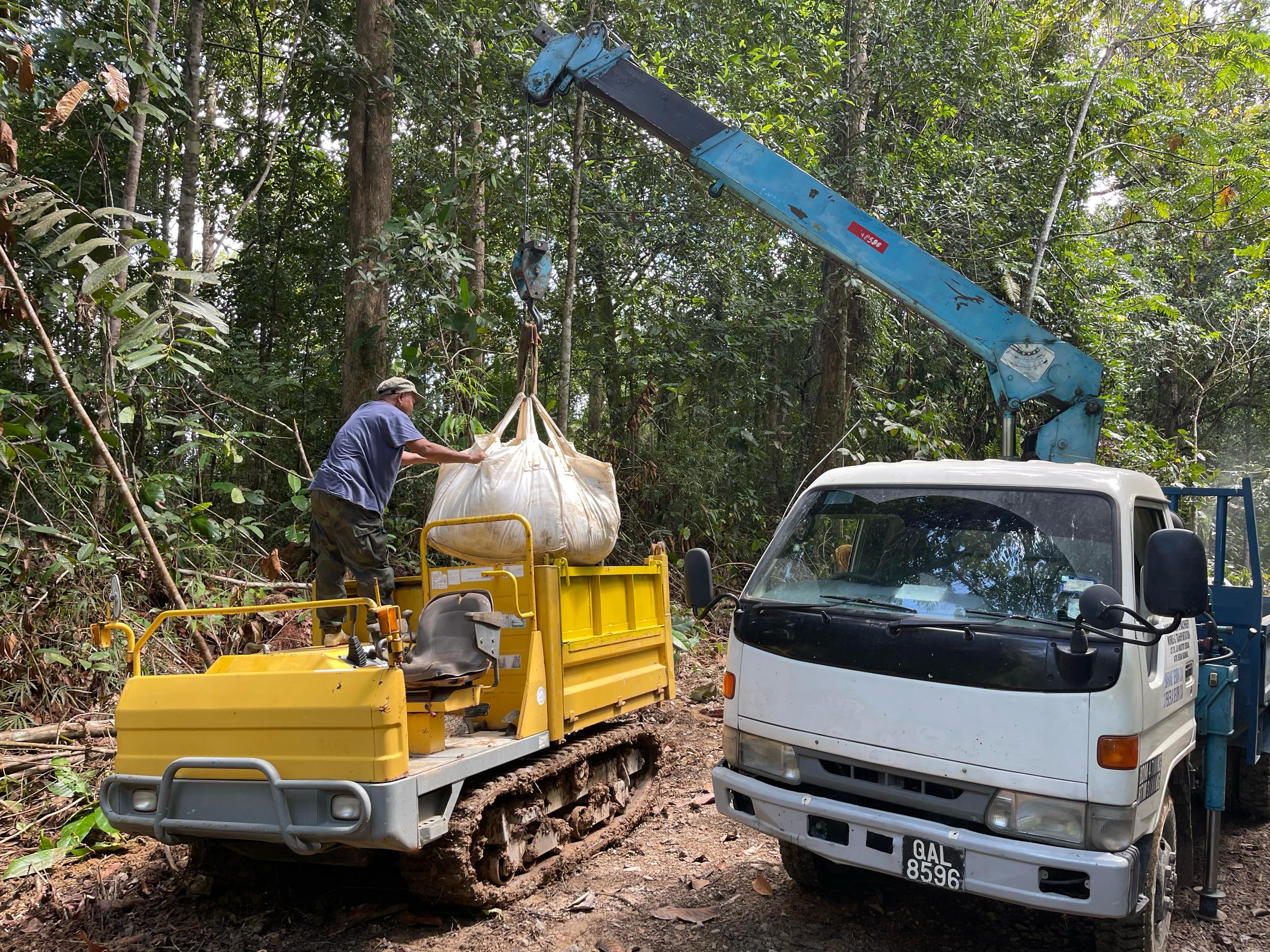
Transporting heavy machinery and materials
Materials and heavy machinery for weir construction were transported in during breaks between rain, and weir construction work at the water source began in early June. By mid-June, the foundation and rebar framework for the weir structure were being assembled.
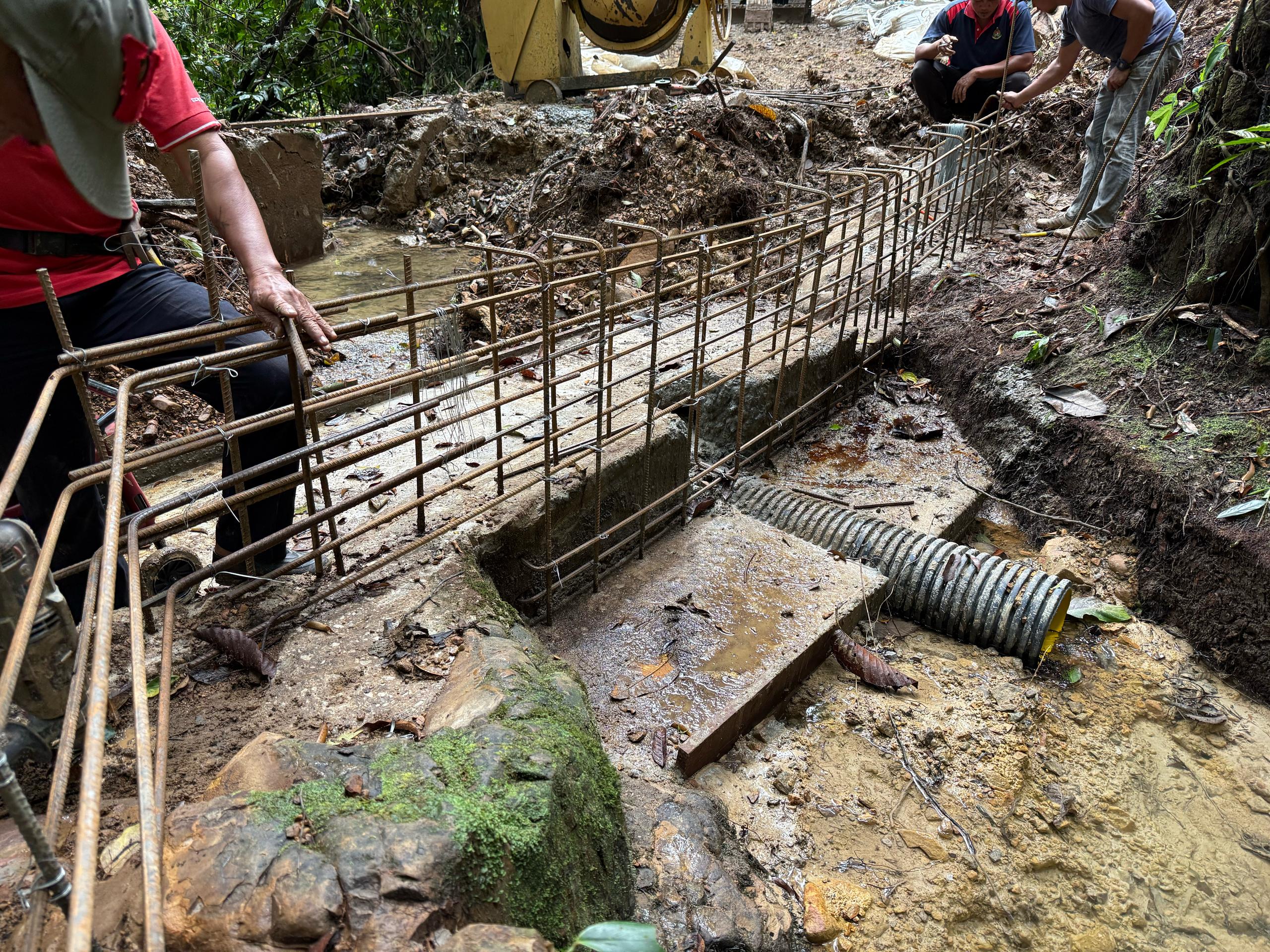
Rebar assembly work for the weir
Concrete was poured on fair-weather days, and the weir was completed in early July.
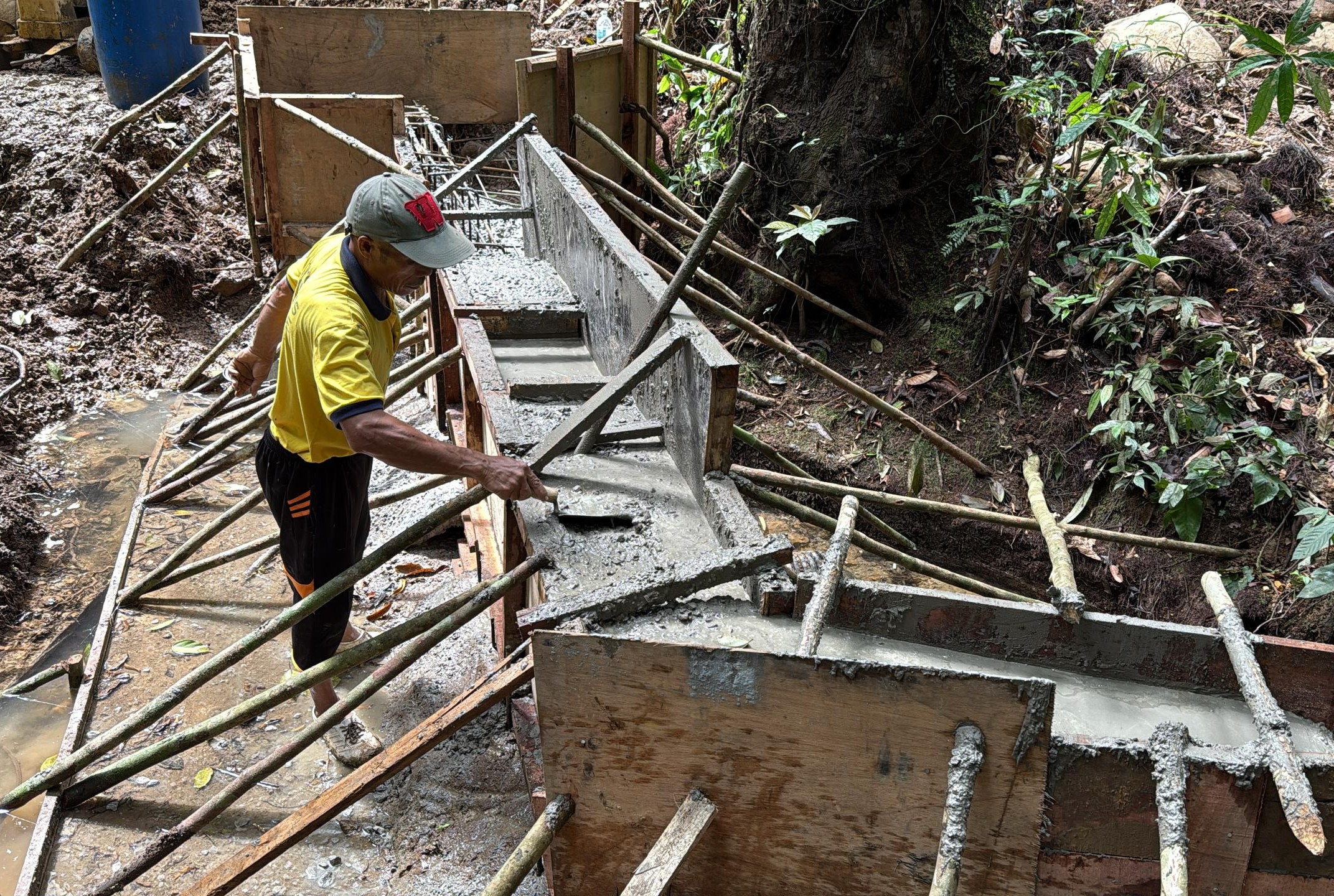
Concrete pouring
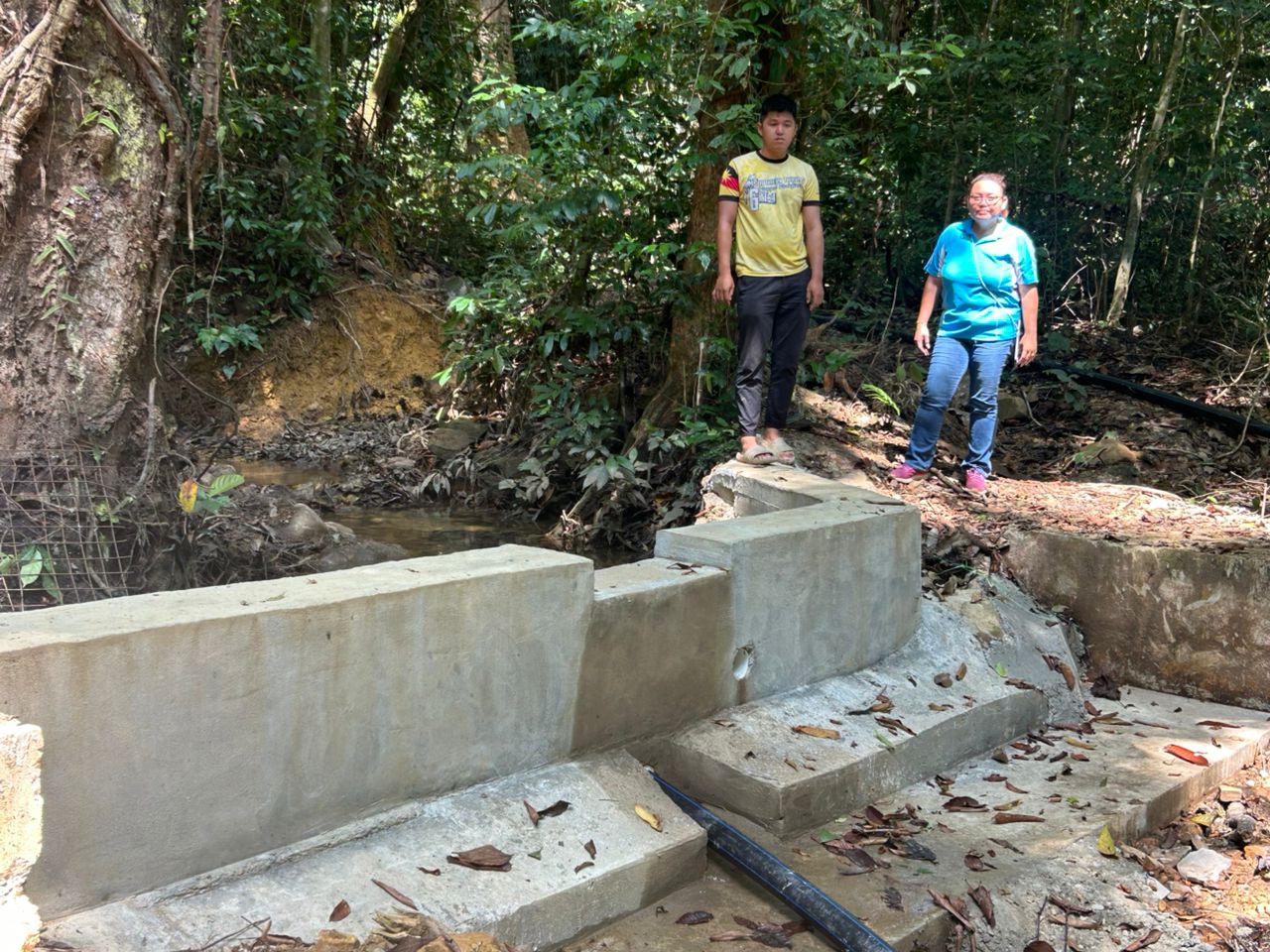
The completed weir
Following completion of the weir, work began in mid-July on replacing and relaying deteriorated sections (0.5 km) of the 1.2 km intake pipe running from the water source to the target villages. After that, the connector fittings along the full length of the pipe will be replaced to restore the overall function of the water supply system. Water delivery to all households in the target villages is scheduled to be completed by the end of September.
Upcoming Activities
● Formation of a Self-Managed Water System Organization
Once the village water supply system is fully operational, self-managed water system organizations will be established in both Kela Village and Jaya Village. These bodies will take charge of maintenance and repair, accumulating funds to cover necessary expenses and building a sustainable management structure.
● Tree Planting to Protect the Water Source
From the end of this year through January of next year, 3,000 native saplings — including dipterocarp species — will be planted around the water source area to protect its hydrological function.
● Post-Improvement Village Survey and Agricultural Improvement Program
After the water supply system is in place, specialists from relevant agencies and local NGOs will conduct a survey to assess changes in water conditions and available time in the target communities. Based on the findings, an agricultural improvement plan will be drawn up. With the villages’ agreement, the agricultural improvement program will then be launched.
● Environmental and Hygiene Education Program: Working with local NGOs, environmental and hygiene education programs will be conducted at two primary schools serving children from the target communities.