
Awarding the Order of the Rising Sun, Gold and Silver Star to Abang Johari, Premier of Sarawak
The original of this article was written in Japanese and can be found here.
The Japan Malaysia Association (JMA) has been conducting tropical rainforest reforestation activities in the state of Sarawak on the island of Borneo since 1995. This year marks the 30th anniversary of these efforts, and by next year, the total number of trees planted is expected to reach one million. In 2016 and 2018, two of JMA’s reforestation areas were elevated from protected forests to national parks. In 2019, we have signed a cooperation agreement with the Sarawak State Government, and since then are carrying out our work in collaboration with the Sarawak State Government and relevant agencies such as the Sarawak Forestry Department and the Sarawak Forestry Corporation.
Furthermore, since 2021, JMA has utilized the “Grant Assistance for Japanese NGO Projects”—an Official Development Assistance (ODA) fund provided by the Ministry of Foreign Affairs of Japan—to implement projects aimed at improving living conditions by developing water environments in indigenous residential areas of Sarawak.
Premier Abang Johari of Sarawak has provided deep understanding and cooperation for JMA’s reforestation activities over many years. In recognition of his contributions, Premier Johari was conferred the Order of the Rising Sun, Gold and Silver Star by His Majesty the Emperor of Japan on 11 November 2025.
In honor of this decoration, the JMA hosted a commemorative celebration party for Premier Johari on November 10, 2025, at the Imperial Hotel Tokyo (Ogi Room).
Attendees from the Malaysian side:
- Abang Johari, Premier of Sarawak
- Shahril Effendi bin Abd Ghany, Malaysian Ambassador to Japan
- Amar Mohamad Abu Bakar Marzuki, State Secretary of Sarawak
- Hamden bin Haji Mohammad, Director of Forests, Sarawak Forest Department
- Mr. Hapispina, Deputy Director of Forests
- Mr. Cheng, Spokesperson for the Office of the Premier of Sarawak
- The Premier’s son
- Mr. Hazam, Security of the Premier.
Attendees from the Japanese side:
- Keiji Furuya, President of JMA (Member of the House of Representatives)
- Haruko Arimura, Vice President of JMA (Member of the House of Councillors)
- Ichiro Miyashita, Secretary-General of the Japan-Malaysia Parliamentary Friendship League
- Shingo Miyamoto, Director-General, Southeast and Southwest Asian Affairs Department, Ministry of Foreign Affairs
- Representatives from the business sector including Tsuyoshi Nagano (Chairman of Tokio Marine Holdings / Japan-Malaysia Economic Association), Naoya Kinoshita (President of Kinoshita Group), Hiromi Tazaki (Chairperson & CEO of JAC Recruitment), and senior executives from Mitsubishi Corporation.
- Koichi Ogawa, Chairman of JMA, along with other board members and coordinators.
Introduction by Yuma Kosuga (JMA Deputy Director)
We are delighted that Premier Abang Johari has received the Order of the Rising Sun, Gold and Silver Star. As a long-time supporter of our activities, his decoration is a source of great pride for our association.
When Vice President Arimura visited the Premier in Sarawak in August 2024, they promised to meet again, and it was a moving moment to see them reunite in Japan for such a prestigious occasion. The Premier greeted her with a warm smile, saying, “Nice to see you again!”
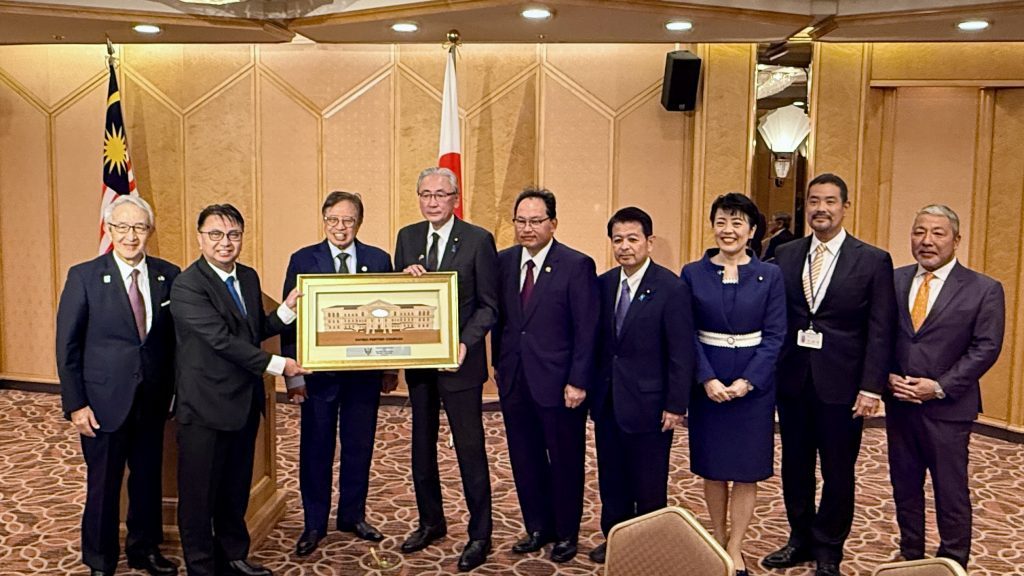
The celebration was attended by representatives of companies that have long supported our reforestation efforts, as well as officials from the Ministry of Foreign Affairs and the business community. Local media covered the event extensively, reporting it immediately on television and news sites in Malaysia.
About Sarawak
Sarawak is the largest state in Malaysia, accounting for about 40% of the nation’s landmass. As of 2023, its population stands at roughly 2.51 million, with 171 Japanese residents recorded as of January 2024.
The state’s economy is heavily driven by natural resources: Liquefied Natural Gas (LNG), crude oil, and palm oil make up 72% of its total exports. Japan is Sarawak’s top export destination, with trade reaching approximately MYR 20.7 billion (approx. JPY 760 billion). Notably, 91.5% of the LNG Japan imports from Malaysia is produced in Sarawak.
Historically, humans have inhabited the region now known as the State of Sarawak since ancient times, as evidenced by the discovery of human remains dating back some 40,000 years. In modern times, in the mid-19th century, the British adventurer and merchant James Brooke quelled a conflict between the indigenous peoples of the Sarawak region. As a result, he was appointed King of Sarawak (the ‘White King’) by the Sultan of Brunei, who ruled the region at the time, and the ‘Kingdom of Sarawak (1841–1946)’ was established, thus laying the foundations for what is now the State of Sarawak.
The area that is now the State of Sarawak has been inhabited by humans since antiquity, with archaeological evidence pointing to human presence dating back approximately 40,000 years. The modern history of Sarawak began in the mid-19th century when James Brooke, a British adventurer and merchant, intervened to resolve a conflict among the region’s indigenous people. Consequently, the Sultan of Brunei, the then-ruler of the territory, appointed Brooke as the White Rajah of Sarawak. This led to the establishment of the ‘Kingdom of Sarawak (1841–1946)’, which laid the foundational groundwork for the contemporary State of Sarawak.
The relationship between Japan and Sarawak began in the late 19th century when Shozo Yorioka (1865–1911) proposed managing rubber plantations to the Rajah of Sarawak. Yorioka obtained a lease, established the company Nissa Shokai, to build an integrated system for rubber cultivation and manufacturing. Nissa Shokai later focused on trade between Japan and the Kingdom of Sarawak. In 1929, Nissa Shokai proposed a visit by the Rajah and Ranee of Sarawak to Japan. This visit subsequently led to the settlement of rice-farming immigrants from Okinawa. Although these immigrants withdrew before the war due to difficult living conditions, this period marks the beginning of exchange between Japan and Sarawak.
Subsequently, the Kingdom of Sarawak ceased to exist following the Japanese occupation during the Second World War, and after the war it became a British Crown Colony. Subsequently, in 1963, Sarawak joined forces with the Federation of Malaya (the present-day Malaysian Peninsula, which had gained independence in 1957), North Borneo (Sabah) and Singapore (which seceded two years later) to form Malaysia, a union that continues to this day. However, in recent years, due to Sarawak’s growing influence in national politics, there has been a growing movement to restore the state’s unique rights, as stipulated in the agreement at the time of Malaysia’s formation, in negotiations with the federal government. From this political perspective, as well as from an economic standpoint given its natural resources, and considering its history of joining the Federation of Malaysia, Sarawak can be described as a state with a particularly strong degree of autonomy within Malaysia (e.g. negotiations with the federal government to increase the state’s share of oil royalties; the establishment of its own state-owned oil company, bank and university; and the change of the state leader’s title from ‘Chief Minister’—a term dating back to the colonial era—to ‘Premier’).
The Kingdom of Sarawak ended when the Japanese occupied it during World War II, and became a British Crown Colony after the war. Then, in 1963, Sarawak, along with the Federation of Malaya (now the Malaysian Peninsula, independent since 1957), North Borneo (Sabah), and Singapore (which left two years later), formed Malaysia, which exists today. However, Sarawak’s influence in national politics has recently grown. As a result, there is a push for the federal government to restore the state’s special rights, which were agreed upon when Malaysia was formed. Considering this political situation, its natural resources, and its history of joining the Federation of Malaysia, Sarawak has a notably high level of independence within Malaysia. Examples of this autonomy include negotiating with the federal government for a larger share of oil royalties, setting up its own state-owned oil company, bank, and university, and changing the state leader’s title from ‘Chief Minister’ (a colonial-era term) to ‘Premier’.
About the Premier Johari
Born on 6 August 1949 in Limbang, Sarawak, Premier Abang Johari hails from a distinguished Malay Muslim family in Sarawak. His great-grandfather was a regional ruler before the establishment of the Kingdom of Sarawak, and his father served as the first Head of State of Sarawak following the country’s independence. After completing his schooling in Sarawak, he began his career at Malaysia Airlines before pursuing an MBA from Brunel University in the UK.
He was first elected as a member of the State Legislative Assembly in 1981 from the Parti Pesaka Bumiputera Bersatu (PBB), the largest political party in Sarawak, and is currently serving his ninth term. After holding various key positions in the state, he became the leader of the PBB and the Chief Minister (Premier) in January 2017 following the passing of the then-Chief Minister Adenan. As a member of the State Legislative Assembly and as Premier, he is a politician focused on the development of the state. Furthermore, as the Chairman of the Gabungan Parti Sarawak (GPS), a coalition formed after the 2018 national elections, he leads not only the state assembly members but also the federal parliamentary group elected from the state. In the 2022 national election, the GPS won 23 seats (out of 31 allocated to the state), holding significant influence over the formation of the ruling coalition in national politics. While Premier Johari himself does not hold a position in the federal cabinet, the first-ever Deputy Prime Minister from Sarawak was appointed from the GPS. In national elections for the Federation of Malaysia, it is expected that no single political coalition will secure a majority for the time being, and the GPS is anticipated to remain a key player in the formation of ruling coalitions in future national elections. Premier Johari, who also represents the state-owned oil company PETROS, is an important figure even within the Malaysian federal government.
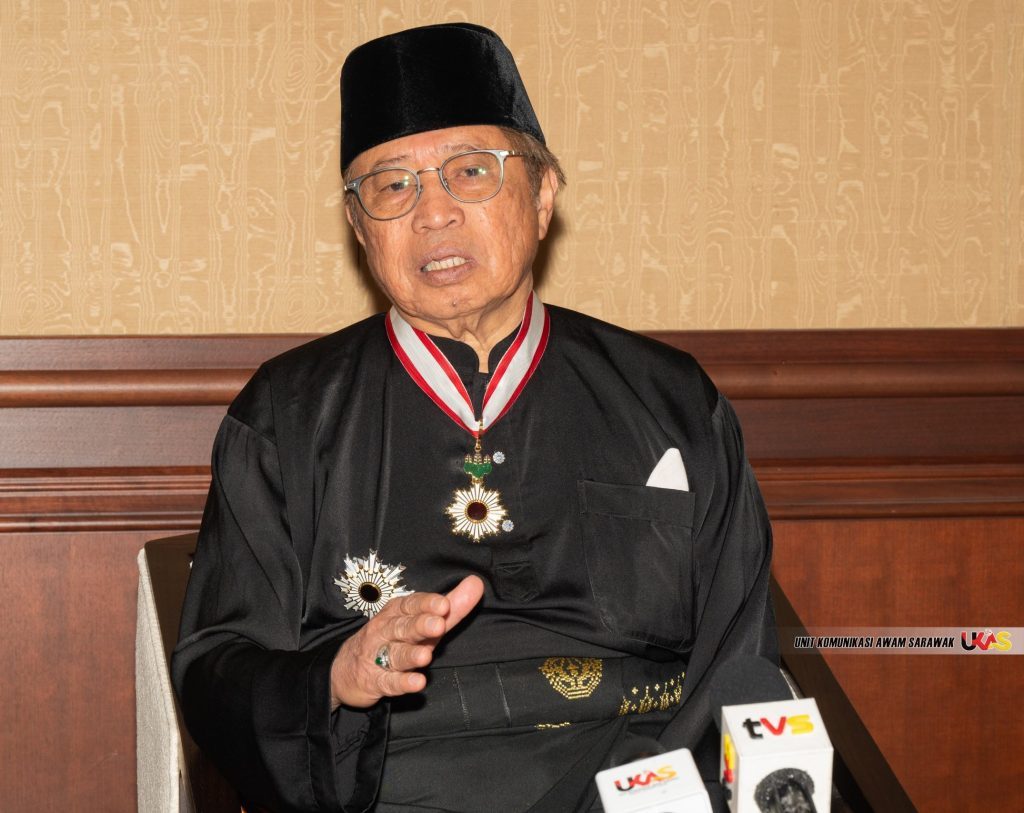
Premier Johari after receiving the award
(Credit: Office of the Premier of Sarawak)
Background Leading to the Conferment
Based on the overview of Sarawak State and Premier Johari provided above, we would like to explain the background that led to this conferment from JMA’s perspective.
When JMA initiated the Rainforest Restoration Project in Sarawak in 1995, Premier Johari was the Minister of Industrial Development. At that time, the state was prioritizing the expansion of oil palm plantations for economic growth. To achieve a balance between nature conservation and industrial development, the state government negotiated and selected our current operational areas for reforestation. For the past 30 years, our association’s rainforest restoration planting activities have been consistently supported by the understanding and cooperation of Premier Johari.
Since 2000, we have organized annual friendship delegation visits to Sarawak. These visits include activities such as planting trees for rainforest restoration, touring orangutan sanctuaries, and visiting historical sites in Kuching. During the periods from 2000 to 2004 and 2011 to 2016, Premier Johari served as the Minister of Tourism, and the Ministry provided our delegations with various forms of assistance. Also during this time, through discussions with Premier Johari and with his full cooperation, JMA initiated an internship program that sends Japanese university students to work with the Ministry of Tourism, which contributed to providing overseas work experience for participating students.
In December 2016, the Apeng Forest Reserve (approx. 1,100 ha), JMA’s rainforest restoration planting sites, was elevated to a National Park. In making this decision, we received great cooperation from Premier Johari, who was the Deputy Chief Minister at the time. As a result, the trees planted by our association became legally protected in perpetuity and shielded from logging.
In August 2018, a portion of the Sabal Forest Reserve (approx. 4,700 ha), another one of JMA’s rainforest restoration planting sites, was elevated to a National Park, a decision made by Premier Johari, who had assumed the office of Chief Minister.
In January 2019, Sarawak announced the Forest Landscape Restoration Program as a forest conservation policy. Based on this policy, under the leadership of Premier Johari, JMA and the Sarawak Government signed a cooperation agreement in June of the same year, which was renewed again in June 2022.
In August 2024, our association’s Vice President Haruko Arimura, Chairman Ogawa, and others paid a courtesy call on Premier Johari at the Sarawak Premier’s Office in the state capital of Kuching to discuss cooperation toward the upcoming 30th anniversary of the rainforest restoration activities in 2025. On this occasion, Premier Johari expressed his respect for our past activities and stated the intention that Sarawak would continue to cooperate fully moving forward.
Furthermore, considering the current international landscape, Sarawak, Malaysia is undeniably a politically and economically indispensable partner for Japan. Premier Johari is a remarkably important figure, not only for Sarawak but for the Federation of Malaysia as a whole. The JMA acknowledges that this conferment was a decision reached after careful and holistic consideration of these factors.
The conferment of this honor is a decision made by the Government of Japan, and JMA cannot definitively pinpoint the exact decisive factor from countless positive reasons. However, from JMA’s viewpoint, the progress of the rainforest restoration project and the promotion of friendly relations between Japan and Malaysia would have been impossible without the support of Premier Johari.
Under these circumstances, the fact that Premier Johari was awarded the Order of the Rising Sun, Gold and Silver Star this time will undoubtedly be a great help in further strengthening the friendship between Japan and Malaysia in the future.
Congratulatory Reception
The congratulatory reception was held on Monday, November 10, 2025, in the Ogi Room at the Imperial Hotel Tokyo. To accommodate the attendees’ schedules, the event began at 11:15 AM. Shortly before the start, attendees from the Japanese side, the Sarawak Forest Department, and the local Sarawak media arrived and waited for the arrival of Premier Johari and other officials from the Sarawak Premier’s Office. The news of Prime Minister Johari’s arrival seemed to send a wave of tension through the attendees, especially those from Sarawak. However, when the Prime Minister actually entered the venue, he greeted the attendees, including Vice President Arimura and Chairman Ogawa, with a smile.
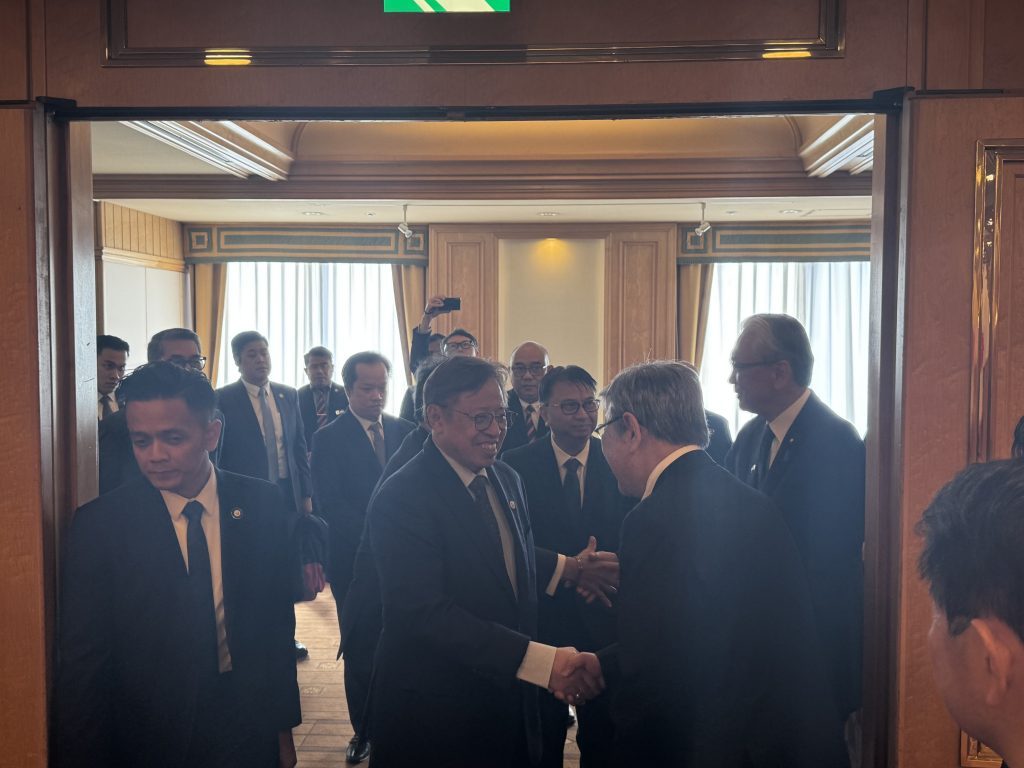
Premier Johari shaking hands with Chairman Ogawa of JMA
The reception was moderated by Takuji Arai, the Executive Director of JMA, who conducted proceedings in Malay and featured congratulatory addresses in the following order: first from JMA President Furuya, followed by Mr. Miyamoto, Director-General of the Southeast and Southwest Asian Affairs Department of the Ministry of Foreign Affairs, and finally by Mr. Nagano, President of the Japan-Malaysia Economic Association.
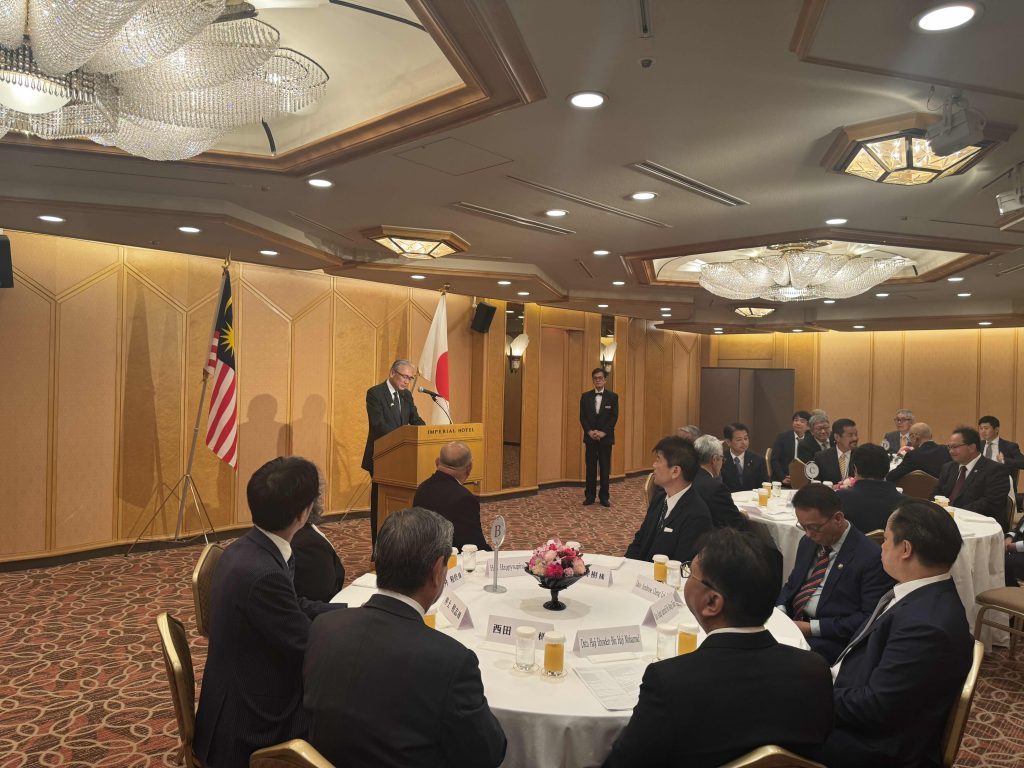
President Furuya delivering congratulatory message
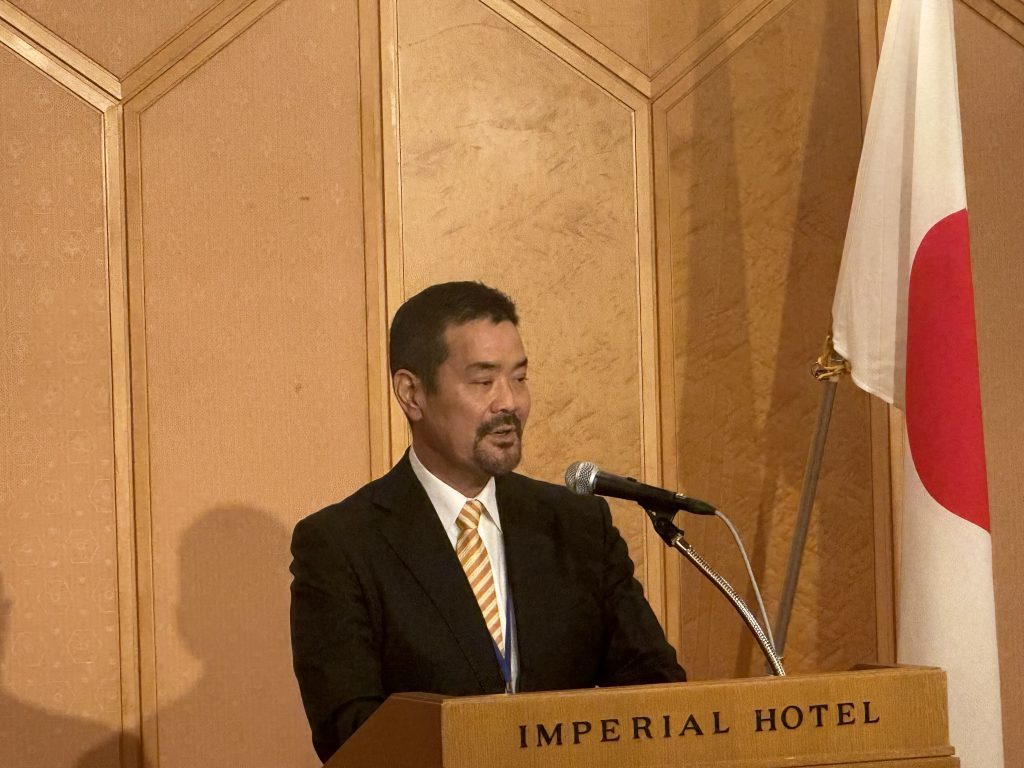
Shingo Miyamoto, Director-General, Southeast and Southwest Asian Affairs Department, Ministry of Foreign Affairs
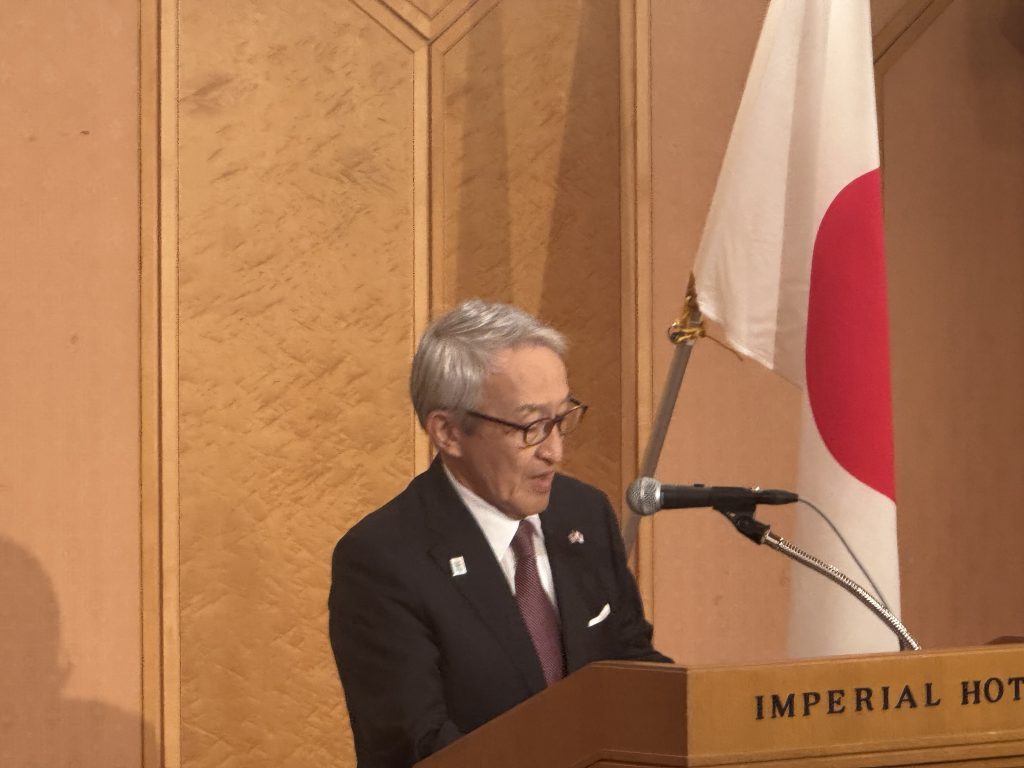
Tsuyoshi Nagano, Japan-Malaysia Economic Association
In their congratulatory remarks, everyone expressed their deep gratitude for Premier Johari’s long-standing and dedicated support, noted that Sarawak is a vital partner for Japan, voiced wishes for continued and unchanging friendship, and offered their profound respect and congratulations on his receipt of the Order of the Rising Sun, Gold and Silver Star.
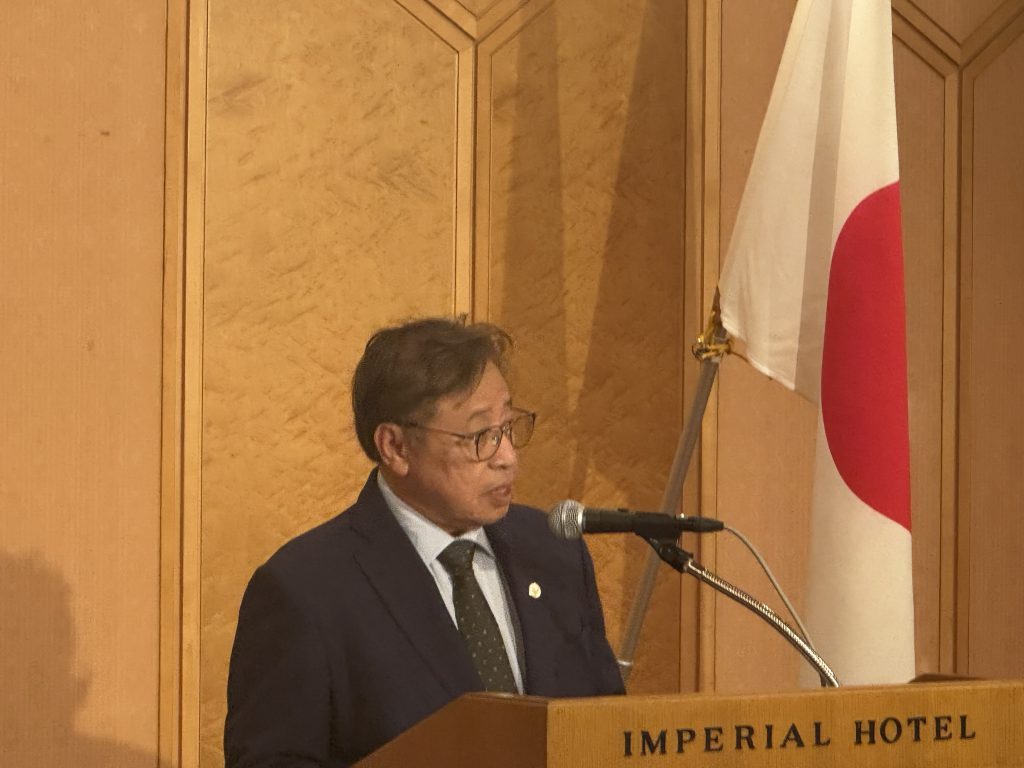
Premier Johari delivering acceptance speech
Premier Johari’s acceptance speech followed. He began by expressing gratitude for the warm welcome, stating that our presence at the reception was not just formal protocol, but a sincere affirmation of a friendship cultivated through mutual respect over decades. Premier Johari highlighted the Japan Malaysia Association’s role as a vital link between the people of Japan and Sarawak. Furthermore, he pointed to the mutually cooperative rainforest restoration project, which will achieve the one-million-tree milestone next year, as a potential model case for global learning and observation.
After the acceptance speech, there was a presentation of commemorative gifts from the Sarawak Forest Department, and the proceedings moved forward in a thoroughly amicable atmosphere. Finally, Vice President Arimura of our association proposed a toast, and the event transitioned into a time of socializing while enjoying light refreshments and soft drinks.
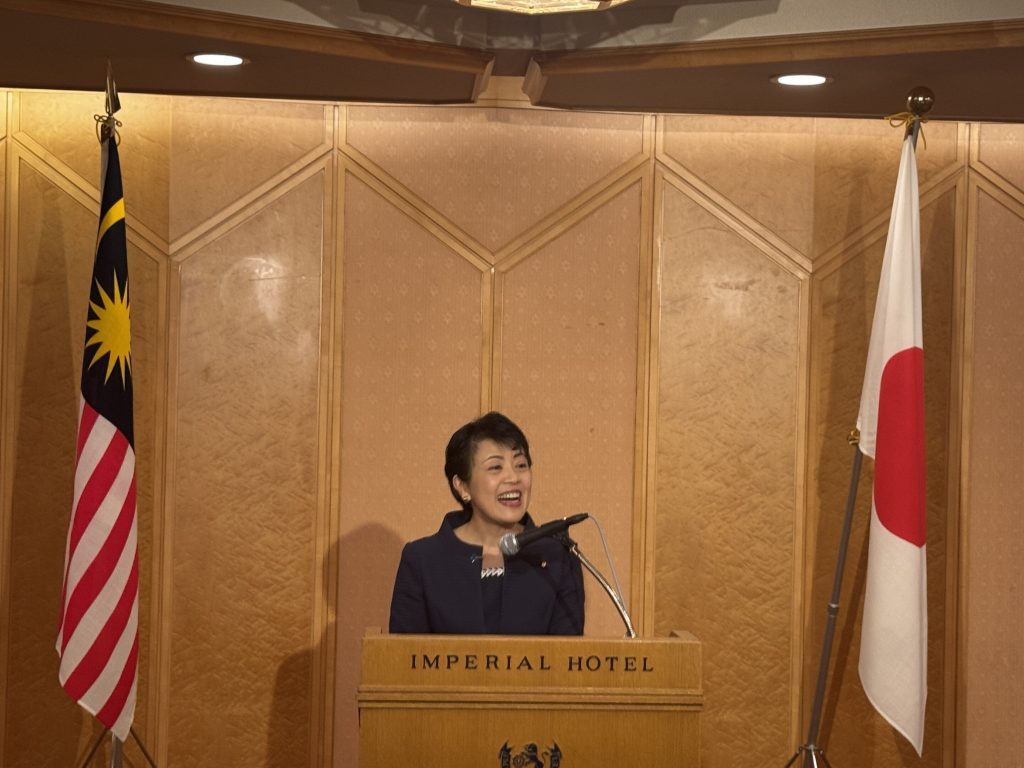
Haruko Arimura, Vice President of JMA, proposing a toast
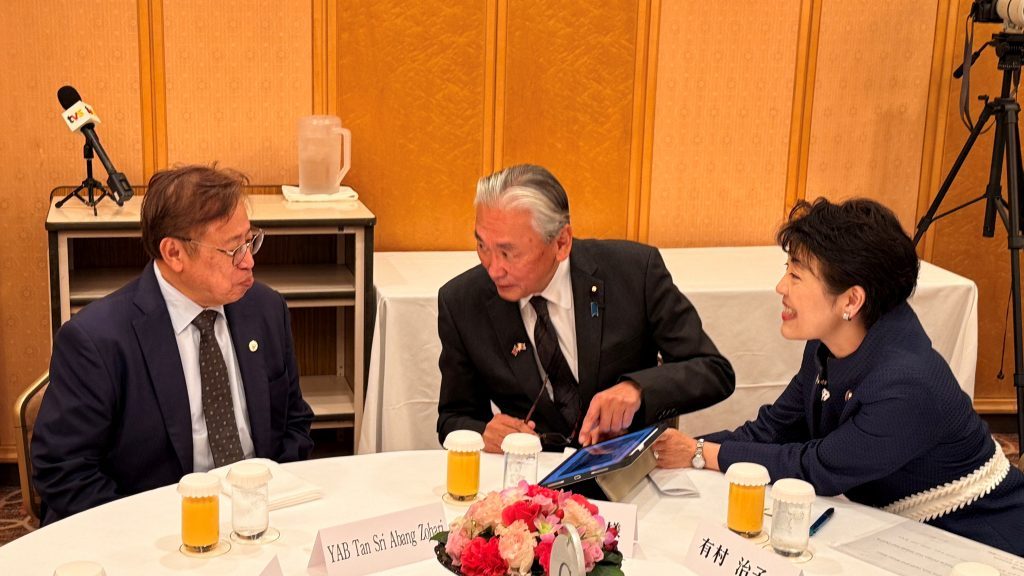
Premier Johari talking with Furuya and Arimura, President and Vice President of JMA
Conclusion
JMA has been continuously engaged in the rainforest restoration project in Sarawak for 30 years, and with the number of trees planted set to reach one million next year, our activities are entering a new and important phase. Moving beyond merely increasing the number of trees, the proper maintenance and management of the one million trees achieved over these three decades are now the highest priority for rainforest restoration. As Premier Johari has also emphasized, we will continue to build trust and cooperation as we move forward, with the goal of establishing these Asian rainforests as a global model case.