
Sarawak Tree-Planting Experience & Water Improvement Project Tour
The original of this article was written in Japanese and can be found here.
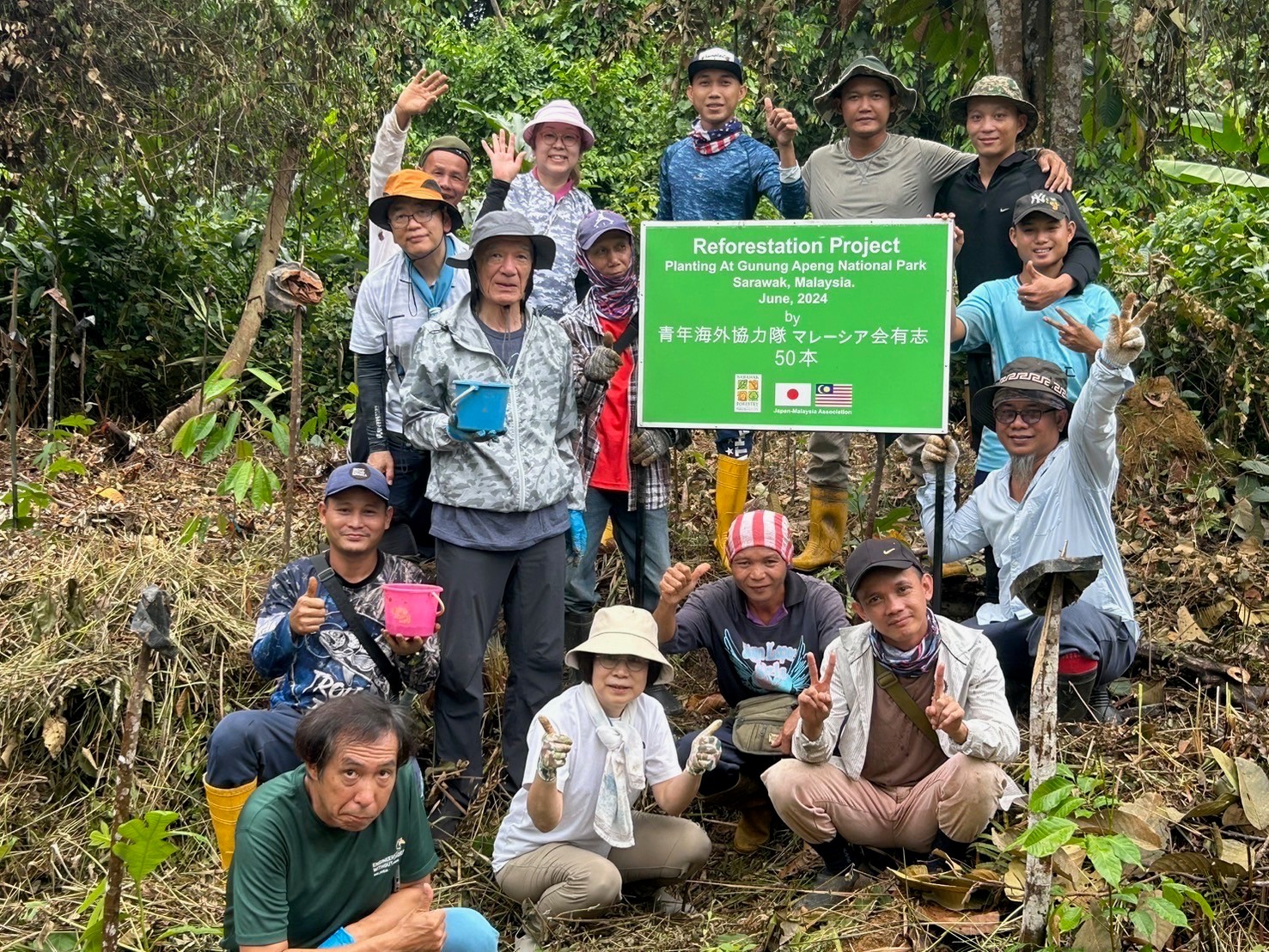
Commemorative photo with local staff
*This article was originally published in Vol. 55 of the Association’s bulletin “Malaysia” (issued August 31, 2024). It was contributed by Ms. Kurumi Sugiyama, a member of “Malaysia-kai,” the alumni association of Japan Overseas Cooperation Volunteers (JOCV) who served in Malaysia.
“Malaysia-kai” — the alumni group of former JOCV members dispatched to Malaysia — has long maintained ties with the Japan Malaysia Association (JMA). In addition to supporting JMA’s rainforest restoration activities in Sarawak, the group organized a site visit on Friday, June 13 and Saturday, June 14 this year, with members and their families participating as volunteers. We are pleased to share this report on the visit, contributed by Malaysia-kai member Ms. Kurumi Sugiyama.
Reuniting in Sarawak
Most of the participants on this tour were JOCV alumni who had once been dispatched to Malaysia. The number of JOCV members sent to Malaysia has dropped dramatically in recent years, but a generation ago, more than 100 volunteers were posted to Peninsular Malaysia alone. After nearly three months of training in Japan, each of us spent roughly two years at our assigned posts, working as government-dispatched volunteers.
Back in those days, some of us worked in areas where even electricity and running water were scarce. (I myself was posted to a public corporation developing oil palm settlements — places carved out of cleared jungle, the very embodiment of environmental destruction.) Years have passed, and although we have remained interested in Malaysia, we have become middle-aged and older without doing much for the country. When we learned about JMA’s various projects, however, we thought, “Let’s at least go see things for ourselves and try it firsthand!” After consulting with Mr. Arai of the Association and going through several months of planning, recruiting participants, and coordination, we finally made it to Sarawak this June!
A First Visit to the Rainforest Restoration Site
Although our group came from different job categories, served at different times in different locations, and varied in age, we met for the first time at a food court in Kuching, and the very next day began our hands-on experience and site visits. Our first stop was the area where JMA had begun tree-planting in 1995. After decades of effort, the Sarawak government recognized this work and elevated the site to national park status in 2016, making it a fully protected reserve.
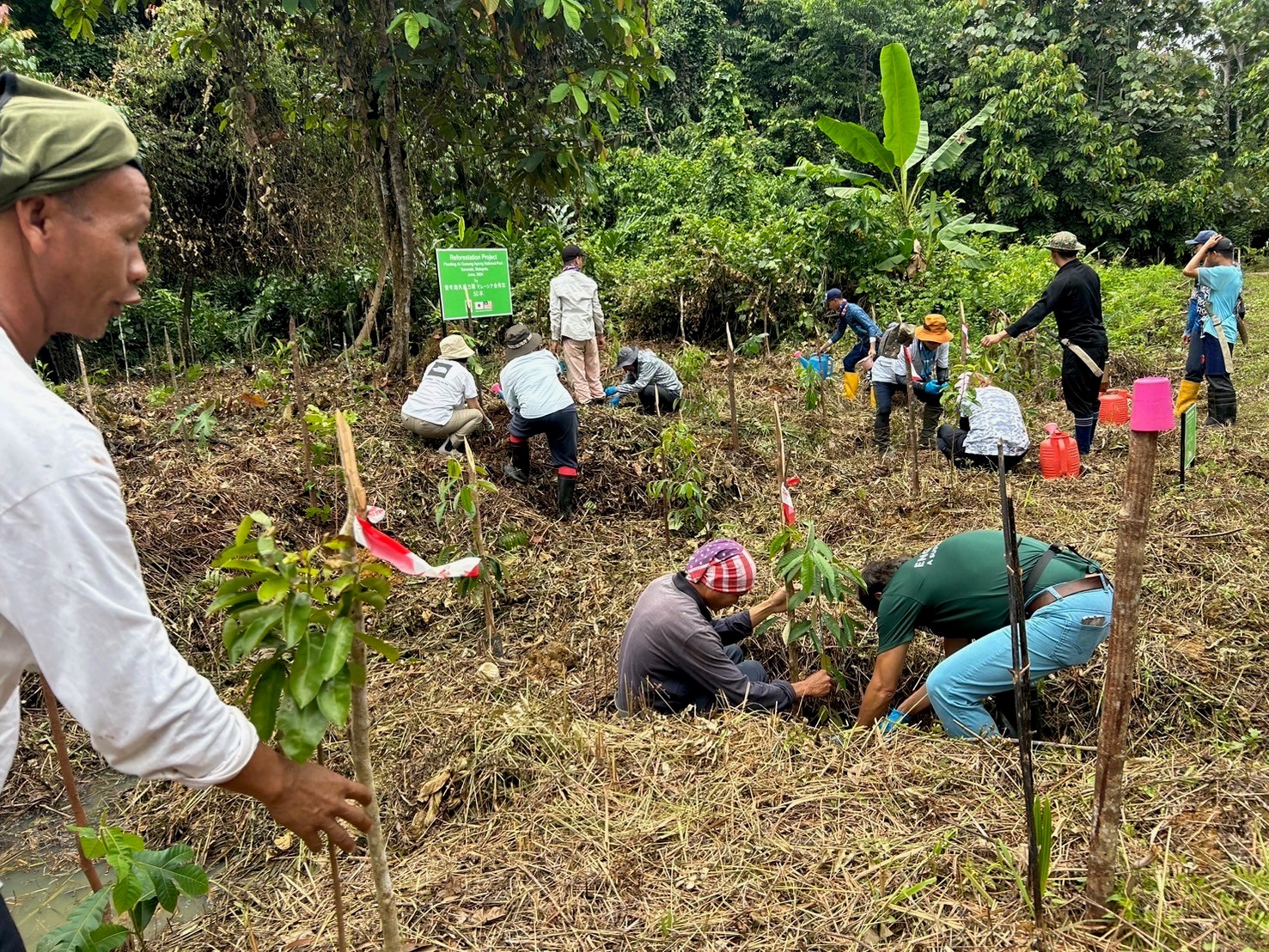
Planting trees together with local residents
Having made a small donation to the project, we were given the chance to plant fruit-tree seedlings, including durian. (You really do grow attached to them — I want to come back and harvest the fruit one day!) But the unfamiliar work was exhausting, even for just a few saplings. The experience drove home just how much labor and time the “Rainforest Restoration Project” requires for planting and ongoing care, and how impossible it would all be without the cooperation of local people.
Thanks to JMA’s long-running efforts, residents in each area now take part in planting work, seedling cultivation, and management. Women raise seedlings on their own land, which the Association then purchases — creating a local economic cycle. Local staff also handle all the preparatory work before planting, as well as post-planting maintenance. On top of that, tree-planting programs have been organized for students from nearby elementary and junior high schools, who represent the next generation. We came away understanding that this rainforest restoration work connects environmental education, the local economy, and the future itself.
Years of Patient Dialogue
On this visit we were guided by Mr. Sakai, the local coordinator who has been involved with JMA’s projects for many years. He shared the history of the work with us — the difficult early days when indigenous communities did not understand the project (Should they cut trees for profit, or could protecting nature itself become a livelihood?), and the patient, never-give-up communication (all in Malay, of course) that he built up step by step. Because the project has continued for so long, the trees have grown, and the land — once devastated by unplanned logging — has recovered to such an extent that it is now hard to imagine its former state. It is returning, we were told, to “the forest as it was meant to be.”
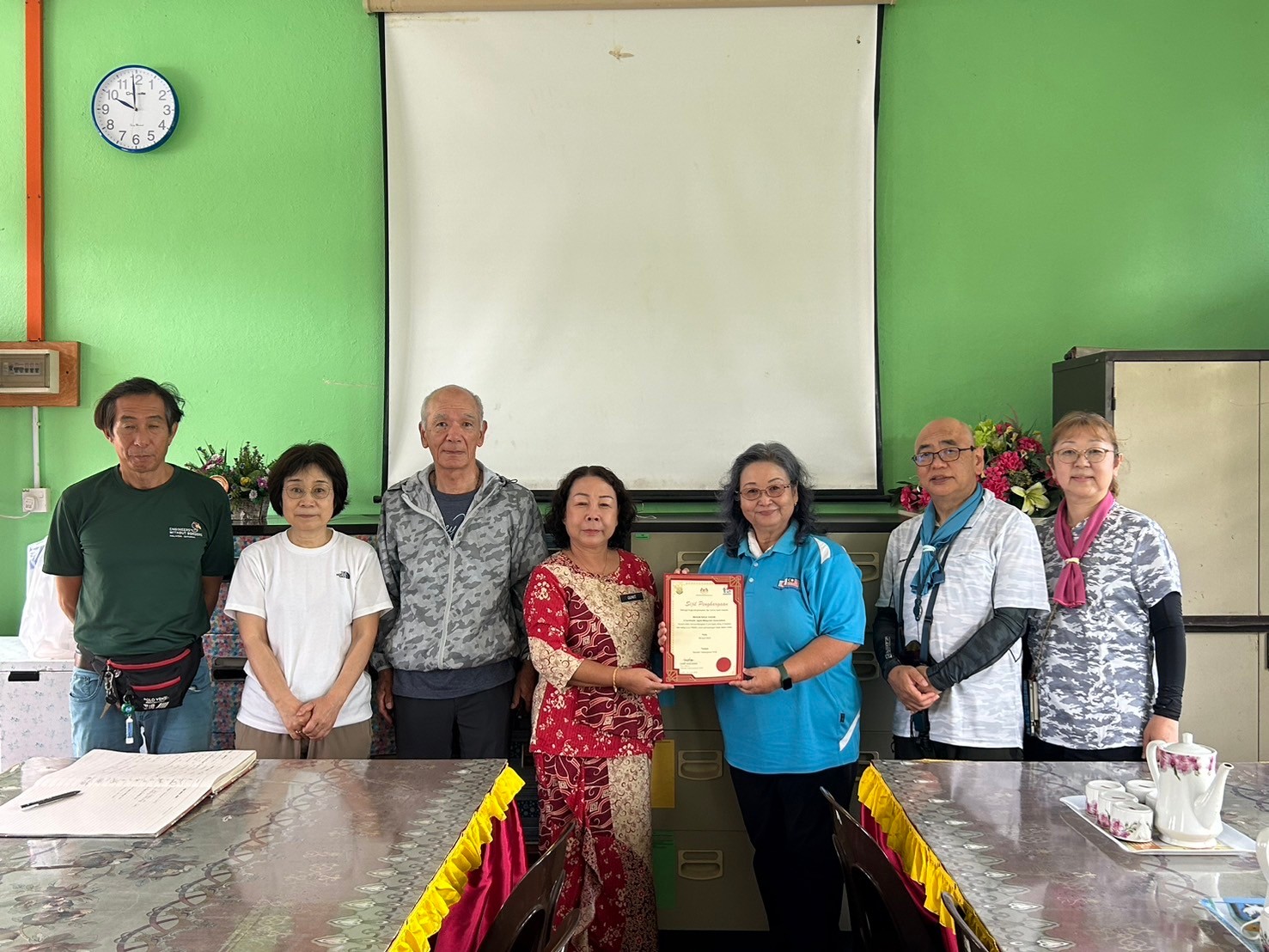
Visiting an elementary school in the project area
A Wide Range of Project Sites
The tour also took us to many other places connected with JMA’s work: the water environment improvement project, a “Michi-no-Eki” roadside station (!), a seedling nursery, the Sepilok Orangutan Rehabilitation Centre, and longhouses and elementary schools of indigenous communities.
Behind Malaysia’s development lies a history of jungle clearing — for rubber and oil palm plantations and for timber exports. When we think about what we, who have used rubber and oil palm products without giving it a second thought, can do, one option is to donate 7,500 yen per unit to JMA. With each unit, local workers plant five seedlings, and donors even receive reports on how the trees are growing. If those efforts eventually help restore the jungle and create habitat for elephants, orangutans, and countless plants and insects — isn’t that a wonderful thought?
Looking Ahead
This trip to Kuching was our first attempt at something like this, but we hope to continue activities of this kind. We want to keep thinking about how we can give back to Malaysia — the country where we spent our youth — and how each of us can share the realities of Malaysia today (both its natural environment and its development) with those around us.
Above all, these few days in Kuching were simply joyful and deeply rewarding!